


Smoke fills the air we breathe

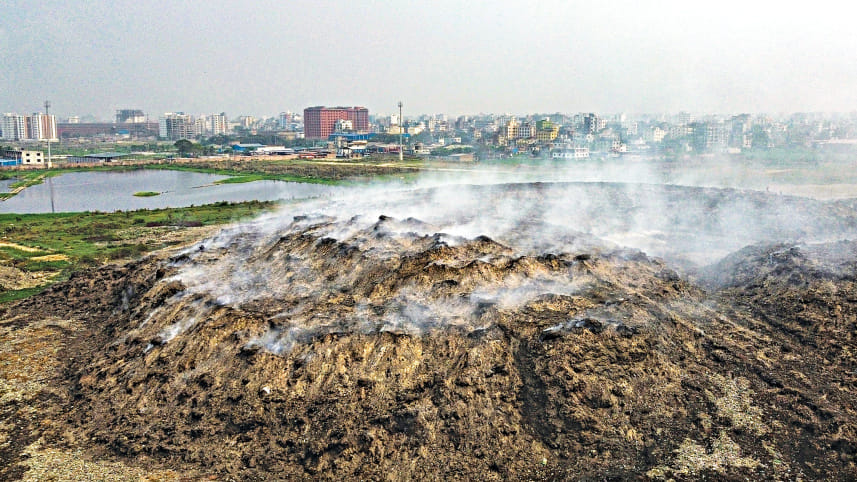
Smoke from burning garbage at the Matuail and Amin Bazar landfills often blankets Dhaka’s sky, underscoring how poor waste management has become a major driver of the city’s air pollution.
Waste collectors also frequently burn trash along highways outside the capital. Along with emissions from brick kilns and vehicles, and dust from roads and construction sites, these practices further worsen the city’s already toxic air.
 For all latest news, follow The Daily Star's Google News channel.
 According to the Switzerland-based Air Quality Index (AQI), Dhaka’s air is frequently ranked among the most polluted in the world. The average AQI in Dhaka and its surrounding areas consistently hovers around 200, occasionally surging beyond 600.
Just yesterday, Dhaka’s air quality ranked the third worst in the world, after Karachi and Beijing, while Bangladesh’s overall average air quality was the second worst globally.
On the AQI scale, 0-50 is considered “good,” 51-100 “moderate,” 101-150 “unhealthy for sensitive groups,” 151-200 “unhealthy,” 201-300 “very unhealthy,” and anything above 300 is classified as “hazardous.”
On March 4, the AQI in Savar was 640.
Contacted, Ziaul Haque, head of the CASE project at the Department of Environment, stated that the visible air pollution in Dhaka this winter and post-winter season was primarily caused by smoke originating from the landfills at Amin Bazar and Matuail.
MATUAIL: WASTE PILES AS HIGH AS 80FT
Last Saturday morning, despite the sunshine, the sky remained obscured by a thick haze, with smoke clearly visible.
A field visit to the Matuail landfill revealed numerous 50 to 80ft-high mounds of waste sprawling across the 100-acre site.
One such mound, consisting mostly of polythene, was on fire, with plumes of smoke spiralling upwards. Sanitation workers present at the site claimed that these fires ignite spontaneously and are not intentionally set by anyone.
Md Harun, a sanitation worker, noted that fires occur daily and that once a fire starts, it continues to burn unless the Fire Service intervenes.
“This morning,” he had told this correspondent, “the Fire Service was here to douse a fire that had broken out earlier. Even still, it’s not completely extinguished.”
Hena Begum, who has been collecting polythene at the Matuail dumping site for five years to sell, said that the frequency of fires has increased this year. “I could not come to the site for a few days because of the fire and smoke here.”
Earlier, the Department of Environment built an organic fertiliser plant at Matuail with funds from the Climate Change Trust Fund, but it remains non-functional.
Nashir Uddin Bhuiyan, who recently took charge of the plant’s operations, explained that approximately 80 percent of the incoming waste, such as polythene, is non-biodegradable.
He said their plant intends to produce fertiliser from the remaining 20 percent and is expected to commence operations soon.
He further noted that methane gas generated within these waste piles causes fires to persist once they are ignited.
Asked, Dr Mohammed Shafiullah Siddique Bhuiya, supervising engineer of the Waste Management Department of Dhaka South City Corporation, also said these fires start spontaneously.
“Waste has been accumulating at the site for 35 to 40 years, forming multiple layers where methane and greenhouse gases have built up. When daily waste is deposited, the presence of any flammable substances can react with the accumulated methane, triggering fires.”
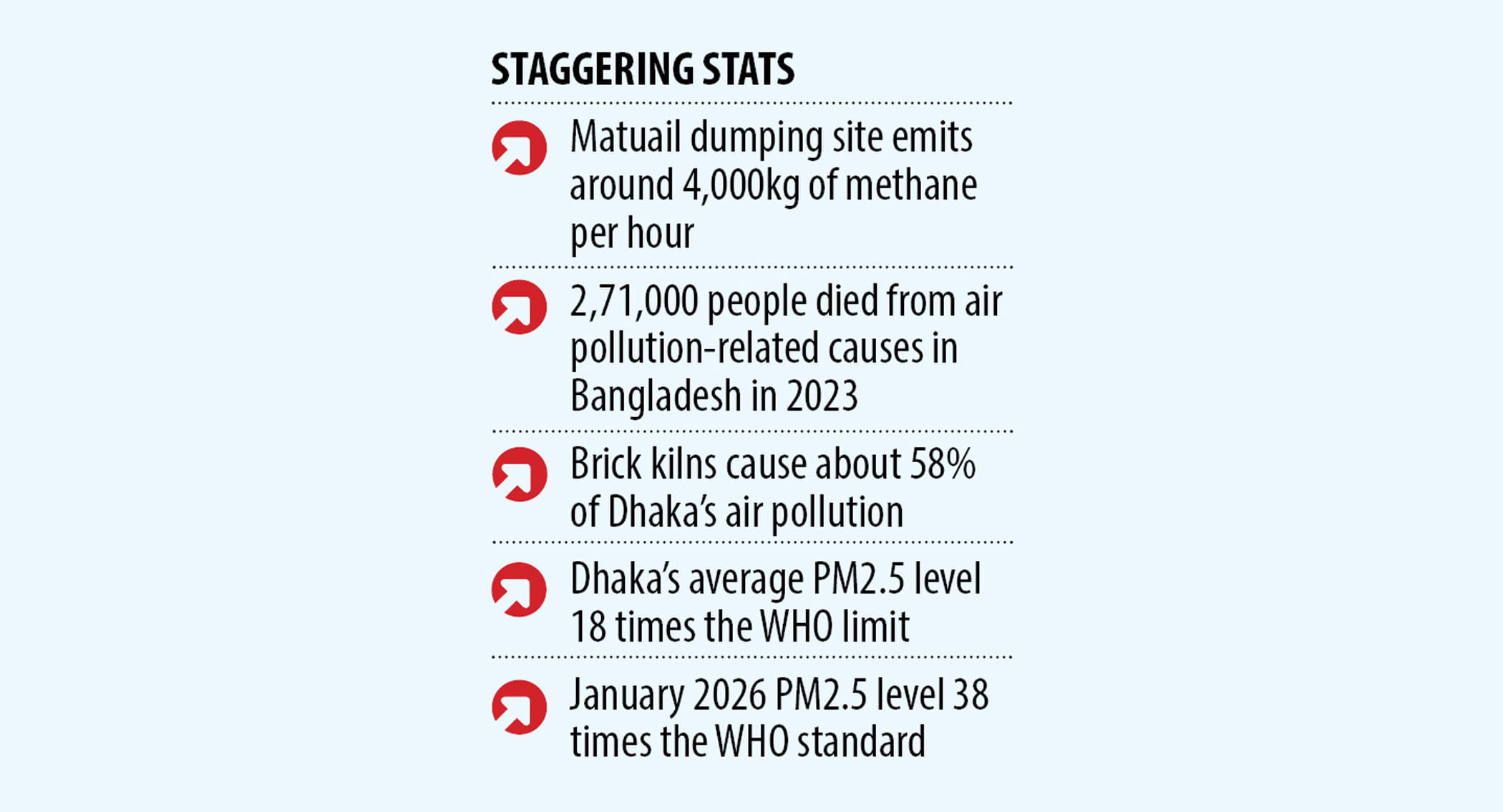
A 2023 article by Dev Patel, published by Harvard University on the Matuail dumping site, states that the Matuail site emits 4,000 kilograms of methane gas per hour.
THE WASTE-LADEN ROAD TO CUMILLA
On the route to Cumilla after leaving the Matuail site, sanitation workers were seen setting fire to small piles of waste starting from Jatrabari. Further along the highway, numerous waste heaps lined the roadsides.
In some areas, waste was spread out to prevent the piles from becoming too high.
Numerous burning or smouldering piles of waste were observed on both sides of the road through Jatrabari, Narayanganj, Gazaria, Nimsar, Burichang, Shahdaulatpur, and Barura.
Rashidul Hasan, a scrap trader in Chandina, was carrying charred remains of polythene stocks. “Since polythene destroys the environment, I gather and burn them whenever I find them.”
SAVAR: THE DEGRADED AIRSHED
Arriving at Savar, this correspondent saw seven or eight men of varying ages sitting under a tree in the Nagarkonda area on Sunday noon.
Approached, a middle-aged man exclaimed, “Our lives are cursed. What more do you want to know from us?”
The man, Tayeb Mia, a farmer and a permanent resident of the area, said they live adjacent to the Aminbazar landfill, where smoke from burning polythene-mixed waste has been choking locals for two months.
“I don’t want to talk about this anymore; what is the use of talking?” he asked before leaving the spot in frustration.
In August last year, the then government had declared the Savar area a degraded airshed, and the operations of 106 brick kilns, except “Tunnel kilns” and “hybrid hoffman kilns”, were halted from September.
In a circular, the government had also banned the open burning of solid waste and the issuance of clearances for industries that may cause air pollution.
Yet, smoke generated from the Amin Bazar dumping site has been causing severe health hazards to locals.
“Additionally, around 30 to 40 brick kilns reopened as owners obtained permission from the High Court and restarted their activities last month,” said Deputy Director of the DoE Mohammad Abdul Motalib.
During a visit to Rony Bricks Co in Savar’s Bhakurta area, a notice citing a HC directive was found posted at the entrance, requesting relevant authorities not to disrupt operations in accordance with the order in Writ Petition No-15982/2025.
Speaking to The Daily Star, Enayet Hossain, who oversees the kiln, said the HC granted them six months of operational permission after they filed a petition citing financial losses. He claimed many other kiln owners in Savar are also operating under similar court directives.
According to DoE sources, brick kilns contribute around 58 percent of Dhaka’s total air pollution.
Burning solid waste, along with smoke from industries and brick kilns and emissions from old vehicles, generates PM2.5 (particles smaller than 2.5 micrometres) in the air -- considered the main pollutant in Dhaka’s air.
PM2.5 RISING; AUTHORITIES IDLE
Between 1998 and 2023, the country’s PM2.5 pollution surged by 66 percent, according to the global annual report of the Air Quality Life Index, published by the Energy Policy Institute of the University of Chicago.
Last year, Dhaka’s annual average PM2.5 level stood at 90.35 micrograms per cubic metre -- around 18 times higher than the WHO recommended annual limit of 5 micrograms per cubic meter.
Generally, during the dry season, the PM2.5 level surges higher than in other months of the year.
In January 2026, Dhaka’s average PM2.5 concentration rose to 193 per cubic metre -- 38 times higher than the WHO standard.
BREATHING TOXIC AIR
Just in 2023, 271,000 people in Bangladesh died from air pollution-related causes that year, according to a global report.
Over 90 percent of those deaths were linked to noncommunicable diseases, such as heart and lung ailments, diabetes and dementia, said the sixth edition of the State of Global Air-2025.
(Our Savar correspondent contributed to this report)


Comments