


Family cards could reduce poverty to 11.3%

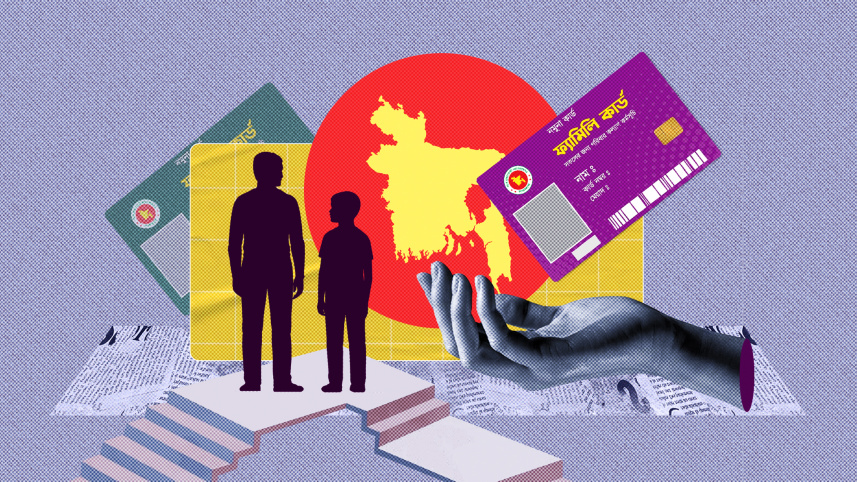
The government’s “Family Card” programme, which will provide Tk 2,500 a month to poor and vulnerable households, could reduce the country’s poverty rate by more than 7 percentage points if carried out effectively, according to a new study.
“If the allowance is extended to all poor and vulnerable families, overall poverty would decline from 18.7 percent to 11.3 percent, a 7.4 percentage-point reduction,” said the study.
 For all latest news, follow The Daily Star's Google News channel.
 Extreme poverty would also fall sharply, from 5.6 percent to 2.2 percent, a drop of 3.4 percentage points.
The study was conducted by local think tank Research and Policy Integration for Development (RAPID) and presented at an event in Dhaka yesterday by RAPID Chairman MA Razzaque.
The study suggested the programme would have a particularly strong effect among poor and vulnerable groups. Poverty in this segment could fall from 33.9 percent to 15.5 percent, an 8.4 percentage-point decline, RAPID said.
Under the Family Card initiative, the allowance will be transferred according to the beneficiary’s preference, either through a mobile wallet or a bank account, allowing them to receive the support from home.
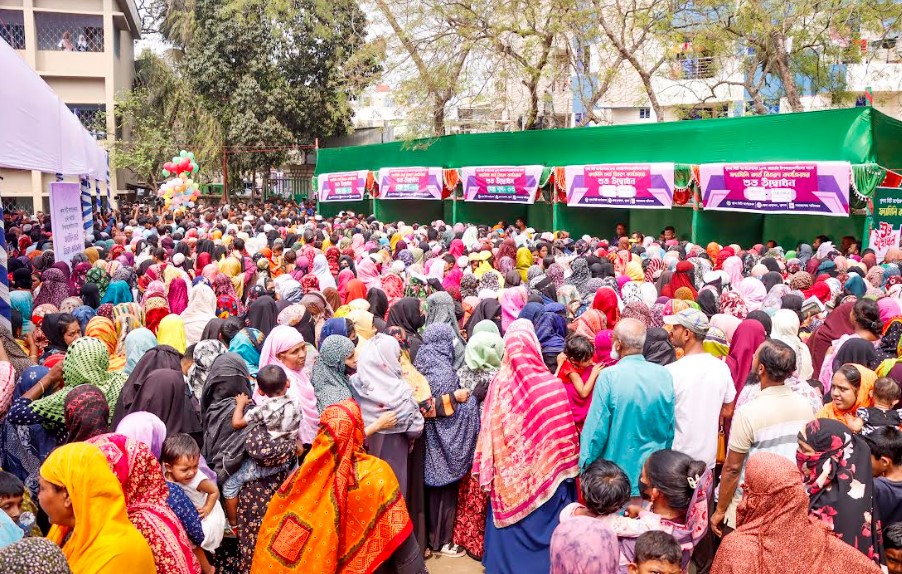
The government inaugurated the pilot phase of the programme on Tuesday. At least 40,000 families will receive benefits during the four-month trial.
In absolute terms, the programme could lift around 1.23 crore people out of poverty, reduce the number of extremely poor by 56 lakh and help 1.56 crore people move out of economic vulnerability, according to RAPID.
“The effectiveness of the Family Card programme will depend heavily on accurate targeting and transparent beneficiary selection,” Razzaque said.
To minimise exclusion errors, where eligible households are left out, and inclusion errors, where non-poor households receive benefits, the selection process should follow a transparent and data-based approach, he said.
Razzaque said spending on social protection can be politically popular for any government.
He, however, warned about the government’s fiscal space as it has committed to spending 3 percent of GDP on social protection.
The government’s ultimate objective is to gradually bring 2 crore families under the monthly cash support, as per the Family Card Piloting Implementation Guideline, 2026.
Once fully rolled out, the programme, a key election pledge of the Bangladesh Nationalist Party (BNP), would cost about Tk 5,000 crore a month, or roughly Tk 60,000 crore a year.
“In a country where the tax-to-GDP ratio remains below 7 percent, expanding such spending inevitably creates significant fiscal pressure,” said Razzaque.
To address this, he suggested that overlapping or redundant safety-net programmes could be gradually phased out, with the savings redirected to finance family cards.
Still, he said, a stronger political commitment could help create additional fiscal space over time. Better design and tighter targeting of existing resources would also improve the quality and impact of public spending.
“If implemented properly, these reforms could provide a strong boost to Bangladesh’s social protection agenda.”
He argued that expanding the programme would have manageable fiscal implications, with administrative capacity rather than macroeconomic constraints likely to pose the main challenge.
If extended to 2 crore households, the scheme would cost about 0.96 percent of GDP, raising total social protection spending to around 2.16 percent, still below the government’s target of 3 percent by 2028.
If limited to poor and vulnerable households, the cost would fall to about 0.57 percent of GDP. That would keep total spending near 1.77 percent, leaving room for other safety-net programmes.
Razzaque also said family cards should be integrated into Bangladesh’s wider social protection framework rather than run as a separate initiative.
At the event, Shah Mohammad Mahboob, director general of the Department of Social Services under the Social Welfare Ministry, said the government has a strong political commitment, which is helping them to run the programme smoothly.
“The Tk 2,500 is not just a financial transfer; it also represents trust. People feel that the government is standing beside them,” he said.
Mohammad Abu Yusuf, secretary of the social welfare ministry, said implementing the programme involved several coordination challenges.
“But there is no political bias in the selection process. We are doing it under a scientific system,” he added.


Comments