


We need education reforms that actually work

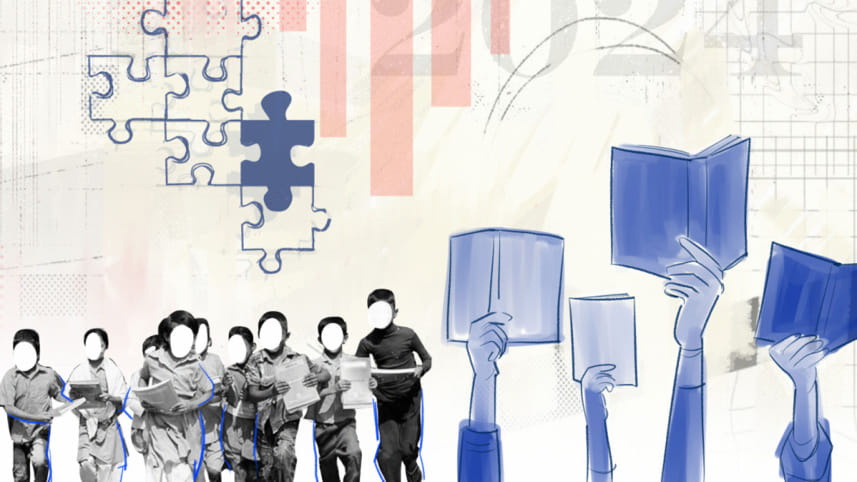
People’s expectations about real reform in education have been raised by the busy round of meetings and expression of resolve seen in Minister of Education Dr Ehsanul Haque Milon and State Minister for Primary and Mass Education Bobby Hajjaj. The ministers announced a 12-point initial agenda for action, reflecting some of the election promises of the ruling Bangladesh Nationalist Party (BNP). They have also spoken about controlling rampant corruption in education, bringing students back to the classroom (from coaching centres), and schooling that prepares young people for the world of work.
Each individual objective sounds reasonable and justifiable, but discrete action on each would make for fragmented and partial steps. It may end up being a false remedy for a symptom of a disease rather than for the disease itself.

For example, the near-universal practice of private coaching and tutoring is villainised for making students memorise guidebooks instead of studying textbooks, burdening parents with huge costs, and keeping students away from classrooms. The solution prescribed is to ban or severely restrict private coaching and tutoring. This remedy ignores the fact that coaching centres are the symptoms—the disease is that teaching and learning do not happen in the classroom. Students do not see a good reason to be in the classroom. They feel compelled to rely on coaching to prepare for their exams. Restrictions and bans on coaching have proved difficult to enforce because both suppliers and customers believe it is needed.
A multifaceted, multi-layered, and holistic approach is necessary to find a workable solution for the problem. Key issues have to be simultaneously addressed related to teachers’ preparation and performance, school and classroom management, learning content preparation, learning assessment and exams, and teachers’/schools’ interactions with students and parents. The solution has to work for each school and classroom and be supported by the administrative superstructure extending from the ministry, directorate, education boards, curriculum board, teachers’ training colleges, and field-level administration.
Why does the miserably poor quality of instruction in mainstream school education—excepting the elite high-cost English medium schools and the selective Bangla medium ones—persist in Bangladesh and much of South Asia? Despite many development projects with international assistance carried out over the last four or five decades, studies point to a critical failure: the power dynamics of policymaking and decision-making by politicians and administrators who fail to prioritise inclusive and equitable education of acceptable quality for all children.
A further probe into the non-action or misguided action of decision-makers suggests a common deficiency, which is the fragmented, partial, incoherent, and non-holistic response to problems. This highlights the absence of a systems approach which is a scientific method for designing, implementing, and evaluating teaching-learning as an integrated whole. The aim is to optimise educational outcomes by analysing and working on interconnected components—inputs (students, teachers, infrastructure), processes (instructional methods, assessment of learning, management of teachers), and outputs (student performance and learning outcomes). Feedback loops allow for corrections in the system. This systems approach ensures goal-oriented, efficient, and learner-centric instruction that produces the learning outcomes.
Political neglect and system incoherence are evident in the non-action and wrong actions following the adoption of the 2010 National Education Policy. Instead of a systematic effort and coordinated work plan to implement the policy, development projects and activities were undertaken in a fragmented manner for sub-sectors without an integrated view or time-bound goals regarding quality, equity, and inclusion in education. The lack of political vision and leadership has been filled by bureaucrats in the two ministries by default. The bureaucrats by their nature are inclined to protect the status quo. This double failure has landed us in today’s education debacle. Can repetition be avoided? Some early signs are not that promising.
Observers have been arguing that school education—pre-primary to pre-university—should be put under one ministerial jurisdiction. Thereby, an integrated plan for quality, universal school education can be planned and implemented to meet the demand for basic competencies in our youth. It seemed this logic had won when a minister and a state minister were appointed for the whole education sector. But now the tasks have been redistributed and the state minister has been placed in charge of the old Ministry of Primary and Mass Education. Is this a retreat to the old order and a vindication of Parkinson’s law (which, in essence, says that work and staff keep expanding in a bureaucracy)?
Another problematic move concerns scholarship examinations. High-stakes public examinations after Class 5 and Class 8, respectively, have been discontinued. But there is a lobby to retain the scholarship examinations at these levels based on the argument that it is an inducement for better student performance. This may be so for those who are already good performers in a class, as only these 10-20 percent students are sent for the scholarship exams. But teachers’ time and effort are diverted to these students at the cost of the remaining 80 percent of pupils who need more help from the teachers. Regular classes are halted in schools where the scholarship exams are held. Well-heeled parents of scholarship examinees support these exams; they are usually more educated, better-off, and more vocal than the parents of the disadvantaged majority.
These are instances of a bureaucratic mindset that has prevailed while sacrificing the best interests of children and education. A holistic systems thinking approach has been absent. The highly centralised management structure and the personnel there, mired in the routine tasks of regulating and controlling a large system from the capital, are not equipped in terms of training or temperament to work out and implement a major educational reform agenda.
Two consultative committees on primary and non-formal education and secondary education, respectively, were appointed by the interim government. Based on research, field visits, and stakeholder consultation, the reports of the two committees presented a critical review of school education in the country and recommendations for reform, indicating necessary short-, medium-, and long-term actions. Both reports examined the causes of past reform failures and suggested essential steps for an effective new initiative. But it is clear that reforms are not likely to take place if the task is left to the current administrative apparatus and actors as an additional duty. The reports proposed that a high-level task force should be appointed to take education reforms forward. Other subsectors of education—such as higher education, vocational-technical education, madrasa education, higher professional and technology education—also deserve to have their respective task forces. Joint strategies for preparing young children for school are needed from the ministries of education and women and children affairs.
At the same time, a comprehensive five-year education sector plan and a ten-year perspective plan need to be developed, guided by a dedicated education development council. The sector plan should combine and integrate the various sub-sector plans prepared by respective task forces. The task forces and the council may be transformed eventually into a permanent statutory education commission. These are the necessary next steps for launching an education reform effort that may have a better chance to succeed.
Dr Manzoor Ahmed is professor emeritus at BRAC University. He was the convener of the consultation committee on primary and non-formal education appointed by the Ministry of Primary and Mass Education, as well as of the consultation committee on secondary education appointed by the Ministry of Education. Views expressed are his own.
Views expressed in this article are the author's own.
Follow The Daily Star Opinion on Facebook for the latest opinions, commentaries, and analyses by experts and professionals. To contribute your article or letter to The Daily Star Opinion, see our guidelines for submission.
 For all latest news, follow The Daily Star's Google News channel.


Comments