


Maradona of the desert
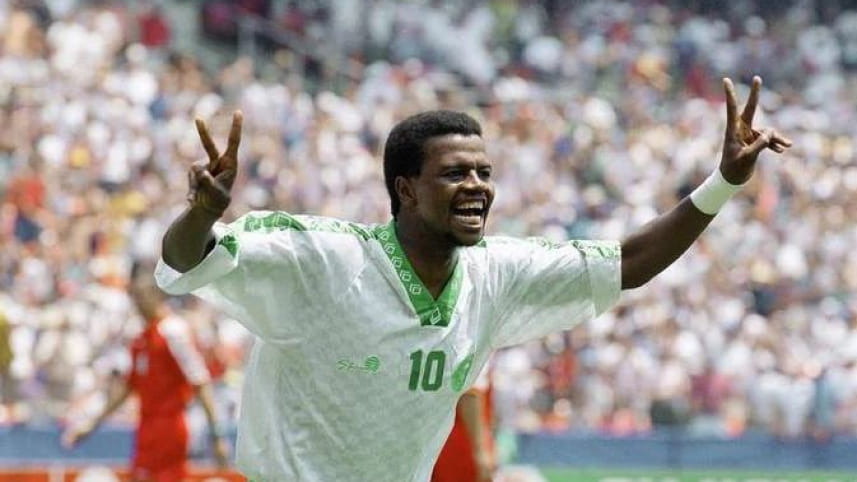
June 29, 1994 FIFA World Cup group stage, Saudi Arabia vs Belgium.
The sky above the Robert F. Kennedy Memorial Stadium in Washington, D.C., may have been a shade bluer that day, and the sun shone as fiercely as the scorching sands of a desert. On that blazing afternoon, the blades of grass at the stadium perhaps did not know that they were about to inscribe history beneath the footsteps of a nomadic prince. Accompanied by that relentless heat, football history witnessed the writing of an incredible epic -- one named “Maradona of the Desert,” Saeed Al-Owairan.
 For all latest news, follow The Daily Star's Google News channel.
 Only five minutes had passed on the clock. When a ball from Saudi Arabia’s defence lazily came to rest at Al-Owairan’s feet, the excitement in the stands had not yet begun to rise. As he took his first steps with the ball inside his own half, it seemed as though he was merely measuring the distance of the field. But those steps were the harbinger of a storm.
He began to run. The ball clung to his feet as if bound by some invisible spell. By the time he reached midfield, he had already beaten Belgium’s first two sentinels purely with the rhythm of his speed. As opposition defenders threw themselves into sliding tackles to stop him, Al-Owairan seemed possessed by some miraculous trance. He was like a thirsty deer whose eyes sought only a drop of water – and that water was the ball hitting the opponent’s net.
It took him only 10.5 seconds to travel from his own defence to the opposition goal, and in that brief span he ran nearly 69 metres with the ball at his feet. That epic run was not merely football; it was the seamless recitation of a long poem. Four world-class defenders desperately tried to surround him but failed; Al-Owairan slipped through them as if he were a traveller from a parallel universe.
When he reached the edge of the penalty box, standing before him like the immovable Himalayas was one of the finest goalkeepers of that era, Michel Preud’homme. Al-Owairan’s body trembled from exhaustion and excitement, yet his focus remained unshaken. Preud’homme stepped forward to block him, but with astonishing quickness Al-Owairan chipped the ball into the net. Immediately after scoring, he lost his balance and collapsed onto the green carpet. That fall was the fatigue of a victorious hero.
The entire stadium stood stunned, as if in a single moment they had witnessed the rebirth of Diego Maradona’s divine goal from Mexico City in 1986. That solitary strike secured Saudi Arabia a historic 1-0 victory, and world football found a new darling – one whom everyone began to call, in unison, the “Maradona of the Desert.”
In recognition of that unforgettable feat, Al-Owairan was named Asian Footballer of the Year later that same year. It was a grand stage where he was crowned the finest footballer in Asia. The International Federation of Football History & Statistics (IFFHS) even placed him high on the list of the world’s best goal-scorers of that year. That solitary run was not just a point or a victory; in FIFA’s eyes, it was a unique exhibition of modern football. Saudi Arabia’s then King Fahd bin Abdul Aziz rewarded him with an expensive Rolls-Royce car and immense wealth -- a fairy-tale reward for a boy of the desert.
Yet fate often writes in strange ways. The story of his fall from that towering peak of fame was just as dramatic. In 1996, when he was arrested on charges of moral misconduct aboard a pleasure boat in Jeddah, all of Saudi Arabia was left stunned. He was sent to prison and banned from football for a year. The bright star suddenly disappeared behind clouds.
After that period of confinement ended, when he returned to the green fields at the 1998 World Cup in France, the old cheetah-like speed was no longer in his body. Age and mental fatigue had taken away the magic from his feet. Although he appeared on the field in that World Cup against Denmark, it was merely a faded presence.
The dream the football world once saw in his eyes -- of becoming Maradona’s successor -- may not have lasted long. But Al-Owairan proved that even from the dust of the desert such brilliance can emerge that it dazzles the entire world. Even today, whenever World Cup memories are revisited, that single goal returns again and again in FIFA’s archives -- the young man running in one breath, whose rhythm with the ball halted Belgium’s defence, and for a moment, even stopped time itself.
Comments