


Has football lost its magic? Ancelotti thinks talent is paying the price
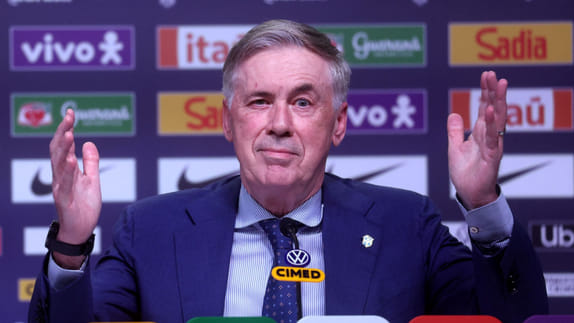
Brazil coach Carlo Ancelotti believes modern football, despite all its advancements, has made life harder for pure talent.
Speaking during an interview marking Radio MARCA’s 25th anniversary, the veteran manager reflected on how the game has evolved over the last two decades -- and what may have been lost along the way.
 For all latest news, follow The Daily Star's Google News channel.
 “I don't know if it's for better or for worse,” Ancelotti said. “On an environmental level, it has surely improved. Better stadiums, better pitches, better refereeing thanks to technology. The intensity has improved, but more intensity does not always mean more spectacle. I think talent has more difficulty today to show itself than 20 years ago.”
It was a telling observation from a coach who has lived through football’s many transformations -- and one that frames his current journey with the Brazil national football team.
After ending his historic spell with Real Madrid last summer as the most successful coach in the club’s history, Ancelotti stepped into one of the few challenges that had long eluded him: international management.
Brazil had pursued him persistently, convinced he was the man to guide them toward a long-awaited sixth World Cup.
“When you leave Madrid after winning the Champions League, you can only come to Brazil,” he said. “I didn’t have the idea of going to another club… last year we thought it was time to leave and now I’m happy.”
The transition has brought a different rhythm to his work.
“Less stress because there are not many games,” he explained. “It is more a job of observation… Brazil has at least 70 players who can be in the national team and making an assessment of all is not so simple.”
Yet in Brazil, football is anything but calm.
The expectations are immense, the passion unmatched. The demand for a sixth World Cup has been constant for years.
“They have been asking for it for a long time,” Ancelotti admitted. “This is not only a goal, it is also a motivation.”
That pressure is visible in everyday life, but so is the warmth.
“People welcome me very well here… they are happy, cheerful, good people. The atmosphere in Brazil is a football environment, very passionate.”
Still, Ancelotti is mindful of the fine line between passion and pressure.
“A mistake in a friendly here punishes you,” he said. “I want to treat them not to put so much pressure on themselves.”
Part of his approach has been to fully immerse himself in Brazilian football culture. He has built strong relationships with domestic coaches, regularly exchanging ideas with those at clubs like Palmeiras, Flamengo and Bahia.
“I talk to them a lot because I think they can help me to look for players,” he explained.
At the Brazilian FA headquarters, history also plays a powerful role --much like it did at Madrid.
“At Madrid, history is every day… you see Di Stefano, Puskas, Sergio Ramos, Casillas or Ronaldo,” he said. “Here it is the same—Pele is inside this house every day, just like Zico and Romário.”
Despite embracing his new role, Ancelotti maintains close ties with Madrid.
“I have fantastic memories… an extraordinary affection for the club,” he said. “When Madrid plays, I’m watching.”
He still speaks to figures at the club, including president Florentino Pérez, and keeps in touch with players such as Rodrygo.
Reflecting on Madrid’s recent transition, Ancelotti pointed to how quickly success can shift in football.
“Football changes with a few things and with that the chemistry changes,” he explained. “That doesn’t happen with a click, it takes time.”
Now, in Brazil, he faces the opposite challenge -- building that chemistry from within a national team that has struggled for consistency in recent years.
“The difficulty has to be a motivation to do better,” he said. “There is a lot of pressure, but also an incredible affection for the national team. Here, when the national team plays, everything stops.”
Ancelotti’s philosophy, shaped over decades, remains simple.
“Hard work and sacrifice beat talent only when talent has no hard work and sacrifice.”
It’s a message particularly relevant in today’s game -- where, as he believes, talent often has less room to shine.
And yet, in players like Vinícius Junior, he still sees that spark.
“Vinicius has never failed in important matches,” Ancelotti said. “I don’t remember a semifinal or a quarterfinal where he has failed… I’m sure he’s going to have a great World Cup.”
Understanding players like Vinícius, he added, comes down to understanding Brazil itself.
“He is Brazilian… humble, joyful and with extraordinary talent.”
In a game that continues to evolve at relentless speed, Ancelotti’s task may be as much about protecting that joy as it is about winning trophies.


Comments