


Will Family Card actually lift the poor or sink the economy?

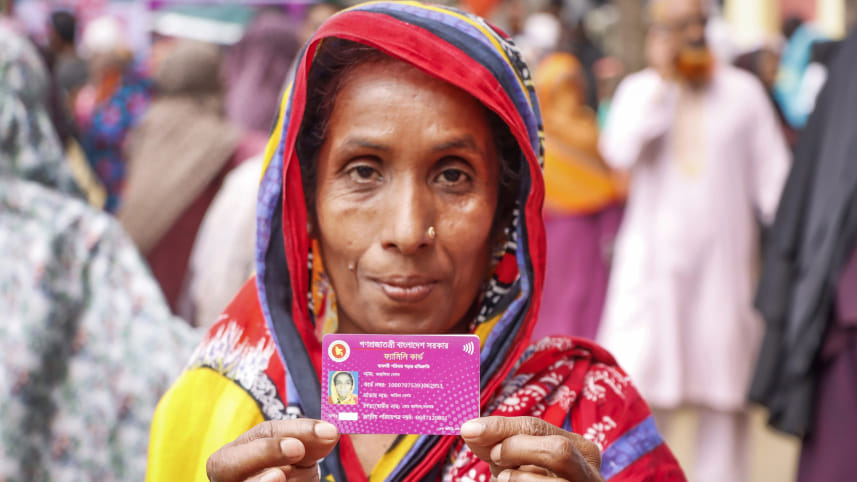
The announcement of the Family Card programme, which promises a Tk 2,500 monthly allowance for vulnerable families, has been celebrated as a landmark initiative in the government’s efforts to deliver on a major election promise. On the surface, it is a heartwarming initiative that seeks to help millions of people escape poverty. Even though the intention behind the programme is admirable, the government’s haste in rolling out the programme without a clear economic strategy or a comprehensive review of the existing social protection programmes threatens to undermine the very foundations of the economy that it seeks to strengthen.
The first and most pressing concern that arises from this programme is the fiscal sustainability that it requires. The government has indicated plans to expand this programme to include some two crore families by 2030. This means that it will cost the government approximately Tk 60,000 crore annually. This amount is a major part of the country’s Annual Development Programme (ADP) that goes into building roads, bridges, power plants, etc. The government’s capacity to generate revenue is limited, with a tax-GDP ratio that remains one of the lowest in the world. Additionally, a huge and ever-expanding share of the national budget is already locked into inflexible commitments, such as the interest payments on the national debt and power sector subsidies. This leaves a very narrow fiscal space for a new, recurring commitment.
 For all latest news, follow The Daily Star's Google News channel.
 To finance the family card at the intended scale, the government might have to make difficult trade-offs. It cannot cut the salaries and benefits of its employees, so the funds for the card are likely to come from somewhere else: the human capital, including the education and health budget, or the ADP for physical capital. Reducing the education and health budget will be a short-sighted solution as it will undermine the country’s growth potential. Similarly, the ADP cannot be deprived of funds, as this will only slow down the growth of the country’s infrastructure, which, in turn, will slow down the growth of the economy’s capacity to produce goods and services.
In addition to the macroeconomic considerations, the design of the family card programme also poses questions about its efficacy. Bangladesh already has some 140 social protection programmes running under 26 ministries, but they have been roundly criticised for their inclusion and exclusion errors. The process for the family card programme is also prone to similar problems and may fail to include those who deserve to benefit most from the initiative. If the money is transferred to those who are not actually poor, then the programme’s ability to combat poverty will be reduced to nothing but a waste of public money.
Furthermore, discussions on the family card have been almost exclusively on the potential benefits of the programme with little attention paid to the opportunity costs. Perhaps the funds could be better utilised for programmes that have a long-term rate of return, such as those that combine early childhood nutrition with effective communication and skill trainings. A recent study conducted on the long-term impact of cash transfers in Bangladesh found that while cash transfers give a temporary reprieve from poverty, a combination of cash and complementary services like nutrition education may result in a long-term solution to poverty.
Ultimately, the family card is a litmus test for good economic management. Launching a scheme of this nature without a dedicated source of finance, without streamlining existing welfare programmes, and all the while lacking a proper and transparent mechanism to ensure that funds are channelled to the right people, is fiscally irresponsible. The government needs to treat this as an opportunity to reform the overall structure of social welfare web, not just add another layer of inefficiency to an already crumbling system.
Dr Md Deen Islam is professor of economics at the University of Dhaka and research director at Research and Policy Integration for Development (RAPID).
Views expressed in this article are the author's own.
Follow The Daily Star Opinion on Facebook for the latest opinions, commentaries, and analyses by experts and professionals. To contribute your article or letter to The Daily Star Opinion, see our guidelines for submission.


Comments