


What the government must prioritise to tackle power and energy challenges

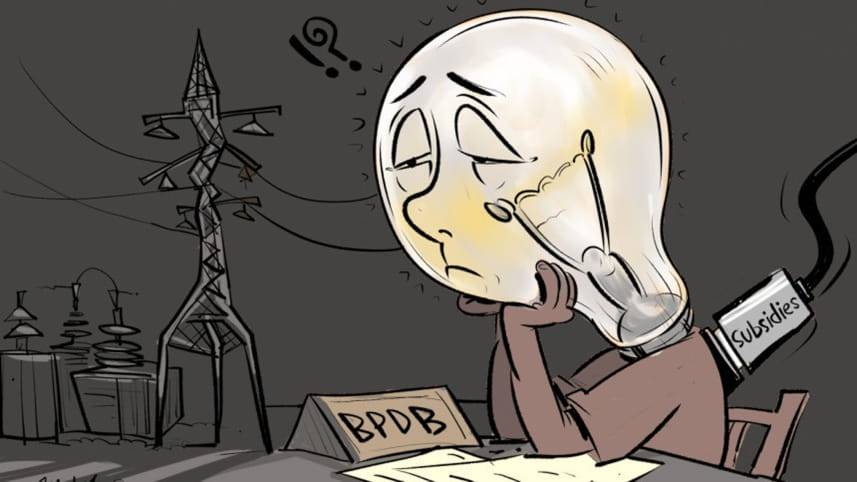
Having taken office at a critical juncture for Bangladesh, the newly elected BNP government faces some pressing challenges. Among the immediate tasks it needs to deal with is addressing the growing power and energy demands, tackling which will require careful planning and fiscal prudence. Several interrelated issues underscore the situation: rising summer power demand during Ramadan and peak irrigation; the country’s heavy import dependency that exposes it to energy supply disruptions and price volatility; the need to address the International Monetary Fund’s (IMF) concerns over power and energy subsidies under its $5.5 billion loan programme; and the imperative to avoid sharp tariff hikes that could undermine the competitiveness of the country’s export-oriented apparel industry.
It is in this context that the new government must translate its election manifesto pledge—raising renewable energy capacity from its current five percent to 20 percent by 2030—into concrete action, particularly by working towards attracting investors.
 For all latest news, follow The Daily Star's Google News channel.
 Bangladesh generally experiences a surge in peak power demand every summer due to rising temperatures. Last year, however, was an outlier, when the country saw a dip in peak power demand, resulting from lower temperatures in April 2025 compared to April 2024, and 62.9 percent more precipitation than usual in May 2025. In addition, many industries had suspended operations because of financial challenges.
With early signs of an uptick in power demand in January-February this year, Bangladesh will likely require higher generation levels this summer. Research by the Institute for Energy Economics and Financial Analysis (IEEFA) shows that between January 19 and February 18 this year, peak power demand soared up to 6.5 percent compared to the same period last year. With the ongoing irrigation season coinciding with Ramadan, and as temperatures rise further in March, this trend may intensify.
Therefore, the new government should consider formulating a power supply rationing plan without affecting industries and businesses to safeguard economic activities. With the Bangladesh Power Development Board’s (BPDB) payment backlog to private power producers exceeding Tk 25,000 crore, the government also needs to clear dues to avoid massive power supply disruptions.
With growing geopolitical tensions that may result in surging fuel prices in the international market, the government must also work towards developing an ecosystem that encourages judicious energy use across the country. This could include motivating households, industries and businesses to adopt efficient appliances and working on bringing in behavioural changes among people. To that end, the Sustainable and Renewable Energy Development Authority (SREDA) should plan and execute national awareness-raising campaigns on energy efficiency and conservation. Additionally, rationalising high import duties on components of efficient appliances would help reduce upfront costs and make them affordable. Meanwhile, government offices should work to implement the SREDA-developed benchmark energy consumption standards for different appliances at all levels.
Dilemma over IMF pressure to raise power tariffs
The BPDB incurred an aggregate revenue shortfall of Tk 55,600 crore in FY2024-25, driven by a loss of about Tk 5 per kilowatt-hour (kWh). The government covered the lion’s share of this loss, injecting subsidies worth more than Tk 38,600 crore. The IMF reportedly prescribed that Bangladesh reduce this hefty subsidy by 2028 as part of its evaluation of the $4.7 billion loan facility approved in January 2023 to support the country’s macroeconomic stability. In June 2025, IMF extended the loan to $5.5 billion.
So far, Bangladesh has received $3.6 billion in five tranches. The sixth was deferred pending the formation of an elected government, alongside a call to raise power tariffs to minimise subsidies. However, IEEFA’s ballpark estimate shows that cutting the current subsidy by even 50 percent will require the BPDB to raise the average bulk electricity selling price for distribution utilities by more than 25 percent and adjust the retail price. This may adversely affect the country’s apparel sector.
For instance, the textile industry, with a sanctioned load of 5MW operating for 12 hours a day, pays roughly Tk 10.935 per kWh, which is around 6.4 percent less than its Vietnamese counterpart. This is calculated based on the peak and off-peak power tariff and demand charge of Bangladeshi industries connected to a 33kV line and peak, off-peak, and standard tariffs of Vietnamese industries.
The new government will need to consider a rational adjustment for industry. This is especially relevant for the apparel sector, which accounts for more than 80 percent of the country’s export earnings. Moreover, instead of passing all costs on to the consumers, the government must focus on enhancing energy efficiency and reducing wastage. For instance, by limiting losses due to leakage and pilferage, which amount to more than 7,000 crore cubic feet per annum, Bangladesh may slightly reduce capacity payments by redirecting part of this saved gas to independent power producers (IPPs) operating at lower capacity, thereby reducing the power generation cost.
Besides, the government can refrain from adding new fossil fuel-fired plants and catalyse the uptake of cost-competitive renewable energy that will help limit costs by replacing expensive peaking power plants during the day. In the medium term, it should explore the South Asian region’s vast hydro potential, such as in Nepal, building on its 40MW power trade agreement with the nation. Simultaneously, the country could explore the feasibility of exporting surplus power to Nepal during the winter season, when hydropower generation falls.
Unless Bangladesh makes efforts to control power generation costs, price hikes alone will not significantly minimise the subsidy burden.
Attracting renewable energy investment
New investments in the renewable energy sector almost stagnated in 2025 due to a lack of new projects. Prior to this, the sector had roughly attracted investment worth $238 million per annum on average. The new government’s intention to expand renewable energy capacity to 20 percent by 2030 should help accelerate the annual flow of investment by 4.1 times compared to the previous trend. This will necessitate mobilising private and international capital at scale, for which a viable project pipeline is key.
The government must urgently engage with key renewable energy stakeholders, including investors and financiers, to identify and resolve barriers to investment. Unless these concerns are resolved, the renewable energy sector’s growth will likely remain sluggish, and the country will fall short of its 2030 goal. Once the government overcomes these initial challenges, it will have scope to manoeuvre the energy and power sector through well-devised plans, backed by funding allocations in the upcoming budget for FY2026-27.
Shafiqul Alam is lead energy analyst for Bangladesh at the Institute for Energy Economics and Financial Analysis (IEEFA).
Views expressed in this article are the author's own.
Follow The Daily Star Opinion on Facebook for the latest opinions, commentaries, and analyses by experts and professionals. To contribute your article or letter to The Daily Star Opinion, see our guidelines for submission.
Comments