


Dissecting the UNSC plan for Gaza and its inevitable dead end

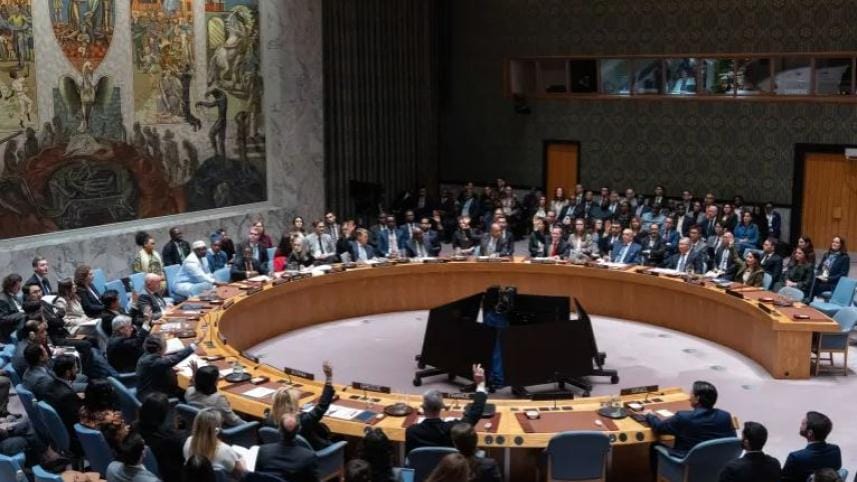
US policy documents on the Middle East do not reach the daylight before Israel is given the chance to filter and gut them. The latest UN Security Council (UNSC) 2803, Comprehensive Plan, is no exception. The resolution perpetuates the same failed logic that has governed international diplomacy for decades—one in which Palestinian rights are conditioned, but Israeli obligations are delayed with no mechanism, timelines, or accountability for violating agreements.
Following two years of using food as a weapon of war and genocide, the UNSC adopted the US-sponsored resolution, not to condemn but to reward the perpetrator. The UNSC Comprehensive Plan for Gaza is anything but comprehensive. It is narrow, short on details, rich in contradictions, and utterly lacking any overarching purpose.
 For all latest news, follow The Daily Star's Google News channel.
 Take the second paragraph of the resolution, for instance. The resolution "welcomes the establishment of the Board of Peace (BoP)" as a transitional international administration that will manage Gaza's redevelopment "until such time as the Palestinian Authority has satisfactorily completed its reform program."

In other words, the recognition of the inalienable rights of the Palestinian people is contingent, sequenced, and time-bound: reform first, demonstrate worthiness, satisfy outside evaluators, and then—maybe—they can "securely and effectively take back control" of their land. Meanwhile, Israel's commitments are, at best, deliberately vague, crafted with ambiguities allowing varying interpretations, much like UNSC Resolutions 242 and 338, written purposefully in a nebulous language that enabled Israel to evade compliance for decades.
There is not one single concrete or enforceable requirement placed on Israel: to halt its extrajudicial assassinations, military attacks, complete withdrawal, or stop the expansion of Jewish-only colonies established on the same land reserved for the supposed Palestinian "self-determination."
The resolution weakens item 7 of "Trump's 20-point Gaza peace plan", which had called for "full aid be immediately sent into the Gaza Strip." The new Comprehensive Plan replaced "immediately" with an emphasis on "the importance of the full resumption of humanitarian aid." Israel's inexplicit obligations are further watered down to mere "consultation" and "cooperation," giving the occupying power wide latitude to dictate interpretations and evade any real accountability.
The distortion becomes even more evident in paragraphs three through eight. These sections deepen the asymmetry: Israel, whose leaders are indicted war criminals, is elevated to a co-supervisor with veto power over every stage of Gaza's future. In effect, this resolution upends international law by granting war criminals the final word on Gaza's fate.
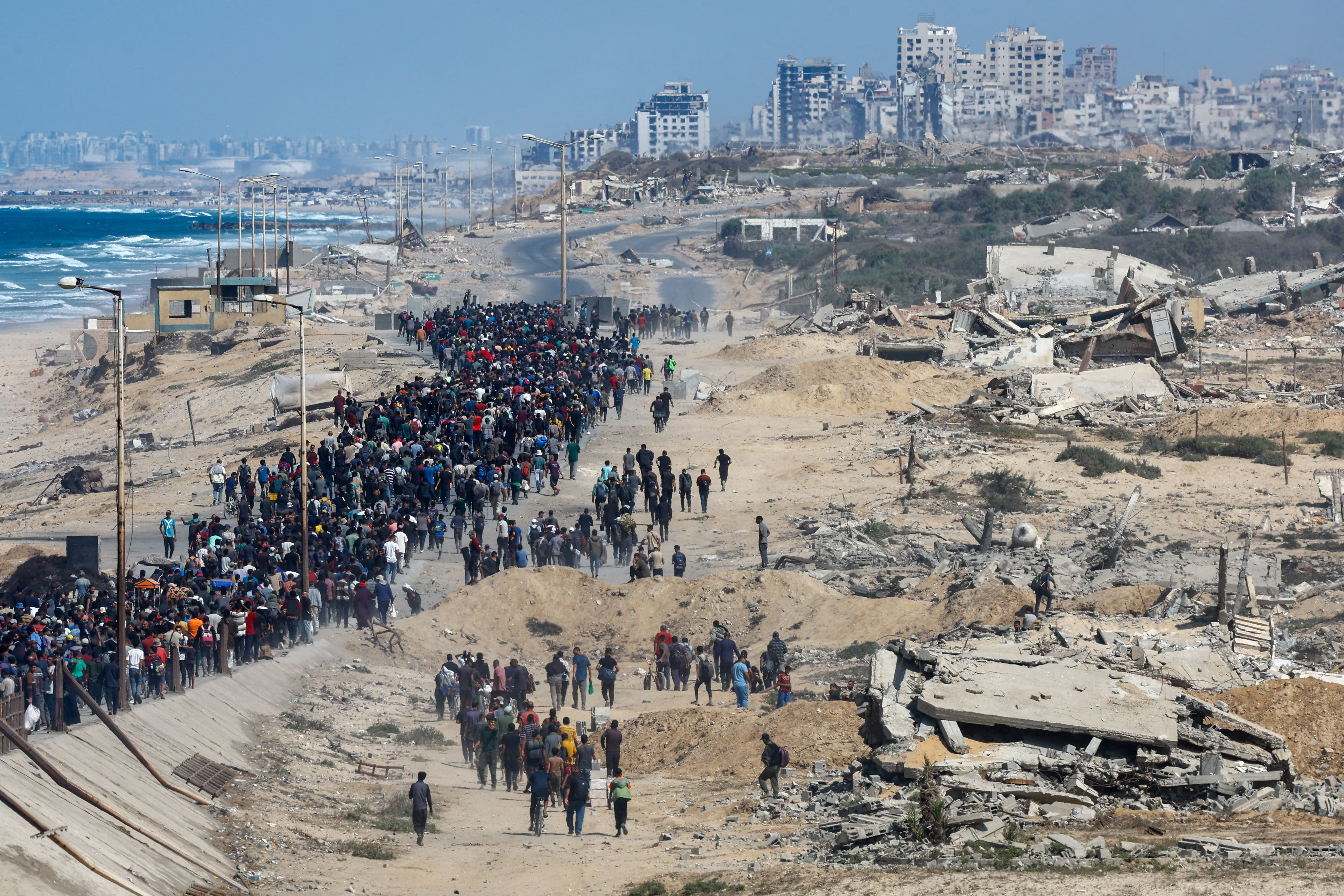
Paragraph three, which addresses humanitarian aid, orders stringent monitoring of aid distribution inside Gaza. At the same time, there is no unequivocal demand on Israel to open all crossings or stop hindering humanitarian aid delivery fully. The limited aid must be policed in Gaza, but the state that used food as a weapon and starved the population is not required to do anything differently.
In paragraph four, a foreign-controlled "operational entities" strip Palestinians of their political agency by placing them under a technocratic committee selected from abroad and subordinate to the misnomer BoP. Yet, there is nothing in the resolution about the freedom of ingress and egress, no mention of opening the seaport or rebuilding the airport. Furthermore, there are no tangible punitive measures if and when Israel fails to adhere to the UNSC Resolution.
The funding structures in paragraphs 5–6 absolve Israel of responsibility. Gaza's reconstruction is handed to donors and the World Bank, financed through voluntary contributions. Israel, the power that destroyed Gaza is not asked to contribute a dollar, let alone pay reparations or assume legal responsibility for murdering and injuring 241,000 Palestinians, destroying all the universities, 97 percent of schools, 94 percent of the hospitals and 92 percent of the residential homes.
The heart of the resolution's inequity is found in paragraph seven, which authorises a foreign military force (ISF) tasked with enforcing Palestinian demilitarisation. The Palestinian Resistance must disarm, surrender weapons, accept foreign security supervision, and undergo vetting. Israel's withdrawal, however, takes place only "when conditions allow" and is to be negotiated between its army and ISF, guarantors, and the US. Palestinians are entirely excluded from determining the terms of the Israeli withdrawal from their own land.
Even more alarming, the resolution normalises Israeli occupation "that will remain until Gaza is properly secure from any resurgent terror threat." The open-ended clause grants Israel a permanent military footprint in and around Gaza while also granting it the power to define and determine any so-called "resurgent threat."
Finally, paragraph eight mandates that any extension of international presence in Gaza must be done "in full cooperation and coordination with Egypt and Israel." Once again, Palestinians are excluded from determining their own future. It is all left for Israel since its consent is conditional on the "full cooperation."
Taken together, these provisions expose the true nature of the so-called Comprehensive Plan: a political instrument designed to entrench, not end, the structural inequality of occupation. And less than 72 hours following the UNSC Resolution, Benjamin Netanyahu appointed Bezalel Smotrich and Itamar Ben-Gvir, two Jewish racist ministers who openly called for the ethnic cleansing and for building Jewish-only colonies in Gaza, to be in charge of, or more likely to undermine, the second phase of Trump's 20-point plan.
In short, the UNSC Comprehensive Plan whitewashes Israel's genocide and ties the future of Palestinian self-determination to a checklist that Israel is neither bound to accept nor prevented from obstructing. A plan that will lead to exactly where previous UN Resolutions, mainly 194, 242, and 338, had gone, to an inevitable dead-end.
Jamal Kanj is the author of Children of Catastrophe: Journey from a Palestinian Refugee Camp to America, and other books. He writes frequently on Palestine/Arab world issues for various national and international publications.
Views expressed in this article are the author's own.
Follow The Daily Star Opinion on Facebook for the latest opinions, commentaries and analyses by experts and professionals. To contribute your article or letter to The Daily Star Opinion, see our guidelines for submission.
Comments