


Stay out of Gaza ISF
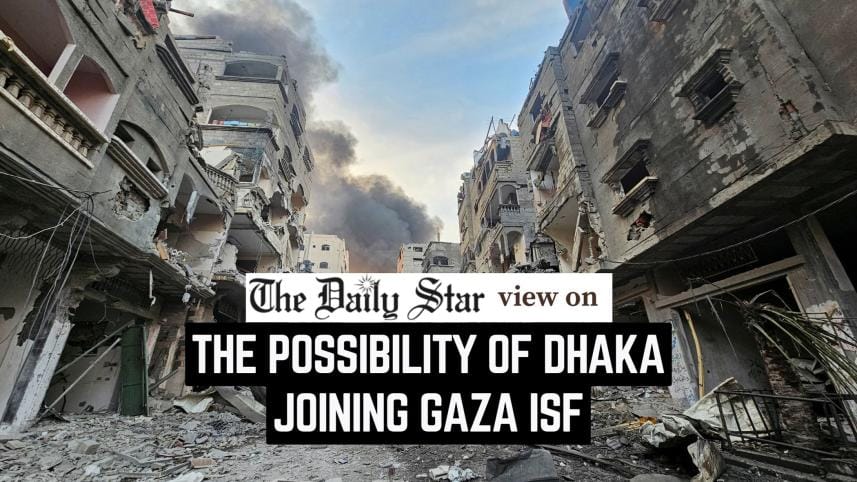
The interest expressed by National Security Adviser Khalilur Rahman in participating in the proposed International Stabilisation Force (ISF) for Gaza is both perplexing and troubling. It is difficult to comprehend the rationale behind such an initiative by an interim government that is expected to leave office within a month or so, but still appears willing to saddle the country and its armed forces with a commitment that borders on an outlandish adventure.
The clarification offered by the chief adviser’s press secretary, Shafiqul Alam, regarding the adviser’s discussions with US officials is neither convincing nor coherent; indeed, it appears internally contradictory. Referring to United Nations Security Council Resolution 2803, he stated, “As one of the largest contributors to UN peacekeeping forces and an ardent supporter of the Palestinian cause, Bangladesh’s interest in participating in the ISF is contingent on the fulfilment of a number of principles.” These, he explained, include the force being temporary and operating under a clear UNSC mandate, the establishment of a permanent ceasefire and complete withdrawal of Israeli forces from Gaza, and the transfer of responsibility for Gaza to the Palestinians.
 For all latest news, follow The Daily Star's Google News channel.
 However, Resolution 2803 tells a different story. It states that “as the Force establishes control and stability, the Israel Defense Forces will withdraw from the Gaza Strip based on standards, milestones, and timeframes linked to demilitarisation that will be agreed between specified parties—save for a security perimeter presence that will remain until Gaza is properly secure from any resurgent terror threat.” The language of the resolution makes it abundantly clear that the proposed multinational force is not intended as a peacekeeping mission. Rather, it is designed to secure Gaza while the IDF retains a continuing presence. In effect, the IDF’s withdrawal is conditional and open-ended.
It is also noteworthy that although the UNSC adopted the resolution, two veto-wielding members—Russia and China—abstained, citing the lack of clarity and warning that the force “could actually transform it into a party to the conflict.” Even members who voted in favour expressed reservations about the resolution’s vagueness. While attempting to justify the interim government’s interest in the ISF, the government’s spokesperson pointed out that all Muslim members of the UNSC supported the resolution. Yet, Pakistan and Somalia explicitly voiced concerns over the absence of any meaningful role for the Palestinian Authority and the lack of a clear pathway towards Palestinian statehood.
Against this backdrop, the interim government’s reiteration of Bangladesh’s long-held policy—steadfast support for the Palestinian people’s right to self-determination and the establishment of a sovereign Palestinian state based on the 1967 borders, with Al-Quds Al-Sharif as its capital—rings hollow due to the willingness to deploy Bangladesh’s armed forces in support of an ill-defined mission.
It is well-documented that Israel is among the most persistent violators of UN resolutions adopted by both the Security Council and the General Assembly. Since the ceasefire mediated by President Donald Trump came into effect on October 10, 2025, Israel has reportedly violated it nearly 1,200 times, including through airstrikes, shelling, and the demolition of homes, resulting in the deaths of at least 439 Palestini-ans. Extending support to a security operation that risks becoming a direct party to the conflict—particularly one that may operate against Palestinian interests—would mark a departure from Bangla-desh’s long and principled history of solidarity with the Palestinian struggle against illegal and brutal occu-pation. Moreover, an interim government scheduled to hand over power within weeks has no authority to entangle the country in such a complex conflict situation.
Comments