

The ‘game’ of migration: A deadly illusion Bangladesh must confront urgently

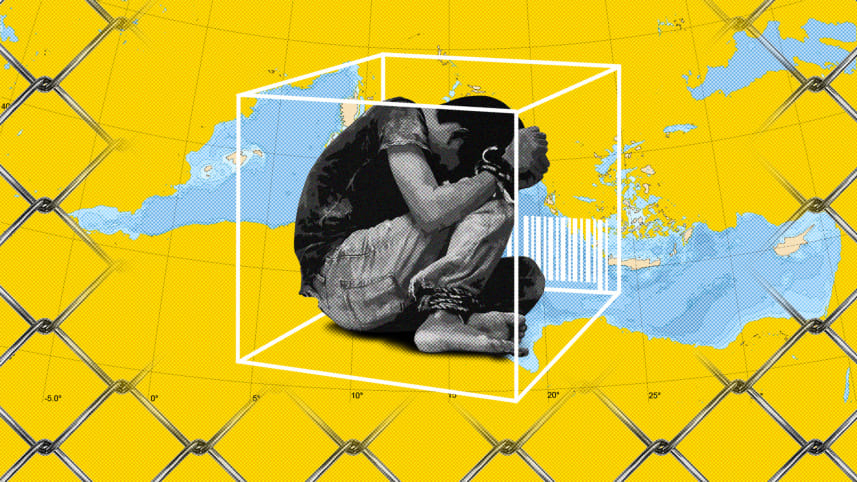
A large section of Bangladesh’s youth today finds itself confronting a stark reality in which some of life’s most consequential decisions are made not on the basis of rationality or safety but are driven by frustration, social pressures, and the dream of achieving rapid success. One such decision is the attempt to reach Europe through irregular sea routes, evading border guards and crossing borders illegally—a process colloquially referred to as “game.”
News headlines repeatedly highlight stories of capsised boats (mostly in the Mediterranean Sea), missing young men, and victims of human trafficking intercepted at borders. Yet, the journey of undocumented migrants continues, even as the latest Middle East crisis rages on. In fact, this dangerous journey is expanding further with the emergence of new routes, evolved trafficking networks, and increasingly sophisticated methods. Why do Bangladeshis knowingly take such life-threatening risks? Sadly, there is no simple answer to this question. This is not merely a consequence of economic hardship; rather, it reflects a complex, multi-layered social reality.

First, the lack of sufficient employment opportunities and income instability discourages many young people from envisioning a future within the country. At the same time, it is true that millions continue to work, run businesses, and sustain themselves in Bangladesh. Thus, the issue is not solely the absence of opportunity, but rather a profound gap between expectations and reality. Second, migration has increasingly become a marker of elevated social status. Stories such as “someone went to Italy and became successful” exert a far greater influence than the harsher realities of migration. As a result, the concept of going abroad has transformed from an economic decision into a form of social competition.
Third, the effort, skill, and patience required for legal migration, such as establishing language proficiency, passing standardised tests, maintaining strong academic records, and/or acquiring technical training, can often be avoided in the so-called “game.” This gap is precisely what drives many towards irregular migration routes.
Fourth, human trafficking syndicates actively exploit this demand. They do not merely traffic people; they advertise a dream—one in which risks are concealed and success stories are exaggerated. In many cases, these networks operate with political patronage, making effective enforcement difficult.
Finally, there is a deeper psychological dimension: disillusionment and alienation from the state. Many young people believe that they must leave the country “by any means necessary,” even if it involves the risk of death. Ongoing political instability and a sense of insecurity fuel this tendency. The “dream of Europe” becomes so powerful that many are willing to step into the deadly waters of the Mediterranean to pursue it.
According to the International Organization for Migration, at least 606 migrants died or went missing along the Mediterranean route in just the first two months of this year. In a recent incident, at least 22 migrant hopefuls died while attempting to cross the sea in a small rubber boat from Libya to Greece, and 18 of them were reportedly from Bangladesh. The boat had left a port in Libya on March 21 carrying 43 people. The passengers on board lost bearings during the journey, spending six days at sea without food and water, according to survivors rescued by a European border agency vessel.
Sadly, these irregular migrations also impact the credibility of the Bangladeshi passport, whose value has effectively deteriorated. Consequently, even travellers with valid visas are now subjected to heightened scrutiny and extensive questioning at immigration checkpoints. Furthermore, several countries have tightened their visa policies and, in some cases, temporarily suspended immigrant visa processing for Bangladeshis.
To combat human trafficking, Bangladesh enacted the Prevention and Suppression of Human Trafficking Act, 2012. However, despite the existence of this law, trafficking networks continued to expand, irregular migration routes sustained, and cases of fraud remained widespread. Recognising these limitations, the interim government promulgated the Prevention and Suppression of Human Trafficking and Migrant Smuggling Ordinance, 2026 on January 6, which could be an important policy advancement if implemented properly. For the first time, this ordinance addresses previous gaps by formally recognising migrant smuggling as a distinct criminal offence alongside human trafficking.
As a result, the so-called “game” towards Europe is no longer merely an unethical act; it is now clearly defined as a punishable offense, with provisions for long-term imprisonment, fines, and, in severe cases, life imprisonment for organised trafficking syndicates. Not only direct traffickers but also their facilitators, financiers, and intermediaries can be brought within the scope of punishment. Measures such as asset seizure, freezing of bank accounts, and travel bans have been incorporated, targeting the financial foundations of these networks.
Importantly, the law also addresses contemporary challenges. It brings online recruitment and digital exploitation, through which many young people are lured, under legal scrutiny. It further includes provisions for victim and witness protection, and explicitly recognises other forms of trafficking such as organ trafficking and forced criminality. Therefore, it is crucial that this ordinance be swiftly passed into law by the parliament and, more importantly, effectively implemented.
However, the depth of this crisis means that no single solution will suffice and that a coordinated approach is essential. First, trafficking syndicates must be dismantled through strict and impartial enforcement of the law, without any political concessions. Second, mandatory pre-departure training must be introduced for aspiring migrants, focusing on language, skills, and labour rights. The government must also provide maximum support for students seeking higher education abroad. In this context, the new BNP government’s initiative to provide loans of up to Tk 10 lakh as financial support for overseas education—to meet bank guarantee or solvency requirements—deserves commendation. This policy can offer a viable alternative to risky and irregular migration. Pursuing education abroad through legal means, acquiring skills, and entering the global labour market benefits not only individuals but the country as a whole. Third, widespread public awareness must be built regarding the risks of irregular migration, particularly in rural areas.
Finally, it is imperative to establish effective institutional support systems for Bangladeshis in distress abroad. Many migrants who travel without proper documentation face detention, abuse, or legal complications but fail to receive timely assistance. Strengthening embassy capacities, establishing emergency helplines, providing legal aid, and actively protecting labour rights are crucial. At the same time, safe and dignified repatriation mechanisms must be ensured for those wishing to return home.
Aparajita Debnath is an advocate at the Dhaka Judge Court.
Views expressed in this article are the author's own.
Follow The Daily Star Opinion on Facebook for the latest opinions, commentaries, and analyses by experts and professionals. To contribute your article or letter to The Daily Star Opinion, see our guidelines for submission.
 For all latest news, follow The Daily Star's Google News channel.


Comments