


Nepal election: A lesson in honouring a people's uprising

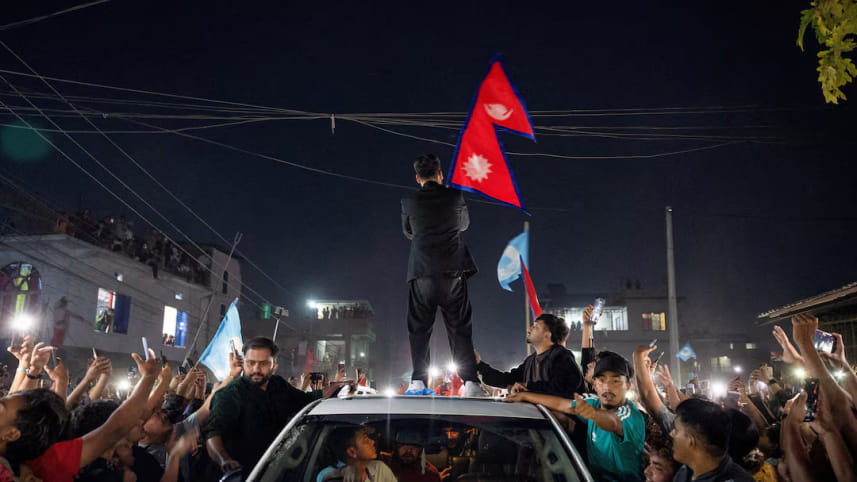
On a Tuesday morning in September 2025, a 19-year-old student named Suman Thapa tried to log into TikTok and saw that it was blocked. By Friday, he was in the streets with thousands of others. By the following week, he was dodging live firing. Nepal’s government had made the oldest mistake in the authoritarian playbook when it tried to silence people who had nothing left to lose.
Something unusual happened in Kathmandu in September last year. It did not begin with a manifesto or in a party headquarters, or through a general strike. It began with a social media ban. The government of former Prime Minister KP Sharma Oli, already under the weight of contradictions, moved to restrict access to online platforms that young Nepalis treat as public space. That decision lit a fire that the administration either did not see or chose to ignore.
 For all latest news, follow The Daily Star's Google News channel.
 Within days, the protests had outgrown their original grievance. Tens of thousands of young people poured into the streets of Kathmandu, Pokhara, and Biratnagar. The movement had no single command structure. It was organised largely on Discord servers and TikTok channels, coordinated by grassroots citizens. Parliament was stormed. Government buildings were set alight. When police opened fire, at least 77 people were killed. By mid-September, Oli resigned and Nepal's president called on elections. The country's first woman to lead a government, former Chief Justice Sushila Karki, was appointed as the interim prime minister. She was tasked with holding the election within six months.
The election was held on March 5 this year. The results point to a landslide for rapper Balendra Shah, which few in Nepal's political establishment anticipated, even after the uprising.
Revolutions rarely announce themselves. Nepal’s did not, either. There was no vanguard party, no clear state transformation, no counter-institution waiting to take power. It signalled a moment of free-falling legitimacy for a political class that recycled itself through coalitions and backroom arrangements for three decades. This is what philosopher Antonio Gramsci called an “organic crisis.” It is a rupture in which the dominant class loses its capacity to lead, not merely to govern by force. The Nepali state's coercive response, including firing at protesters, only confirmed what the streets were already saying. Authority had become a destructive power for a generation that grew up after Nepal's civil war and the 2015 earthquake.
Nepal's political configuration had long been a cartelised party system involving the Nepali Congress, the Communist Party of Nepal (UML), and the Maoists. They compete by rotating through power-sharing arrangements that shield them from meaningful accountability. Oli himself had served four times. The country's economic record remained dismal. GDP per capita stagnated. Youth unemployment was high enough that emigration, particularly to the Gulf states and Malaysia, had become a default life plan for much of the population under 30.
Nepal’s next leader is a rapper whose verses talk about potholes and bureaucratic rot. That alone tells you something has broken open. Balendra Shah, known publicly as Balen, is 35 years old. He trained as a civil engineer, became one of Nepal's most prominent rappers, and won the Kathmandu mayoral race in 2022 on an anti-establishment platform. His music targeted corruption and inequality and his songs circulated as unofficial anthems during the September protests. He joined the Rastriya Swatantra Party (National Independent Party) in December 2025, and was announced as its prime ministerial candidate shortly after. The Rastriya Swatantra Party itself was founded in 2022. Oli, the veteran communist-turned-nationalist, was beaten in his own constituency, where Shah ran directly against him. Nepali Congress, the country's oldest democratic party, won a fraction of its expected seats. Gagan Thapa, Congress's newly elected leader and widely regarded as its most credible reformist voice, lost his own race to an RSP candidate.
The RSP ran a disciplined, well-funded campaign, with a social media operation of over 660 people and significant backing from the Nepali diaspora, particularly in the US. Shah's platform focused on health and education for poor Nepalis, anti-corruption reform, and a break from the coalition politics that had made governance in Kathmandu an exercise in managed dysfunction. He offered something that the old parties had failed to: the credible possibility of a different kind of politics.
Bangladesh went through its own version of this uprising in 2024, when student-led protests brought down Sheikh Hasina's government. The two episodes share certain structural features: the youth frustrated by stagnant economies and closed political systems served as catalysts for the fall of the old system. In both cases, social media was used as both an organising tool and a political battleground. Both uprisings show the particular volatility that results when a government responds to civic protest with lethal force.
The danger in any popular uprising is not that it succeeds in removing a government, but the pace of mobilisation. Nepal has managed this transition better than many had predicted. The interim administration deliberately insulated itself from party politics and provided a holding structure that maintained basic state functions while the election was organised. A voter roll of nearly 19 million was updated, over 800,000 first-time voters were registered, and the election itself was conducted, by all independent observer accounts, freely and fairly.
This was rather significant, given that parliament had been dissolved and the country had just come through its most violent political rupture in years. Nepal's constitutional framework, with its imperfections, provided a procedural path through the crisis. Karki followed it. The Election Commission followed it. The results are being respected.
Winning an election, it turns out, is the easy part. Political scientists who study democratic transitions are fairly united on one uncomfortable point: the removal of an authoritarian or dysfunctional incumbent is not a democratic consolidation. It is a window. What passes through that window depends on whether the incoming government can convert popular energy into durable institutional change. Whether the institutional machine of Nepal, resistant to reform for decades, can be made responsive to those demands is a question that will take years to answer.
At a minimum, what Nepal has demonstrated is that democratic elections remain one of the few mechanisms through which a population can peacefully retire a political class that has exhausted its legitimacy. The uprising created the conditions. The election translated them into a mandate. Whether that mandate becomes governance, with all the complexity and compromise that word implies, is the chapter that has yet to be written.
Aishwarya Sanjukta Roy Proma is lecturer in the Department of International Relations at the University of Rajshahi.


Comments