

The day we became independent
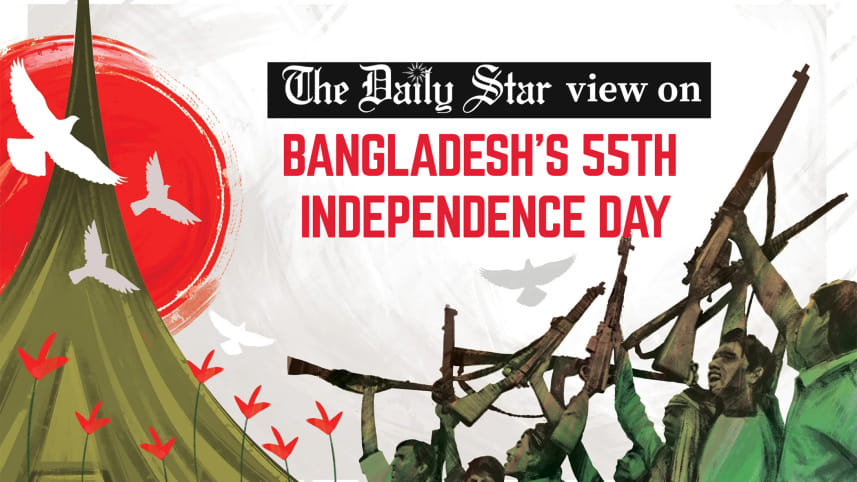
The Independence Day holds special significance for Bangladesh as it marks the moment when we asserted our separate national identity and, following a nine-month-long, blood-soaked war, achieved our freedom. However, we must admit that even after 55 years, the narrative of our Liberation War is not uniform. Shifts in the narrative have occurred with the changing political winds of the day, not only during military rule but also under democratic governments. This has greatly damaged the legacy of our Liberation War and so must be stopped.
In this connection, as the new government considers revising textbooks, it must recognise how past revisions, reframings, and rewritings of history—as well as the idolisation of certain leaders while ignoring others—have affected all of us, especially younger generations. Many, unfortunately, feel disconnected from this defining chapter as constant revisions have created confusion and weakened the emotional bond with our struggle for independence. National history should unite; in our case, it has often deepened divisions. Thus, it is important that the new government led by BNP refrains from repeating past mistakes of revision and reframing in pursuit of partisan interests.

We also expect the government to stand firm against any attempt to undermine our Liberation War. As seen in the aftermath of the July uprising, a section of political actors used the people’s upsurge against the autocratic Awami League regime to attack the Liberation War narrative as well as the values it stood for—democracy, nationalism, secularism, and socialism. According to a report in Prothom Alo, between August 5 and 14, 2024, its correspondents documented 1,494 incidents of sculptures, murals, reliefs, and memorials being desecrated and vandalised across 59 districts of the country. Targets included even the Mujibnagar Muktijuddha Memorial Complex, muktijoddha memorials, and boddhyobhumi grounds representing the genocide perpetrated by the Pakistani army and its local collaborators. The interim government did little to restore these during its 18-month tenure.
The new government must act to protect and restore these sites, especially those representing the glory and pain of our nation’s history. This is particularly urgent as global efforts grow to recognise the 1971 genocide. On March 20 this year, a US congressman introduced a resolution in the House of Representatives calling for formal recognition of the 1971 genocide, citing evidence from officials, journalists, and international bodies. At such a moment, any attempt to distort our history, under any ideological guise, must be firmly resisted.
However varied the narratives of the Liberation War may be, no compromise or inaccuracy should be tolerated in portraying the nation’s independence struggle, the sacrifices of millions of lives, and the violation of thousands of women that eventually led to the achievement of independence. The heroes of different narratives may vary, as may interpretations of their respective contributions, but the historic significance of the war, the sacrifice of millions, and the bravery of freedom fighters must never be minimised. Undermining it would only harm the nation itself.
 For all latest news, follow The Daily Star's Google News channel.


Comments