


Gazipur road collapse probe must set a good precedent
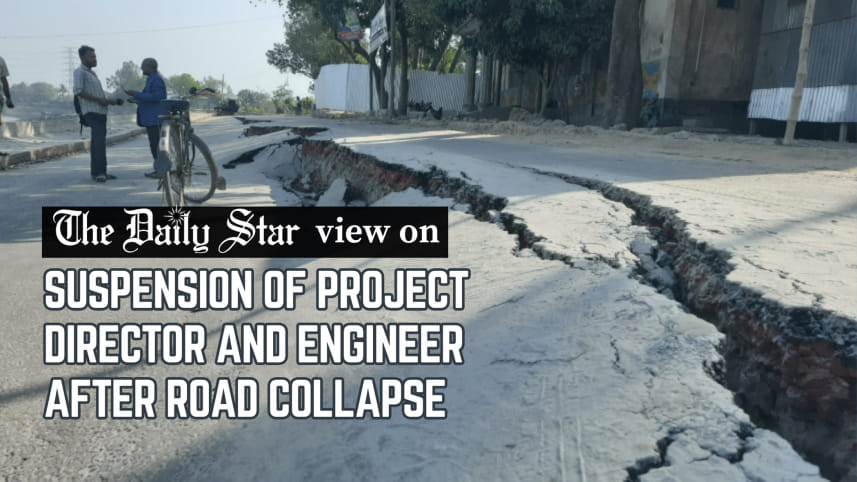
The collapse of a newly constructed road in Gazipur last month—built at a cost of Tk 12 crore—highlighted the lack of responsibility and disregard for state resources among many civil servants who often remain unaccountable for such incidents. This time, however, a project director and an engineer were suspended after the state minister of Local Government, Rural Development and Cooperatives visited the site on Monday (March 23, 2026), following directives from the prime minister. Since initial probes revealed irregularities—including the use of substandard materials—the suspension order undoubtedly signals the correct course of action.
In the past, several newly constructed bridges, culverts, and regional roads have similarly failed. Probe bodies were formed, but often with no visible consequences. In this case, too, several committees were reportedly set up to investigate the February 15 road collapse, including a probe by the Anti-Corruption Commission. Yet, action came more than a month later, only after extensive media reporting, intervention by the prime minister, and a subsequent visit by the state minister. According to a report in this daily, the state minister formed yet another probe committee, dissolving the earlier ones, many of whose findings were never made public.

In a well-governed society—where corruption, nepotism, favouritism, and political influence do not shape infrastructure implementation—this Tk 12 crore road would not have undergone the above-mentioned fate. Irregularities, including the use of substandard materials or gaps in the proper execution of construction methods, would have been detected early rather than after completion. Transparency and accountability must be embedded at every stage, from project feasibility and tendering to construction. This raises the question: was there no routine and rigorous audit of the project during its implementation phase? Unfortunately, infrastructure projects are often awarded on political grounds, and failures to meet standards are overlooked. At most, contractors face financial penalties which rarely account for reconstruction costs or the broader public suffering caused.
We hope this time the course of action will be different. The government has an opportunity to set a precedent by conducting a transparent investigation, publishing its findings, and holding all responsible parties accountable for the irregularities and failure of the Gazipur road project. It must also ensure that internal audits of all infrastructure projects are carried out properly to guarantee transparency and accountability during the implementation phase, and not in the aftermath of a collapse.
 For all latest news, follow The Daily Star's Google News channel.


Comments