


Rangpur eyes bumper Haribhanga mango harvest

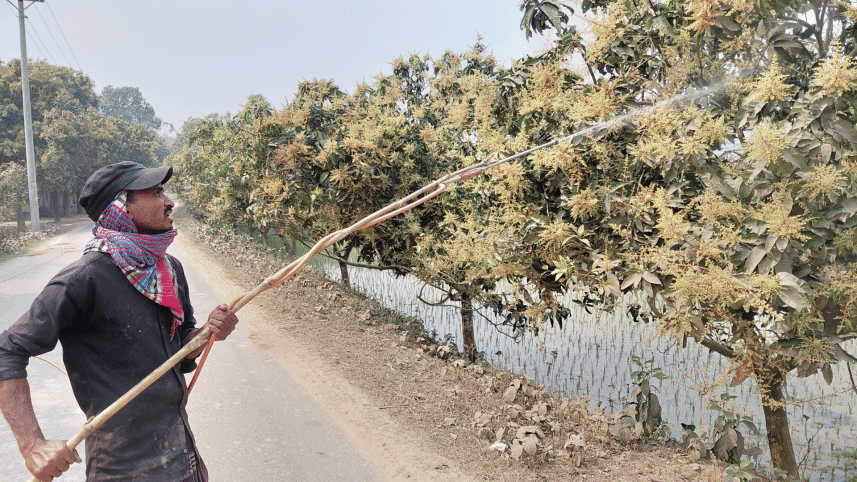
Meher Ali, who owns a Haribhanga mango orchard in Padaganj area of Mithapukur upazila in Rangpur, says the flowering on his trees this year appears better than usual.
“This year the budding is excellent, which indicates a bumper production,” he said.
 For all latest news, follow The Daily Star's Google News channel.
 Like many other growers in Rangpur region, he is now busy taking care of the trees and hoping for a good harvest.
Across the five districts of the Rangpur agricultural region -- Rangpur, Gaibandha, Kurigram, Lalmonirhat and Nilphamari -- mango trees are now laden with blossoms, raising hopes of high yields of the popular Haribhanga variety and better profits for farmers.
Farmers say mango trees, particularly the famous Haribhanga variety, have produced abundant buds this year, something they have not seen in the last six to seven years. Favourable weather conditions and timely flowering have further strengthened expectations of a good harvest.
Commercial cultivation of Haribhanga mango in Rangpur has expanded steadily over the past two decades, especially in Mithapukur, Badarganj and Pirganj upazilas. Many farmers now maintain orchards on five to 15 acres of land, while others cultivate the fruit on smaller plots of one to four acres.
Apart from commercial orchards, many rural households have planted 10 to 25 Haribhanga trees around their homes and rely on seasonal mango sales as a notable source of income.
Meher Ali said orchard owners are hopeful of earning net profits ranging from Tk 16-20 lakh after meeting cultivation costs.
“Now we are busy taking care of the mango trees during the flowering stage,” he added.
Mizanur Rahman, another orchard owner from the Matherhat area of Mithapukur, said he cultivated Haribhanga mango on 17 acres of land and earned about Tk 15 lakh in profit last year.
“If the weather remains favourable, I expect to earn around Tk 20 lakh this year,” he said.
Farmer Akbari Ali from Gopalpur village in the same upazila said the excellent growths in his orchard has made him optimistic.
“I have been earning good returns from mango cultivation for the last 18 years,” he said, adding that seven workers are currently employed to take care of the blossoming trees.
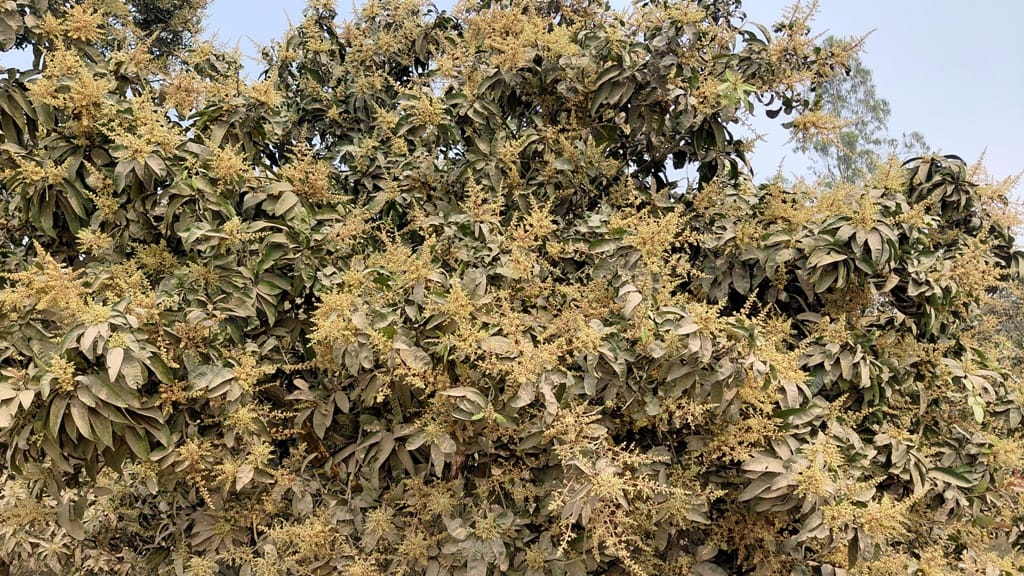
Officials of the Department of Agricultural Extension (DAE) say mango trees in orchards and homesteads started flowering on time this season with the arrival of spring. The trees are now covered with yellowish blossoms, presenting a promising outlook for production.
According to DAE estimates, about 7,500 hectares of land are expected to come under mango cultivation in the Rangpur region this season, including around 6,500 hectares for Haribhanga mango. Production is expected to exceed 95,000 tonnes.
“Enthusiastic farmers have already started intensive care of their blossoming mango trees and are expecting excellent yields and higher profits this season,” said Sirajul Islam, additional director of DAE for Rangpur region.
He said that around 90 percent of mango trees have already started blooming, and almost all of them -- about 95% -- should finish flowering by the first week of March.
Despite a relatively prolonged winter and foggy weather, flowering began on time this year and the current climate remains favourable for fruit setting, he added.
Sirajul said hundreds of farmers in the region have taken up commercial mango cultivation, especially the Haribhanga variety, after securing bumper harvests and good market prices in recent years.
Dr Abu Sayem, deputy director of the Burirhat Horticulture Centre under the DAE in Rangpur, said farmers in the region cultivate several mango varieties, including Haribhanga, Mohanbhog, BARI‑4, Gopalbhog, Langra, Fazlee, Khirsapati, Chyatapori, Lakhna, Gourmoti, Amrapali, and Nakfazlee.
Although different varieties are grown in the region, Haribhanga mango has gained special recognition after receiving Geographical Indication (GI) status and has become commercially prominent across the country.
“Haribhanga mango cultivation has improved the economic condition of hundreds of farming families in Rangpur,” he said, adding that the variety has strong demand both in domestic and export markets.
He advised farmers to take proper care of mango trees during the flowering stage and control pest attacks, particularly grasshoppers and other insects that damage blossoms.
“If temperature variations, rainfall and pest attacks remain within tolerable limits in the coming months, a bumper harvest of quality mangoes is expected this season,” he added.
Comments