


Govt to compile list of extortionists, starting in Dhaka: Home minister
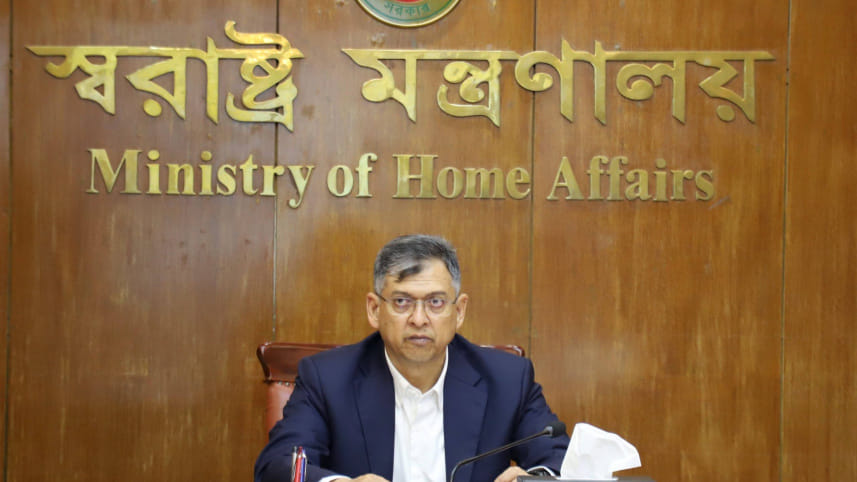
Home Minister Salahuddin Ahmed today said the government will soon start compiling a list of extortionists, beginning in Dhaka, and take steps to bring them under the law.
While briefing reporters after visiting the Dhaka Metropolitan Police (DMP) headquarters, he said he spoke with senior police officers as well as officials from 50 police stations in this regard.
 For all latest news, follow The Daily Star's Google News channel.
 Salahuddin said improving the law-and-order situation, restoring public confidence, and establishing the rule of law are the government’s top priorities, and that the police have a key role to play.
Referring to the previous period, he said the police, like other institutions, were harmed under what he described as a “fascist” system, and that the government wants to rebuild public trust so that people see police as their friend.
He said he found police officials “determined” and ready to make sacrifices for the country, adding that wrongdoings committed by “some people” under a “fascist regime” had brought blame on the institution as a whole.
Salahuddin said the government wants an institutional system where everyone works within rules and responsibilities, so that no personality-driven system develops.
“There will be no personal, authoritarian orders carried out,” he said, adding that police will act according to law and senior officials will run the department with responsibility and accountability.
The home minister said he discussed departmental problems with police, including manpower and equipment issues, and asked what could be done to address them.
Asked whether an officer-in-charge (OC) could directly contact the home minister, Salahuddin said the government has not allowed breaking the chain of command.
He said the chain of command must be established and maintained so that lower-level officials do not bypass their superiors to contact higher authorities directly.
However, he said a minister may contact any level if necessary, and that the police commissioner or inspector general of police may communicate at any level depending on operational needs, while the chain of command remains intact.
Salahuddin also dismissed comparisons with the previous government, saying the country now has a democratic administration formed through what he described as a “fair, neutral, acceptable, and world-recognized” election.
On Dhaka’s traffic congestion and the growing number of vehicles, Salahuddin said a cell has been formed, and the DMP commissioner has been asked to sit with the traffic department to prepare recommendations.
He said the commissioner will submit a report within one week on how traffic congestion can be eased.
Salahuddin pointed to the “limitless” number of battery-run rickshaws and said many are operating even on VIP and major roads where non-motorised vehicles are not supposed to run.
He said the government has decided to begin a pilot initiative to restrict and regulate such movement in phases, starting from Uttara to Airport Road, then along the route through the VIP road and Secretariat.
He said similar measures would be extended gradually to other routes.
Salahuddin also urged citizens to follow traffic rules, saying people often do not obey signals, block lanes meant to remain open, and contribute to congestion.
He said the government wants to rebuild awareness so that people follow lanes and cooperate with traffic police, which he said would help solve the problem to a significant extent.
Asked about the harassment of journalists, Salahuddin said the issue was not discussed at the DMP headquarters, but added that it should be followed as a general principle.
On a question about the Hadi murder, including claims that two accused are still in India and steps to bring them back, Salahuddin said he would not comment in detail while the investigation continues. Asked about changing police uniforms, Salahuddin said the decision will be finalized later after discussions with the police department, adding that changing uniforms does not automatically change mindsets.
Comments