


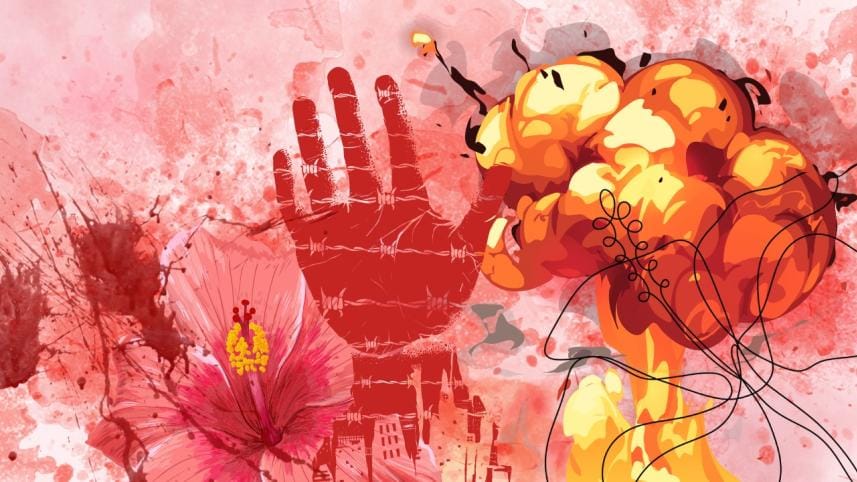
The colour of red hibiscus
The Polish nurse at the rehabilitation center asks her to decide. Does Neela want to have an abortion or wait for the delivery? "You're almost seven months," the nurse says in English. "An abortion would be very risky."
Neela learns that she doesn't need to worry about the newborn. Some foreign organisations are working to take these babies to Europe or Canada where they will be adopted by nice families.
 For all latest news, follow The Daily Star's Google News channel.
 She is given two days to think.
In the shower room Neela asks the ayah to cut off her lice-infested hair.
"Don't worry, child," the old woman says. "I will shampoo it every day and within a week your hair will look lovely again."
The ayah inquires about her family. Family? How would Neela know if they are alive or dead? The rehab office will write them a letter if she provides the address, the ayah tells her.
"What month is it now?" Neela asks. "December?"
It has been nine months away from home.
That night, as Neela strokes her swollen belly, she thinks about her last afternoon with Zahed; she make-believes that the little being inside her is the fruit of their love. That afternoon, weeks before the war broke out, they were walking along the dighi pond. Zahed told her they would get married the following year. An intern at Rajshahi Medical College, he was going to become a full-fledged doctor soon. Neela herself would go to college.
"Neela, say something," Zahed said, brushing the beads of perspiration off her upper lip.
She blushed, couldn't look into his eyes.
"You don't like the groom?"
Her cheeks dimpled with a tight, shy smile.
"Why are you smiling?"
"We'll have two kids," she said. "One boy, one girl."
Zahed shook with laughter. "We're not married yet, and you're thinking about kids!"
**
On the night of Neela's 16th birthday, March 25, 1971, the Pakistani army began a crackdown in the major cities across East Pakistan. Three days later when her family was packing the necessary items to depart for their ancestral village, a jeep stopped in front of their home in Rajshahi. Her father, a homeopathic doctor, thought he had a visitor, but it was the city councillor, flanked by a pair of men. "Doctor shaheb," the councillor said to him. "Neela knows English. She is needed to do some interpreting for the military."
Before her father could respond, the two men grabbed her hands and dragged her toward the jeep. She heard her mother screaming, and saw another man kicking her father to the ground.
The jeep raced down the empty streets, then pulled into the forecourt of a mansion, next to several parked military vehicles. The councillor said something to an armed soldier in Urdu. The soldier escorted Neela through a passageway and deposited her into a small room. The door slammed shut behind her.
She banged on the door. "Let me out!"
The door flew open, and the soldier set the muzzle of his rifle against her head. "Another sound," he said, "and I'll blow your brains out!"
Neela stood by the window, sobbing, and watching the last gold light of the day. Her father, she thought, might be out now in search of her. If news reached Zahed, he would find a way to get her out of here.
Long after dark, she was lying in bed. Her eyes flickered with the sound of the door opening. A fat officer with lots of badges on his uniform walked in. She huddled under the coverlet.
The officer fired up his pipe and regarded her. "You're such a beautiful girl," he said. "Take off your clothes."
A week or so later, she was transported to a shabby camp. No single cell this time, but a hall-like space where 15 girls and women from mid-teens to over 40 were crammed into the room. The smell of unwashed bodies and a suffocating odour from the bathroom filled the air. Windows were shuttered with nails. A dim light bulb was hanging from the middle of the ceiling.
One night some drunken soldiers barged in and raped a Hindu girl in front of all of them. Eyes shut, Neela covered her ears to avoid hearing the cries. The following morning, the Hindu girl was found hanging from the bathroom window. She'd used her salwar as a noose.
Once the dead body was removed, two soldiers came and confiscated whatever the girls were wearing, beating and stripping them all naked. They laughed and said, "That's how you will live now, you bloody Bengali whores." For a long while Neela could not look at the others.
Three days unclothed, and then petticoats and blouses—clothes too scant to tie a noose—are thrown into the room. And an order came not to close the lavatory door under any circumstances.
Neela, like other girls, scratched her tangled hair and clammy skin all the time. They had showers once a month, twice if lucky. No one spoke; they whispered. Sometimes even the hushed voices angered the guards outside the door.
Months later Neela and four other girls were brought to another camp. There, the old woman who brought their food talked in a low tone. Neela learned that they were in the city of Bogra, and it was September. That night they heard gunfire. "Bengalis are fighting," the old woman told them over breakfast.
Some nights the military men did not come at all. "The bastards are scared now," said a tall woman. "The Bengali guerillas are winning." She said that her husband was an army captain. A week before the Massacre of March 25, her husband, along with many other Bengali officers stationed at Dhaka Cantonment, was transferred to Rawalpindi. After he disappeared from there, she was taken into a camp last August.
"Where is he now?" Neela asked.
"He fled West Pakistan to join the war," the tall woman said.
Late one night, amidst the sound of heavy gunfire, Neela and three other girls were moved to a bunker. As days passed, food became scarce. Some days they had only water.
One day a soldier who was fond of her told her that things would be over soon. "We've decided to surrender," he said. "We are waiting for the Indian allied forces to come and take us as prisoners. Just like you girls."
The day the allied forces arrived the soldiers left the bunker with their hands up in the air. Neela hollered from their chamber saying that they were barely dressed and they needed some clothes. Later, in an army jeep, she remained silent when an officer asked her about home.
"We can arrange transportation to get you girls home," he said.
Neela clutched her stomach. "I have no home."
"A rehabilitation center has been opened in Dhaka," he said. "We will send you there."
Her father arrives in late January. Neela throws herself on him and hides her face in his chest, soaking the front of her father's shirt. Then she explodes with questions. How is mother? The younger brother? The cousins? Father answers in pauses, naming relatives, friends, and neighbours—who didn't survive. And he speaks the name she is waiting to hear. Zahed is fine, back in his medical internship.
Father opens a paper bag of fruit. He peels a tangerine and hands her the wedges.
"You need to eat more," he says. "You've grown so thin."
"And you've grown so old over these months."
Father attempts a tiny smile. Then his eyes brim with tears. "I am sorry, I am so sorry," his voice choked. "I couldn't save you, Neela."
She holds him tight, says, "It's not your fault, Baba."
"The councillor," he says, "the bloody rajakar was butchered by the freedom fighters. His flesh was thrown to dogs. But the dogs didn't even touch it."
Neela sits holding his hand a long time. He sighs and strokes her back.
Father gives her a little money and leaves before it gets dark, assuring her he will come back the following month. At his departure, Neela doesn't cry. She cries later in the darkness. He didn't ask her to go along with him.
The girl in the next bed who went through a difficult abortion says, "At least your family is in touch with you. My husband called me a whore and remarried."
**
Instead of visiting her the next month, Father writes a letter to Neela. Back home, he says, his hands are full right now. Their damaged house and his gutted office in the market are being repaired. He is struggling to obtain many common homeopathic supplies. A line toward the end of the letter says that her mother weeps for her day and night. They are both planning to visit her in Dhaka.
Neela begins to lose sleep. She has frequent nightmares in which strange hands try to pull out her baby. She whispers to it, "You're mine, mine. I'm here to protect you."
"All the babies born of us must be sent abroad," says the girl in the next bed.
"But I want to keep it," says Neela. "It's mine!"
"They won't let you."
"The president called us war heroines, didn't he?"
"And it's him who doesn't want any polluted blood in the new country."
Neela hardly eats her dinner. In bed, she twists and turns through the night, her sari damp from perspiration. The moment she closes her eyes she sees blood—her body is surrounded by puddles of blood. It's a sign, she tells herself. That she will die giving birth. She shivers at the thought that her orphaned child will be floating around in a foreign land without care.
Before daylight breaks, Neela slips out of the rehab centre. Walking along the Dhanmondi Lake for a while, she finds a rickshaw. "Take me to the Kamlapur railway station," she says to the driver.
**
The sun is going down when Neela gets off the train. She notices the battered face of her hometown. The restaurant outside the station is gone. Mounds of garbage and piles of broken bricks in that place. At the edge of a ditch standing up is a skinny date tree with its damaged crown. The old bridge that connected two villages to the bazaar is in ruins. She takes a rickshaw home.
One part of the double door gate is missing. As she approaches with trembling feet, she can smell the fragrance of night jasmine by her room window. Father and her little brother are in the front room. Mother is in the outdoor kitchen. Neela trips lightly toward her.
"Ma!"
A bowl drops from Mother's hand. The next moment she is on her feet and Neela is in her embrace. After some minutes Mother recovers herself enough to look at her swelling. She cocks her head and shades her face with the end of her sari.
Neela hears her muffled cries. She touches the back of her shoulder. "Ma! Aren't you happy to see me?"
"You shouldn't have come here," she says.
By then Father is before them, says, "Neela! You!"
"Didn't you tell her not to come here?" Mother says to him. Then to Neela: "The neighbors will ostracise us. Your father will have no visitors."
"Ah, stop it," says Father. "She must be hungry."
Neela stands paralysed, her mouth dry. She feels everything spinning around her.
At dinner, Mother serves her rice and fish curry. Neela plays with the food but doesn't eat. Silent tears trickle down her cheeks, falling and pooling over the rice.
"Eat," says Mother. "What happened, happened."
Lying in her bed, Neela hears whispering in the other room. Father and Mother are talking. Her back aches as she breathes, and she feels a severe tightening in her groin. She rubs her hand over her belly. She inhales the scent of night jasmine and reflects on the old days. A happy family. Her school and study. Her time with Zahed and their proposed marriage.
Father enters her room a little before dawn. Releasing a long sigh, he says, "Your mother and I think it's best if you go back to the rehab centre. Your labour will begin any day." He pauses, scratches the nape of his neck. "You'd better catch the morning train."
Father puts some folded bills at the edge of her bed. He waits. "Forgive me, Neela. It's for the best, for all of us."
**
Under the fierce sun Neela plods on until she reaches the gate of Rajshahi Medical College. Her face is half-covered by the hem of her sari. Her mouth is parched, and she gasps for air. She has been grappling with a regular urge to empty her bladder. "I'm fine," she comforts herself, and drags her feet to the nurses' station. Do they know the intern doctor Zahed? Neela is told to go to a different building where she might find him.
She is climbing up the stairs when she hears his voice. Zahed is coming down along with a girl. They are both in white coats and are laughing. Neela halts and her heart pounds. He wears a mustache now. He almost brushes past her. She fails to utter his name. She trails behind them with heavy steps to the end of a long corridor, then opens her mouth.
"Zahed!"
The two figures stop abruptly and look behind. Zahed squints and takes a moment to recognise her. His surprised face turns pale and he stammers, "Neela! You!" To the girl beside him he says, "She is from my town. You go ahead. I will catch up with you."
The girl leaves them.
Zahed regards her with open mouth, then says, "You are alive! How are you?"
Her lips shiver as she replies. "You can see how I am."
His eyes look teary. "I tried Neela. After your father informed me, I went to the military camp—"
"None of that matters now."
They stand silent.
"Listen," she says. "I need your help."
Zahed stares at her belly and nods. "I'll arrange everything." Then, "You look so thin and drawn. Come, come with me. You must be exhausted."
He guides her to a nurse station and speaks to a nurse. "You wait here," he says to Neela. "I have some work to do. I'll be back in an hour and a half."
A little later an ayah brings her a cup of tea, biscuits and water.
**
After lunch at the hospital canteen, Zahed takes her outside into the garden. They sit on a bench.
"I've fixed everything," he says. "A bed will be available later this afternoon." He touches her hand. "Don't worry. I am with you. You'll be okay."
She looks at him. "I want to keep the baby."
His face hardens. "Are you not here to abort it?"
"I want to deliver it."
"Have you lost your mind?" he hisses.
She meets his gaze. "It's my child."
Zahed stands and rubs the nape of his neck. "Look, Neela. I know you went through a lot. To me, you are no less than a freedom fighter. You equally fought for this land." He pauses and recounts to her that during the war, in April, he fled to India with his family and only returned after Bangladesh's independence. Since his father didn't allow him to join the Liberation War, he worked in the camp hospitals set up for injured muktijuddahs on the Indian borders. "Neela, let me tell you one thing." He looks into her eyes. "I am happy to marry you. But you know my father. He will abandon me. I don't care. We have to move to Dhaka where no one will know about our pasts. I have no demands. Just get rid of this poisoned seed."
Neela beams, then lowers her head. She bites her quivering lip. For a long moment, she cries. Zahed sits and wraps his arm around her shoulder.
**
Neela reclines on a bed in the maternity ward while Zahed is at his duties. All around her are the faces of women of different ages on rows of white beds in rows. She watches a girl in the corner bed suckling her newborn. The girl is almost her age. As Neela smiles to herself a tear rolls down her cheek.
The call for evening prayer comes from the mosque. The crowded ward falls silent, and only the dusk chorus of birds dominates. Neela gasps for a breath. A sharp pain seizes her lower back. She gets off her bed and tiptoes out of the ward.
When she is in the street, the last light of the day is fading. She is sweating all over. She puts her hand over her mouth, rushes to a tree and vomits. Darkness deepens around her.
**
Legs apart, panting, she sits with her back against a bench. It is the classroom of a primary school, which she has entered through a smashed wall. Beside her on the floor are two snails that she picked up on her way here. She will need them, she knows, to cut the umbilical cord. As the night grows longer, she feels her groin is loosening. "Ma, Ma," she moans in pain, and digs her fingers into the dirt floor, her teeth pressed tight together. "I can do it," she tells herself. She saw the midwife do it once.
She says a prayer and removes her clothes.
**
She senses she is drenched in blood and the child is crying. It's a boy. She touches his face. The crying wanes as she fingers his nose, lips. "Ah, you want milk," she says. She carefully takes the baby in her frail hands and places his mouth onto her breast. The baby starts sucking and she sighs with pleasure. In the light of moonbeams streaming through the broken windows, she notes that the baby has her nose and the color of her skin. "You are mine, mine," she says. "I will protect you."
The baby falls asleep with the nipple in its tiny mouth. Neela kisses him, sniffs his soft skin.
Her bleeding doesn't stop. She feels she is drowning. Right after the call of the dawn prayer, she suckles the baby for a third time and wraps it with her petticoat. She gets on her feet and sets off.
She walks along the stream, cradling the baby. Near a ghat she sees a canoe tied to a houseboat. She scans the place. No one around. She totters down the ghat and steps into the water. As she tries to place the swaddled baby on the deck of the canoe, it clenches the seam of her blouse seam. She hears human voices in the distance. Her face twitches and her eyes well up; a salty stream runs down her nose. She unclenches the baby's fist, kisses him, and whispers, "Someone will adopt you." She unties the canoe and pushes it toward the tide.
When the canoe is mid-stream, Neela notices the water around her has turned into the colour of red hibiscus. She eyes the canoe gliding slowly away. The baby starts crying. She trudges up the ghat and follows the canoe along the stream. She stops when she makes out some voices around the corner. She scrambles down through the bush.
There is no crying from the baby anymore. No human voices around. She is in an open field now, sprawled on her back. Her vision is blurred by the sunlight, and she no longer feels the weight of her body.
This story was originally published in Prairie Schooner, Vol. 95, No. 4 (WINTER 2021).
Rahad Abir's debut novel Bengal Hound won the Georgia Author of the Year Award for literary fiction. He is the recipient of the Charles Pick Fellowship at the University of East Anglia and the Marguerite McGlinn Prize for Fiction.
Comments