


Little Grey - Part 2

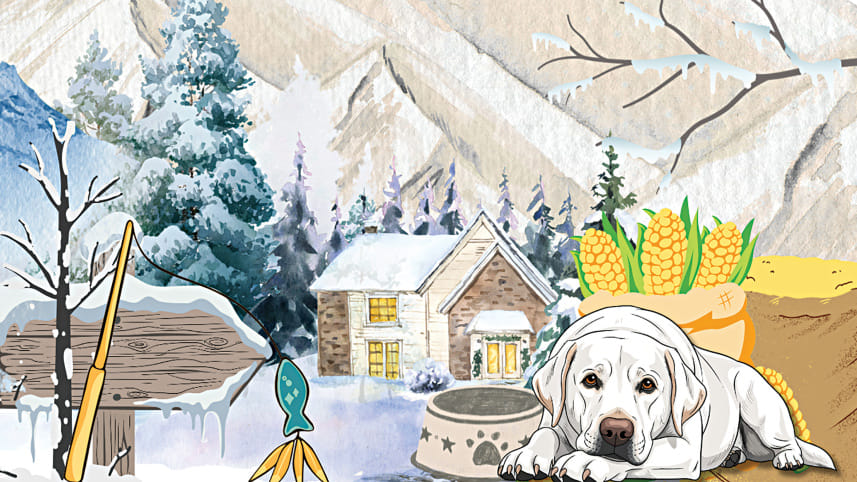
As evening sets in and the stars begin to appear in the dark sky above the village, a sharp series of pops and bangs pierces through Xiaohui’s peace. It is the sound of firecrackers lit by the neighbourhood’s children, which invariably plunges Xiaohui into a raw, all-consuming terror. As the Spring Festival draws closer, these terrifying episodes are becoming more frequent. They usually end as abruptly as they begin and rarely last longer than a minute or two. This evening is no different. After the last pop and the last bang, a smell of burnt sulphur lingers in the air for some time, eventually giving way to the smell of the fire burning in a small oven in the house. The whole family is sitting around the oven with their guests. The father is keeping the fire alive by feeding it corncobs, one after another, as they burn more quickly than wood. Corn is woven into nearly every aspect of daily life in this household, and it would only be logical for grilled corn or popcorn to be the snack of choice. Yet, it is sunflower seeds that keep their hands busy as they talk, and there is always much to talk about in a village. The hulls are falling to the floor in a constant drizzle until late at night, setting a task for the next morning.
Xiaohui has lain down to rest. He enjoys gazing into the sky at night. For a brief moment, he lifts his head. Did he hear them say his name? He misheard. They are talking about Xiaohei in English, “little black.” Xiaohei lived with his grandfather. Both passed away years ago. Xiaohei had black fur and was well-liked by everybody who knew him. He never bit anybody, and his good character as well as his cleverness are the stuff of many stories that are still being told today. He lived a long and healthy life. When he passed away, he was roughly ninety in human years. It is no coincidence that Xiaohui’s name sounds similar to that of Xiaohei. Xiaohui was given his name not only because it describes him well, but also as a way to commemorate Xiaohei, and in the hope that Xiaohui would also be good and have a long life. Only someone looking to offend would have named him after the grandfather or some other revered relative instead. In China, a person is a person, and an animal is an animal. For the grandfather, naturally, a different form of commemoration was chosen. As is traditional Chinese custom, a shrine was built inside the house. It includes incense and candles, and a large photograph of him in his later years, sitting in one of the fields the family has farmed for generations. During the Spring Festival, food and other offerings will be placed at the shrine, and mothers will bring new candles from a nearby temple. For all latest news, follow The Daily Star's Google News channel.
The story of Xiaohei was one of many stories that were conveyed to the guests around the nightly fires. Another story painted a vivid picture of the village’s remarkable transformation from humble mud houses to modern homes with solar panels on their roofs, electric cars parked outside their doorsteps, and all the conveniences of contemporary life–all achieved within the span of a single generation. Local wedding customs, funeral rites, food, the seasons, and the advantages of the Chinese way of life over western decadence were discussed as well, but no topic seemed to captivate the guest as much as Xiaohei’s life, and by extension Xiaohui’s. He appeared taken aback by the amount of thought that was evidently put into choosing Xiaohui’s name, and the care it reflects. It reminded him of the love and attention one might give to a family member, making it difficult for him to reconcile that affection with the seemingly stark reality of Xiaohui’s existence.
It is not long before, one sunny morning, the guest leaves through the gate, never to return. Xiaohui is sitting upright, breathing the crisp morning air as the sun gently warms his fur. Quietly, he watches the guest’s steps. The gate closes and, for a little while, everything is back to how it always was. Eventually, the Spring Festival arrives and the kitchen goes into a frenzied overdrive. A steady stream of neighbours and relatives from near and far needs to be fed. Each morning the mother uses a broom to gather the scattered sunflower hulls into a growing mound. The mound is a temporary testament to the conversations of previous nights, waiting to share the corncobs’ destiny. Xiaohui cherishes and resents this time of year in equal measure. The many strangers walking in and out the gate mean more work and little rest, and the firecrackers may well give him a heart attack one day. But he is handsomely compensated by an abundance of left-over food from the kitchen. He has never been a fussy eater and will eat almost anything, happily.
It is a quiet afternoon and the festivities are nearing their end when the father drives the family’s electric car through the gate. He had gone to a neighbouring town to pick up a delivery from Taobao, China’s Amazon, which literally means “search for treasure.” This particular treasure arrived in a cardboard box so large that the back seats had to be folded down to make space for it. The daughters help to unload the box from the trunk. They put the back seats back up, and the father parks the car next to the front door, its usual spot. The treasure chest made of cardboard contains thick plastic panels that are quickly assembled into a small house. The father is visibly amused by this strange idea of a gift, but not surprised, as strange ideas are expected from outsiders–and hospitality requires that one indulges one’s guests, within reason. The house is located in Xiaohui’s corner. Xiaohui eyes the foreign structure with suspicion. He does not trust it.
Days go by. Every now and then, one sister or the other appears at one of the windows facing the courtyard, checking to see if Xiaohui has gone inside his new house. But each time they look, they find the little house empty, Xiaohui still sitting or lying on the concrete floor. The older sister is particularly invested, which does not go unnoticed by the father. “I could have told you that he won’t go inside,” he says in a variety of Mandarin commonly spoken in Yunnan. Mandarin is a Chinese language, but not all Chinese is Mandarin. Chinese, in fact, is not the name of a language at all. It refers to a group of languages, many as different from one another as Spanish and Italian, that are spoken natively by the ethnic Han Chinese majority. The father is part of one of China’s ethnic minority groups, the Yi, and so is the mother, yet unlike the mother and many other Yi people, he does not speak the Yi language. Why that remains a forgotten chapter of family history. “Xiaohui just needs some time,” the sister counters her father. Surely, he must prefer warmth and shelter.
As temperatures drop and snow is expected soon, the older sister decides to take a more active approach. She lines the floor of the small house with a warm blanket and places some food inside. Xiaohui sniffs around the entrance, lingers for a little while, and then retreats back to a spot on the concrete floor near the stored corn. For a brief moment, it looked like he might go inside. He hesitantly extended his head towards the entrance. His nose was twitching as it caught the enticing scent of food, and he imagined what it would feel like if he were to place his fur on the blanket. But the courage to step over the threshold eluded him, and he quickly withdrew. Some neighbours chuckle at the sister’s persistence, while others offer advice. Maybe it is the house’s orientation that makes the structure unattractive to Xiaohui. The entrance faces the corn rather than the gate and the courtyard, and someone named after the late Xiaohei surely cannot be expected to abandon his sacred duty. Sometimes, unsolicited advice is still good advice, so the house is reoriented. But Xiaohui remains unmoved.
Late in the afternoon of the next day, the snow sets in as predicted. The sisters are back at the window which offers the best view of Xiaohui’s corner, expecting him to finally seek shelter. Instead, Xiaohui curls up in a little space under the wooden slats on which the bags of corn are stored to keep them off the ground. Though corn is not very effective at storing heat, it offers some protection from the snow and helps fend off the wind. “If he doesn’t want it, he doesn’t want it,” remarks the grandmother, who is over for afternoon tea, as she often is. “Look at me. How often have your parents offered me to move in with them? Their house has air conditioning for the summer, heating for the winter, warm water in the showers, and a big couch in front of a big TV. And where am I? In my old little place down the street with none of this modern comfort, where I’ve always been, sitting in front of my old wood stove, listening to old Chinese songs on the radio. I’m used to it.” As the snow slowly covers the empty little house in white, Xiaohui remains nestled beneath the wooden slats, surrounded by the familiar scent of corn and the voices coming from the fireplace. Though the family’s love for him is not expressed in grand gestures, he feels its warmth.
Days go by, then weeks. The snow has long melted away and the sun is back, warming Xiaohui’s fur. The little house remains untouched, until it is eventually moved away. Xiaohui has come to resent it, and he is relieved it is gone–a stubborn storm cloud has moved on at last. Life continues as before. Xiaohui stretches, yawns, and reclaims the spot on the concrete previously occupied by the house. He perks up when people pass, watches the sky at night, sits in the rain, seeks shelter below the corn when the rain gets too cold, or turns into snow, attentively listens to distant conversations he does not understand, and gets excited whenever there is activity in the kitchen, hoping for his next meal. Though his days are back to their old rhythm, a quiet weariness settles into his bones. Xiaohui is tired.
This is the second of two parts of the short story “Little Grey.”
Dr Rainer Ebert holds a PhD in philosophy from Rice University in Texas and is a research fellow in the Department of Philosophy, Practical and Systematic Theology at the University of South Africa. He has been visiting Bangladesh regularly for years. Reach him at rainerebert.com and on X @rainer_ebert.
Comments