


Ekushey in the Mirror of Azad

Mother Language Movement is the awakening period of Bengali nationalism. It was the first collective protest against Pakistani exploitation and deprivation. Through the pathway of this movement, Bengalis achieved the dreamland of a thousand years – Bangladesh. Without any doubt The Language Movement is a unique event in the political history of Bangladesh. It was reflected everywhere. In history, politics, art, culture, literature - we can find the language movement. Newspapers are not the exception. When we talk about newspapers in 1952, The Azad comes to the forefront of discussion.
The Azad is a special name in the history of Bangla and Bangladeshi newspapers. It is impossible to write the history of Bangladesh without mentioning the name of this newspaper. The newspaper was first published in October 1936 from Kolkata. Initially, The Azad was a hardcore supporter of the Muslim League and the Pakistan Movement. This newspaper was once considered the mouthpiece of the Muslims of Bengal and Assam. Its founding editor was Maulana Mohammad Akram Khan (1868-1968). The newspaper is better known as Akram Khan's The Azad.
Maulana Akram Khan himself was an active Muslim League leader and Islamic scholar. He was the president of the provincial Muslim League from 1941-1951. Normally, The Azad used to be published in eight pages. After the partition of 1947, The Azad shifted from Kolkata to Dhaka. The last issue of the newspaper was published from Kolkata on October 12, 1948. Then the office of the newspaper was established by leasing a plot next to Dhakeshwari Road in Dhaka near the Dhakeshwari temple. From there, the newspaper began to be published regularly.
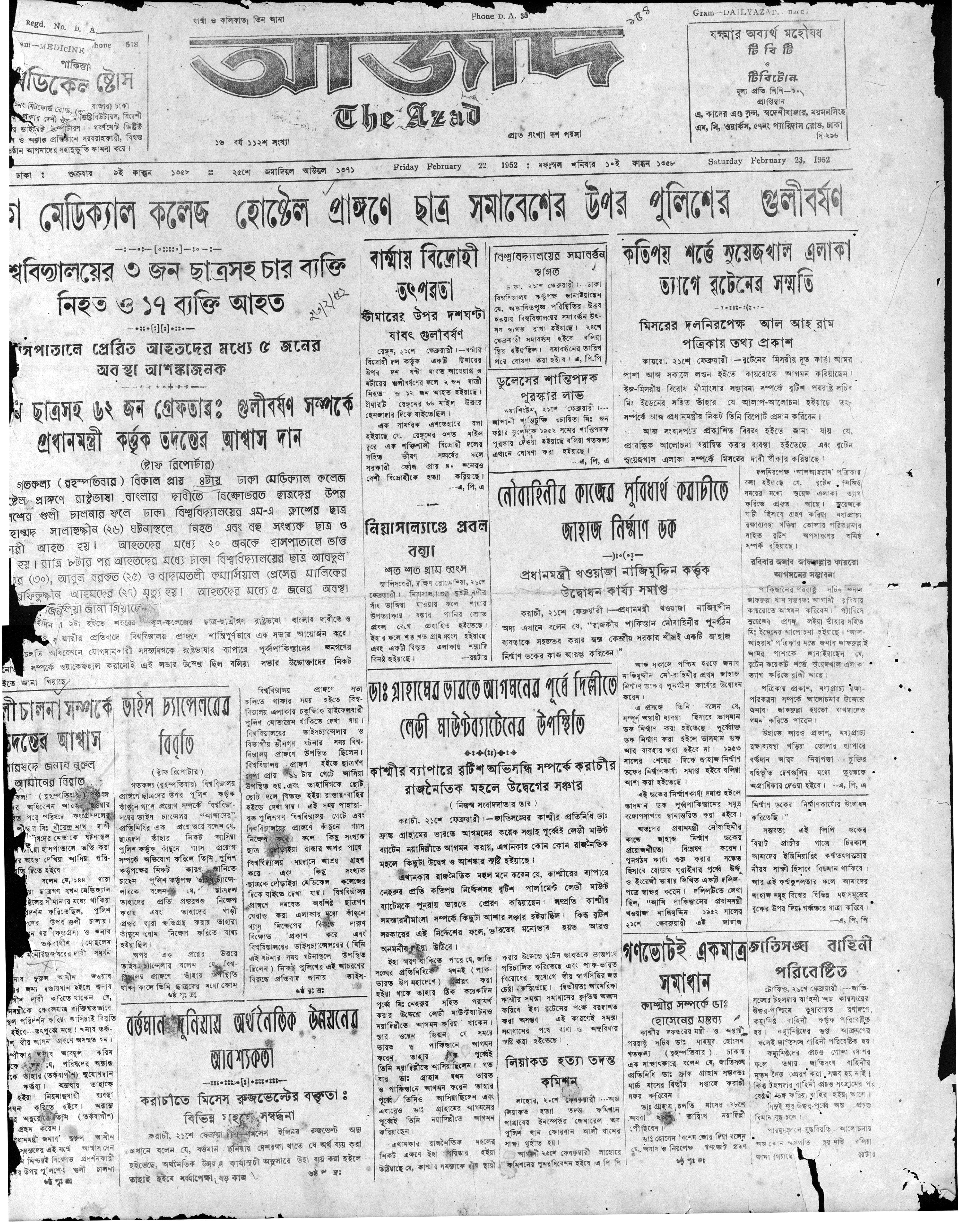
At that time, Azad was the main newspaper of East Pakistan. In the Dhaka chapter of this newspaper Abul Kalam Shamsuddin (1897-1978) was the all in all of its publication. He was one of the known faces in politics too. The Azad came under huge pressure by the then Pakistani government on its stance on various issues. The main and most important of which was the 1952 Mother Language Movement. The Azad published a Telegram on the killing of students by police firing on 21st February 1952. After that, in next few days, The Azad published news on killing of students with great courage and journalistic responsibility.
21 February 1952: Section 144 imposed
February 21, 1952 was a turning point in the political history of Bangladesh. This most significant day was reflected in the newspapers of February 21. On that day, The Azad published a news item in the second column of the front page titled – ‘Section 144 imposed in Dhaka’. The sub-head of this news item was `Processions banned for one month`. This news item narrated that the District Magistrate of Dhaka imposed Section 144 and banned meetings and processions in the city for one month.
Citing the order issued on Wednesday, February 20, the news item further wrote, As the reason for issuing the order, he [District Magistrate] said that a group of people were trying to hold meetings, processions and demonstrations in the city and there was a fear that this would disrupt the peace and security of the people. (The Azad, February 21, 1952)
21 February afternoon: The Azad’s historic Telegram
In journalism, a Telegram means a special issue of a newspaper in a serious circumstance, which is usually published in the afternoon and evening. After the firing on the students protest for the right of the mother language on the afternoon of 21 February, The Azad published that brave Telegram. As mentioned earlier, Azad was the mouthpiece of the Muslim League and pro-government publication even then, The Azad played an exceptionally brave role in special situations. It published a Telegram titled - Dhaka's streets are stained with fresh blood of students. The copies of this historic Telegram were confiscated by Nurul Amin's government.
February 22, 1952: Vivid account of Language Movement
On February 22, The Azad published the news of the student shooting in an eight-column banner headline. The main headline throughout the newspaper was - Police opened fire on student gathering on Dhaka Medical College premises. The sub-head was - Four people including 3 university students killed and 17 people injured.
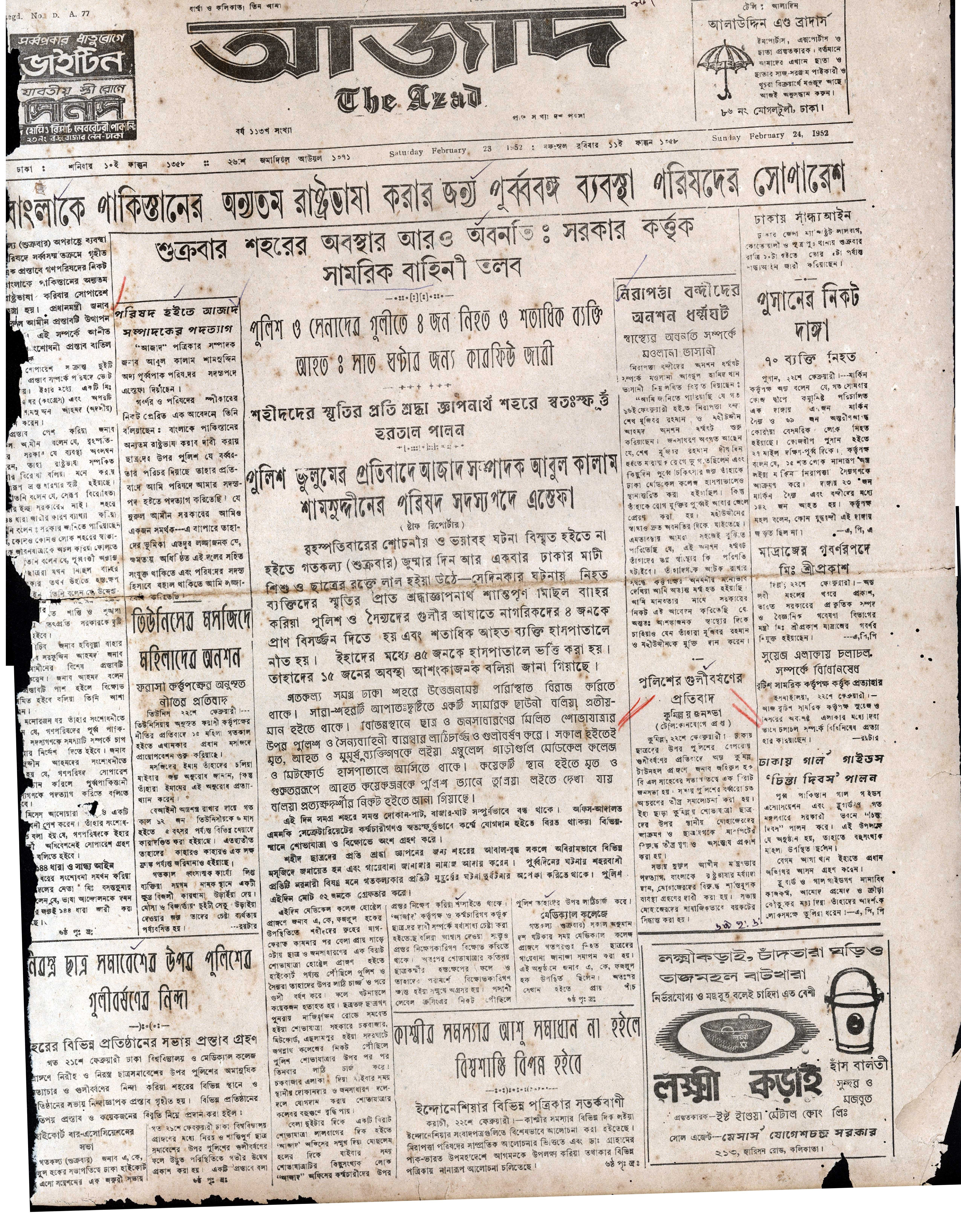
The detailed part of this news says - Yesterday (Thursday at 4 pm) as a result of police firing on students protesting for the state language Bangla in the Dhaka Medical College premises, Mohammad Salhuddin (26) [real name would be Rafiq Uddin Ahmed. At that time, the name of the first martyr was mistakenly printed as Mohammad Salhuddin], an MA student of Dhaka University, was killed on the spot and a large number of students and protesters were injured. 20 of the injured were admitted to the hospital. After 8 pm, among the injured, Abdul Jabbar (30), Abul Barkat (25) and Rafiq Uddin Ahmed (27), son of the owner of Badamtali Commercial Press, all died. The condition of 5 of the injured is said to be critical. (The Azad, 22 February, 1952)
More details of this lead news are as follows - On this day, from 9 am, the students of the city's schools and colleges peacefully organized a meeting in the university premises demanding Bengali as the state language and protesting the imposition of Section 144. The organizers of the meeting said that the purpose of this meeting was to make the members attending the current session of the Parishad [state assembly] aware of the attitude of the people of East Pakistan regarding the state language. (The Azad, 22 February, 1952)
The news further states that- While the meeting was going on in the university premises, police with rifles were seen deployed all around the university campus. The vice chancellor of the university and the departmental Deans were present in the university at the time of the incident. The students from the university premises came to the gate at 11 am and were seen coming out on the road in small groups. At that time, the police on guard fired tear gas at the university gate and in the university premises. As a result, some students ran and took shelter in the ground on the other side of the road and some students were seen running towards the medical college. The remaining students gathered in the university premises protested loudly against the firing of tear gas in the cordoned area and protested against this behavior of the police to the Vice Chancellor of the university (who was present at the scene at the time of the incident). (The Azad, 22 February, 1952)
The main news story was about the police firing on the Dhaka Medical College hostel and the martyrdom of Rafiq Uddin in front of shed number 12. In addition, this main news story focused on the reaction of city residents and students. City dwellers were rushing towards the Medical College after the news of the student's murder spread on 21st February 1952. According to The Azad, the February 21 student murder incident spread tension throughout the city. Then the army was deployed in the key points of the Dhaka City, including Parishad Bhaban [state assembly].
The Azad Editorial: We want investigation
It has been mentioned earlier that The Azad's editor Abul Kalam Shamsuddin was a renowned editor, politician and then member of the state parliament. He resigned from his post in protest against the police shooting of students. The Azad also published a news report about it on the front page on February 23, 1952. The headline was - Azad editor's resignation from the Parishad. Meanwhile, on February 22, The Azad published a strong editorial. The headline was - We want Investigation.
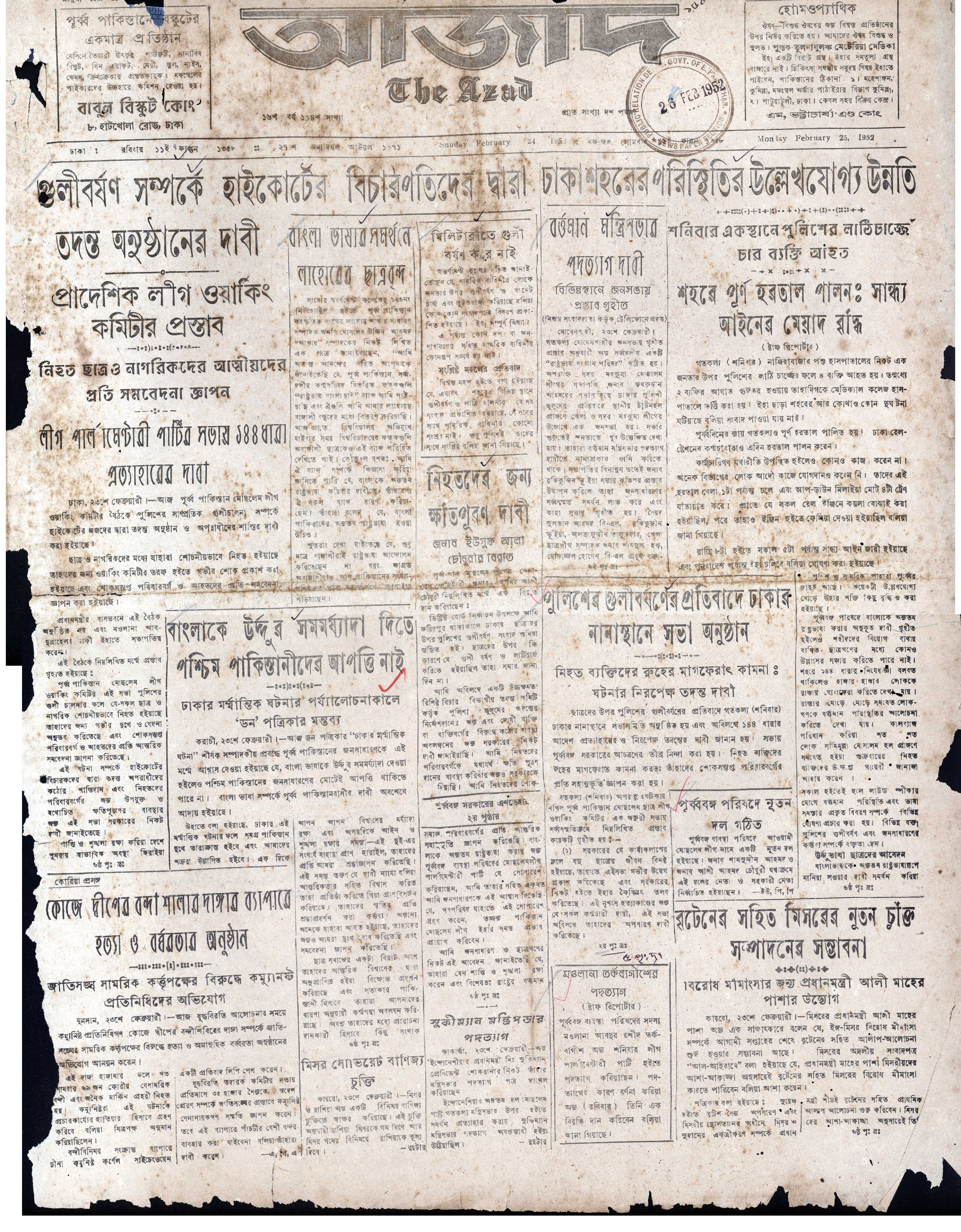
This editorial, written in quite strong language, stated - The deplorable accident that took place near the university and medical college in the heart of Dhaka yesterday is as heartbreaking as it is undesirable. Disobedience to the law, breaking the rules, disorder are not acceptable, but it is also true that no democratic government should create an environment for disobedience to the law.
A review of the events of the past two days shows that almost 15 days back the student organizations had announced a decision to observe a strike in support of the demand to make Bengali the state language. The day before yesterday, the local authorities suddenly imposed Section 144 and closed down the procession and meeting association. The students have been protesting over this issue, tear gas and bullets have been fired, and some have been injured. (Shortened) (The Azad Editorial 22nd February 1952)
The editorial was followed by a strong protest against the firing to the students. It was mentioned that teargas was sufficient to suppress such protests. But the police fired as part of the excessive use of force. And the bullets were fired in the upper part of the body - with the intention of killing.
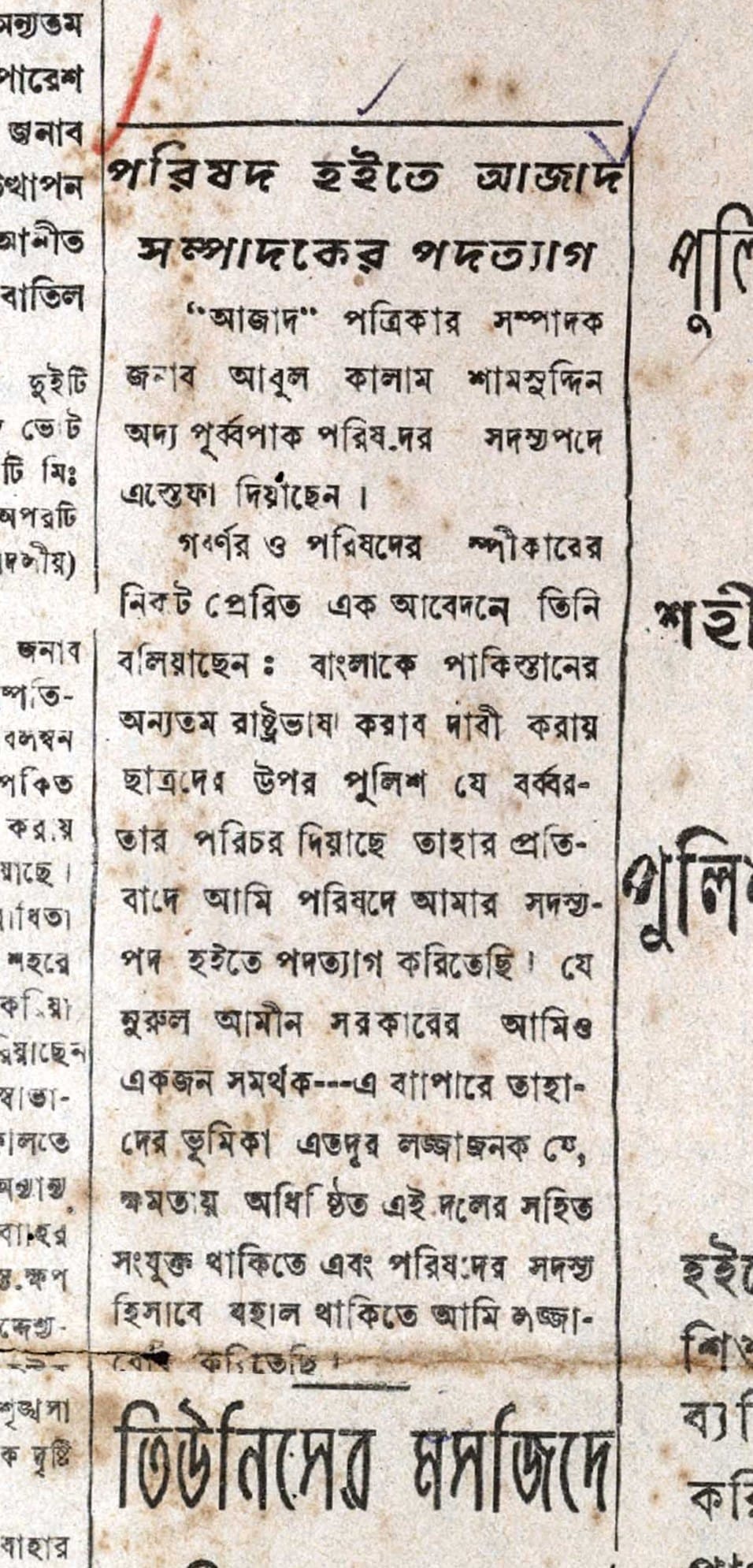
Not only on February 22nd or 23rd 1952, but also in the following few days, The Azad published the news of the language movement with huge importance. It contained detailed information about the student killings, the rationale for the protest and the right to language. Overall, despite being the mouthpiece of the ruling Muslim League, the way The Azad published the news of the language movement was truly commendable and historic.
Rahat Minhaz is an assistant professor in mass communication and journalism in Jagannath University, Dhaka. He can be reached at: minhaz_uddin_du@yahoo.com
Send your articles for Slow Reads to slowreads@thedailystar.net. Check out our submission guidelines for details.
Tagore’s Dan Pratidan and the colonial remaking of Bengal’s moral world
Memories of Indigo Rebellion and the question of national identity
Part 1 / The forgotten art of Bengali advertising
Re-reading Nizamuddin Auliya in history and memory

Remembering Mrinal Sen: Through rain, memory, and cinema

Rethinking the origins of Bongabdo through Bengal’s ecological civilisation
The forgotten front: Rumour, resistance, and the uprising of 1857 in Eastern Bengal
The Burma we imagined in Bengali literature

The Dhaka Masterpiece Paintings
