


Beyond the boundary

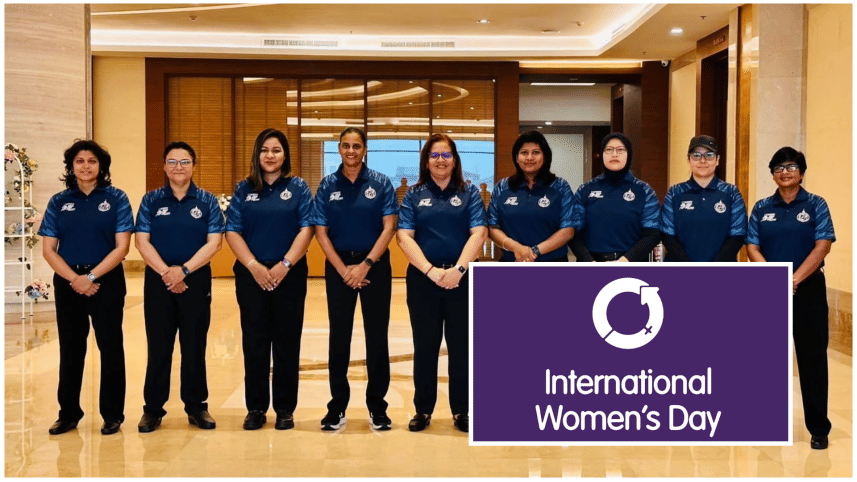
For many years, women’s involvement in cricket in Bangladesh was largely confined to playing on the field. Recently, however, a new pathway has emerged as women step into officiating roles, proving that their contribution to the sport can extend further.
The shift began gaining momentum in late 2022, with the rise of female umpires in the country. At the forefront of this movement is Sathira Jakir Jessy, widely regarded as the pioneer of women’s umpiring in Bangladesh. A former cricketer, Jessy chose to pursue umpiring at a time when very few women saw it as a professional option.
 For all latest news, follow The Daily Star's Google News channel.
 Her progress has been rapid. Jessy has already officiated in several major tournaments, including the ICC Women's World Cup, the ICC Women's T20 World Cup, and the ACC Women's Asia Cup. She has also stood in men’s domestic and international matches, becoming one of the first Bangladeshi women to do so.
Jessy believes umpiring offers long-term opportunities for those involved in cricket. “I think women’s umpiring is a very good profession,” she said. “In fact, I’d say it’s better than playing because a playing career has a certain age limit, but in umpiring, your value increases with experience.”
She explained that the profession requires resilience and confidence. “First, you must be mentally very strong and ready for anything, whether officiating men’s or women’s matches,” Jessy said. “If you are soft or lack confidence, you won’t do well.”
At the same time, she highlighted the importance of education. “A good educational background is important, especially proficiency in English,” she added. “All the laws and playing conditions are written in English.”
Jessy’s success has already influenced other cricketers to consider officiating as a career after their playing days. National team players such as Sharmin Akhter Supta and Rumana Ahmed have completed umpiring courses, while others are exploring similar opportunities.
Another Bangladeshi official making steady progress is Mishu Chowdhury, who recently officiated at the ACC Women's Rising Teams Asia Cup in Thailand. She believes former players have a clear advantage when transitioning into umpiring.
“I believe it is much easier for former cricketers to become umpires because they understand the nuances of the game much faster than someone without a cricket background,” she said.
Institutional backing has also played a role in developing this new pathway. Alongside continuing to organise training programmes, the Bangladesh Cricket Board (BCB) has begun including women umpires in its payroll since 2025, with four women umpires currently on its payroll.
Chairman of the board’s umpires committee, Iftekhar Rahman Mithu, said the initiative has already shown results. “We provided opportunities three years ago, and now they are officiating in World Cups and international matches,” he said.
With more women joining training programmes and gaining experience, umpiring is gradually becoming a new frontier for female cricketers in Bangladesh -- showing that their presence in the sport is expanding well beyond the boundary line.
Comments