


From exile to immortality: The Paolo Rossi story
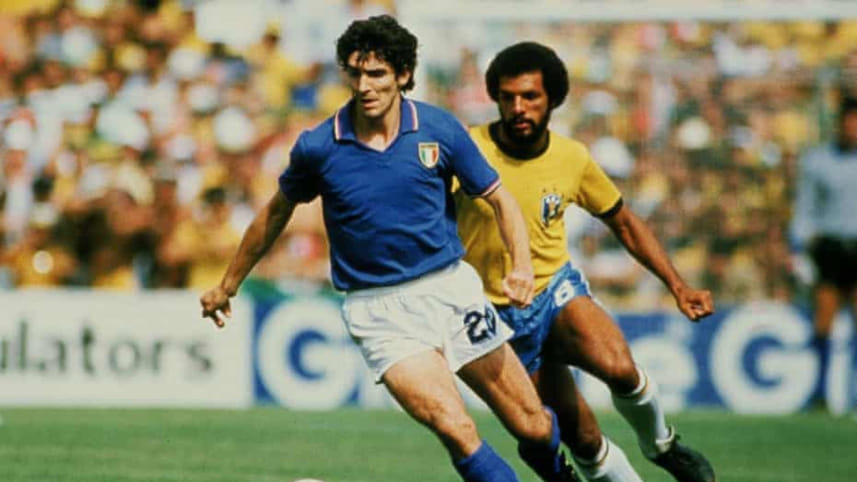
On the vast canvas of time, human life is sometimes painted in such strange colours that even the grandest fairy tales pale in comparison. A fallen hero, once lying in the dust, rises from the suffocating chambers of shame, darkness and exile to wear the crown of world conquest.
In the history of Italian football, Paolo Rossi was one such figure. He was not merely a striker; he was the phoenix who spread his wings from the ashes of his own disgrace and brought unparalleled glory to the Azzurri.
 For all latest news, follow The Daily Star's Google News channel.
 In the late 1970s, a new star rose in Italy’s footballing sky. With his slight frame, sharp gaze and an uncanny predator’s instinct for goals, Rossi quickly became a symbol of hope for the nation. At the 1978 World Cup in Argentina, he was one of the driving forces of Italy’s attack. The young Rossi’s runs, clever positioning and lightning-like strikes made it seem as though the future of Italian football stood firmly on his shoulders.
But just as in human life, the path of football is never straight.
In 1980, a devastating scandal shook Italian football – the match-fixing affair known as “Totonero”. Suddenly the country’s footballing landscape plunged into a dark abyss of distrust and shame. The waves of that scandal crashed directly into Rossi’s life as well. Allegations surfaced that he too had been part of the shadowy network.
The football tribunal delivered its verdict: a three-year ban on the striker.
Though the punishment was later reduced to two years, for a footballer such a sentence meant far more than merely staying away from the field; it was as if his dreams, identity and very existence had all been sent into exile.
Those two years became both a literal and psychological prison for Rossi. Banished from the pitch, the roar of the stands and the rhythm of football, he had to count every passing moment amid deep uncertainty and humiliation. The Italian media, which had once celebrated him with adoration, showed no hesitation in driving nails into his soul by branding him a “traitor”. The Paolo Rossi who had once carried the nation’s dreams turned into a despised villain.
Two long years of darkness.
When the world had turned away from him, one man refused to lose faith in him. That man was Italy’s coach at the time, Enzo Bearzot. With a jeweller’s eye, Bearzot knew that the ruthless, cunning striker still slept within Rossi – and that hidden treasure was exactly what Italy needed most to win the World Cup.
Just before the 1982 World Cup in Spain, Rossi’s suspension was lifted. Calling a player straight into the World Cup squad after two years away from competitive football – physically unfit and mentally battered – was an enormous gamble by Bearzot. Italy’s media erupted in outrage, deriding Rossi as a “ghost on the field”. But Bearzot stood like an unshakable mountain in the storm, shielding Rossi with the devotion of a father and absorbing every arrow of criticism aimed at him.
Italy’s early campaign in Spain was pedestrian to say the least. They drew all three matches in the first round and stumbled into the next stage with great difficulty. Rossi’s performances were, in a word, miserable. On the field he appeared slow, tired and completely out of rhythm. The critics’ pens struck his existence like sharpened swords. Many believed Bearzot’s gamble had failed spectacularly and that Rossi’s era had come to an end.
Then came the defining moment, when Italy entered the dreaded “Group of Death” in the second round. Their opponents included one of the most dazzling teams in football history – Brazil, led by the likes of Zico, Socrates and Falcao – along with Argentina featuring a young Diego Maradona. Although Italy defeated Argentina, they had only one equation left to reach the semifinals: they had to beat the unstoppable Brazil.

July 5, 1982: Sarria Stadium in Barcelona.
That day it seemed as though the Gods of Olympus themselves had descended through Rossi’s feet. Tearing away every poisonous thorn of criticism, Rossi was reborn. In the fifth minute came a magical opening goal, followed by a perfect second in the 25th minute, and finally the winning third in the 74th minute. Rossi’s almost supernatural hattrick against a divine Brazilian side stunned the entire world. That 3–2 victory was not merely a footballing triumph; it was Rossi’s personal victory over his own pain – a poetic rise that shattered the heavy chains of humiliation.
After that miraculous afternoon at Sarria, Rossi transformed into an unstoppable storm. In the semifinal against Poland, both goals in Italy’s 2–0 victory came from his magical boots.
Then came July 11 – the dream final at Santiago Bernabeu in Madrid. The opponents were the formidable West Germany led by Karl‑Heinz Rummenigge. In the 57th minute, Rossi broke the deadlock with a sharp finish inside the box, setting Italy on course for a 3–1 victory. After 44 long years, Italy reclaimed their lost crown and celebrated their third World Cup triumph.
The same Rossi who had begun the tournament as a ridiculed “ghost” finished it with six goals, winning the Golden Boot as the tournament’s top scorer and the Golden Ball as its best player. By the end of the year, he also lifted the Ballon d’Or as Europe’s best footballer, and in doing so, became the only man in history to win all of those three awards in the same year – a feat which still stands.
Few stories in football history are this dramatic, this human, this poetic.
This is not merely the story of a footballer’s triumph. It is the story of a human victory over humiliation. No matter how deep the darkness, light returns with dawn. And in that light, a new man is born.
Comments