


Why Bangladesh still believes teachers should be poor

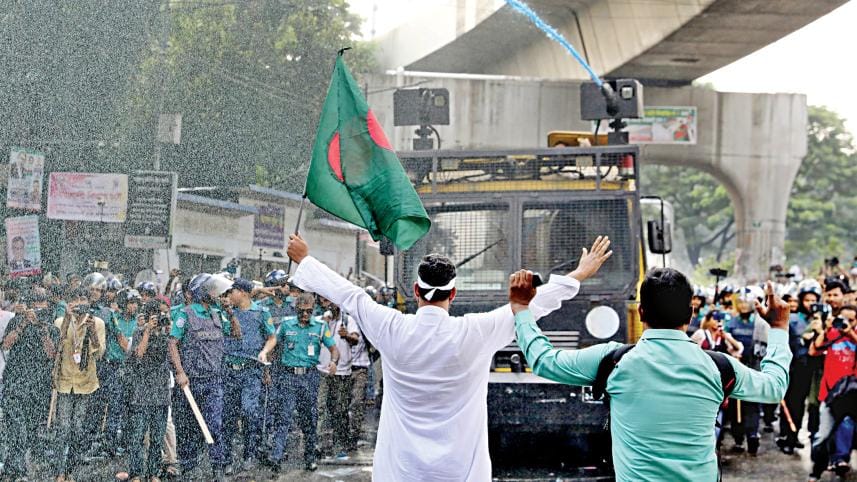
In Bangladesh, we live with a peculiar complacency when it comes to teachers' pay. Many of us casually argue, "Since our teachers are not good enough, their pay is fair." Others add, "They already earn from private tutoring and coaching, so why should we pay them more?" These statements, so casually uttered in drawing rooms and Facebook threads, are far from harmless. They reveal a deep national malaise—our failure to distinguish between the causes and the symptoms of a broken education system.
A recent comparison of secondary school teachers' minimum salaries across seven leading Asian countries exposes the scale of that neglect. In Singapore, a secondary school teacher earns the equivalent of Tk 650,000 per month. True, Singapore is one of the most expensive countries in Asia, but even after adjusting for living costs, the income guarantees dignity and financial security. In China, a teacher earns around Tk 220,000—fourteen times higher than in Bangladesh—even though China's cost of living is roughly twice ours.
 For all latest news, follow The Daily Star's Google News channel.
 It is not difficult to see why China advanced so rapidly. The Chinese understood early that a nation's progress is bound by the quality of its teachers. They invested accordingly. Teacher recruitment there is competitive, well-paid, and deeply respected. The result is not merely better schools, but a stronger, more disciplined, and intellectually confident society.
Bangladesh, by contrast, stands at the bottom of South Asia—not just in teachers' salaries, but also in the overall quality of education. This is not a mere coincidence; it is causality. Our neglect of teachers has corroded not only classrooms but the very fabric of civic life. Look around: the indifference, impatience, and lack of civic responsibility visible in our streets and marketplaces are the social echoes of decades of intellectual neglect.
In Bangladesh, schoolteachers are officially classified as third-class employees. The very phrase is an insult to human dignity. To regard any group of citizens as "third class" is to institutionalise humiliation. To pay them a pittance on top of that only deepens the insult. Behind this arrangement lies a deeply unhealthy psyche. Our politicians want teachers to remain submissive—dependent on them for every favour. They want to be able to summon teachers at will, confident that they will obey.
The creation of politically influenced school management committees has made this control more systematic. Two decades ago, it was the headmaster who ran the school. Today, the president of the managing committee—often a politically connected figure—holds real authority. Through these committees, local politicians and bureaucrats have effectively captured the governance of schools. Teachers, deprived of status and voice, have become functionaries serving the whims of others rather than the needs of students.
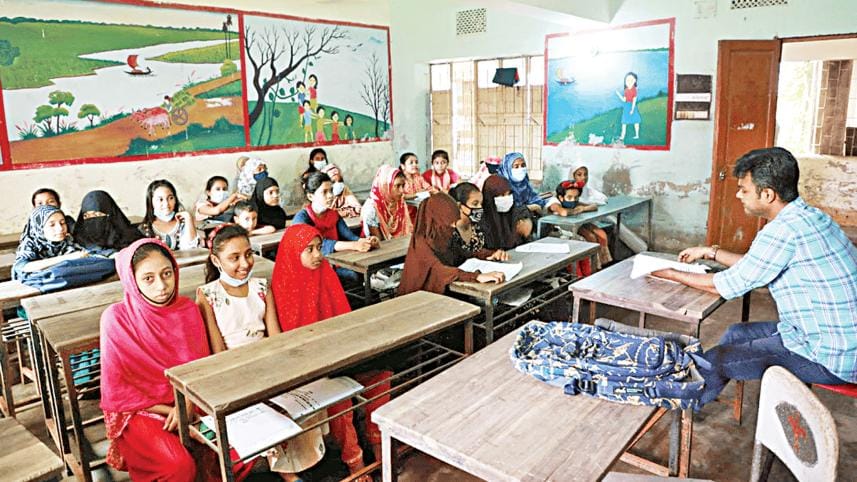
I once came across a job advertisement from a well-known school in Dhaka offering a salary so low it bordered on insult. When I later asked a member of the school's management about it, he explained, without irony, "Even with this pay, we get plenty of good applicants. They earn enough from coaching anyway." That single remark captures our national mindset perfectly: we have normalised systemic underpayment, accepted exploitation as efficiency, and conveniently outsourced teachers' dignity to the private coaching market.
This distortion has profound consequences. When a teacher learns to survive at the cost of self-respect, the student learns that survival—not integrity—is the key to success. When the education system rewards side hustles over sincerity, the values of an entire generation are quietly rewritten.
Over time, deprivation normalises itself. Teachers' demands today are so modest that they almost reflect their learned helplessness. Recently, they requested a 20 percent increase in house rent allowance. The government responded with 5 percent, then revised it to 7.5 percent. The message could not be clearer: those who shape the next generation are valued less than the bureaucrats who merely administer the system.
Predictably, many still ask, "Would higher salaries really solve the problem?" The answer is an unequivocal yes—provided that the policy is part of a broader structural reform. A well-paid profession is an attractive profession. Once teaching becomes dignified and rewarding, talented young people will choose it as a career. Recruitment standards will rise, accountability will follow, and over time, both classroom quality and public trust will improve.
Right now, teaching is so poorly compensated that bright graduates shun it altogether. Those who do enter the profession often do so out of necessity, sustained by income from private coaching. This arrangement commodifies education and undermines its moral foundation.
And yet, as a society, we spend millions on private tutoring and overseas education for our children—while fiercely opposing any proposal to raise teachers' pay. Beneath that contradiction lies a dangerous cultural myth: that a "true" teacher must be self-sacrificing, poor, and humble, as though comfort and dignity somehow dilute their virtue.
History proves the opposite. No nation has risen without first dignifying its teachers. Teachers' honour and remuneration are not administrative matters—they are matters of national survival. If we truly care about education, we must repair the cause, not the effect. No amount of training workshops, flashy "education projects", or donor-funded reforms will make a difference as long as teachers live without dignity or security. Governments may continue launching bureaucratic initiatives, but these will remain cosmetic if the core issue—teacher compensation—is ignored.

UNESCO recommends that each country allocate at least 5.5 percent of its GDP to education, with a separate and protected allocation for research and development (R&D). This is because education and R&D are inseparable. A nation that invests in research invests in the creative and intellectual capacity of its people. Without that foundation, even the most modern infrastructure or digital classroom remains hollow.
Yet Bangladesh continues to underinvest in both, spending far less than the regional average on education. Instead of nurturing minds, we pour funds into administrative overheads, projects, and brick-and-mortar expansions that add little value to learning outcomes. The result is predictable: a disillusioned teaching force, a coaching-dependent education system, and a generation that learns to chase grades rather than knowledge.
Raising teachers' salaries is not an act of generosity—it is an act of national investment. Singapore and China did not transform their education systems by chance; they did so by placing teachers at the heart of national policy. We, on the other hand, continue to justify low pay with hollow logic, effectively selling our children's future at a discount.
Until Bangladesh recognises that education begins with the teacher—not the classroom, not the curriculum, and certainly not the project file—our dream of progress will remain just that: a dream.
Dr Kamrul Hassan Mamun is professor in the Department of Physics at Dhaka University. He can be reached at khassan@du.ac.bd.
Send your articles for Slow Reads to slowreads@thedailystar.net. Check out our submission guidelines for details.
Comments