Digging deeper into Barind’s water crisis

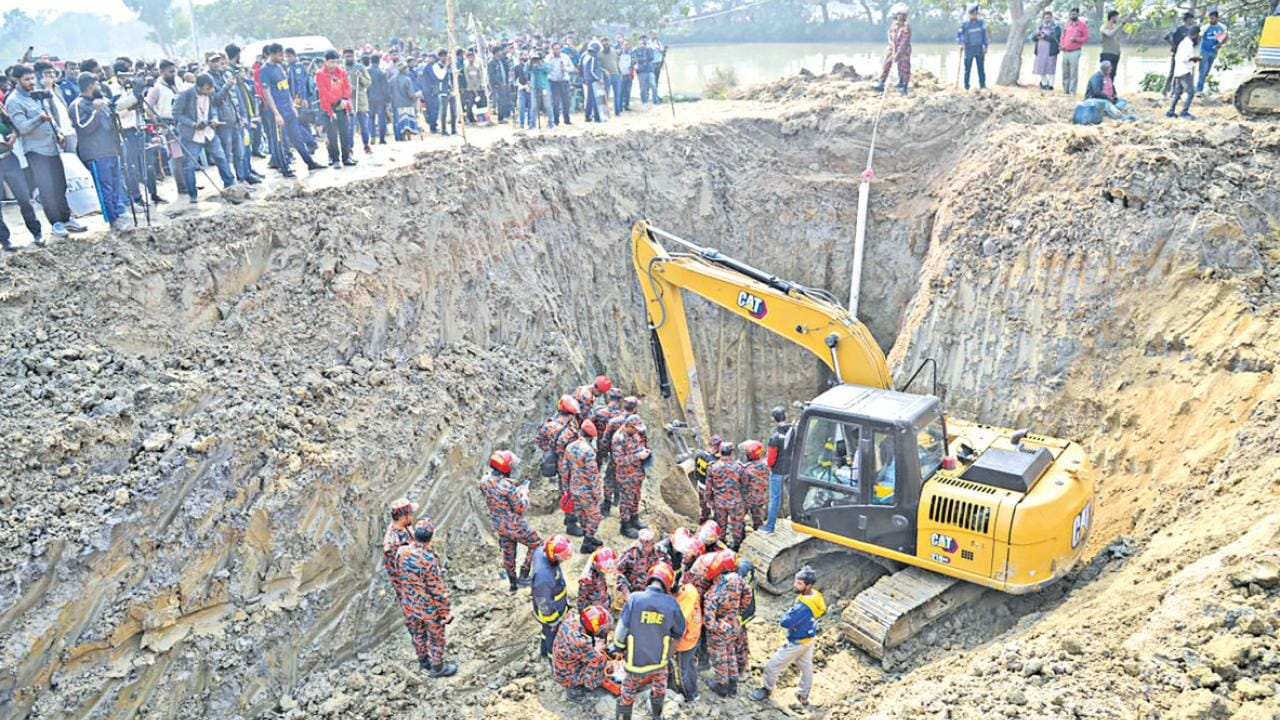
The recent death of a two-year-old who fell into an abandoned tube well shaft in Rajshahi's Tanore upazila is a profound tragedy. It also exposes a landscape shaped by years of unchecked groundwater extraction, where dry shafts lie open and danger has become routine. In the Barind region, what was once a seasonal scarcity of water is now hardening into a permanent crisis.
The Barind region sits on the northwestern part of Bangladesh, stretching across Dinajpur, Rangpur, Bogura, Joypurhat, Naogaon, Pabna, and Rajshahi. It is simultaneously one of the hottest regions during summer and one of the coldest during winter. For decades, the area has been marked as one of South Asia's major drought-prone zones. Now, the warnings feel less like projections and more like an imminent reality.
Most rivers, canals, and wetlands in Barind dry up during the winter. Shallow pumps that once served farmers are no longer able to reach the receding water table. Deep tube wells have taken their place. This shift comes at a cost: farmers must use more electricity to lift water from deeper layers, and constant pumping gives aquifers no time to recover.
"Over-extraction is the main problem," said Professor Dr Khondokar Emamul Haque of Rajshahi University's Geology and Mining Department. "In the Barind belts, the surface water level is already insufficient, so people are forced to extract groundwater for both irrigation and drinking. Because of this constant pressure, the aquifer doesn't get enough time to recharge properly."
"Unlike other floodplain areas, Barind is an elevated plain, and because of this it can't form land reclamation. The grains and finer particles that help recharge aquifers aren't available here. We can't even call it grain; we call it Barind clay. The deposition is not good at all, so natural recharge remains low year after year," shared Dr Haque.

When pumping exceeds the rate at which aquifers can replenish, the soil loses support below ground and begins to sink. Haque warned that "overuse of deep tube wells in these regions can result in land subsidence," a slow sinking of land that can damage roads and homes and make future water storage even more difficult.
Jahid Hossain, Principal Scientific Officer at WARPO (Water Resources Planning Organisation), described it as a combination of overuse and rainfall deficit. "If you look at the average rainfall of Bangladesh and compare it to these areas, you will see it is naturally much lower. The aquifer volume is comparatively low too. These areas are renowned for paddy cultivation, and farmers are naturally dependent on groundwater because rainfall is low and surface water isn't sufficient."
"We are planning to launch an irrigation development project," said Arifur Rahman Ankur, Executive Engineer of the Rajshahi Water Development Division, BWDB. The idea is simple: bring water from the Padma River and distribute it to fields in Tanore, Poba, and other pockets of the region. "We had several studies done, but none of them led to an actual project."
Ankur said the main challenge is that rivers and canals, which used to carry water into Barind's plains, are themselves drying up. Without flowing canals, farmers fall back on tube wells again. The cycle repeats.
He sees two key alternatives. "First, we need to reinvigorate the rivers in those Barind areas. Then the canals will have enough water so farmers can use them during the dry season. That will also help recharge groundwater. And we need to promote rainwater harvesting projects. During the monsoon, we must conserve water for the dry season."
Farmers speak from lived experience, and their stories reveal the uneven spread of crisis across the region. Nur Islam, a farmer from Dinajpur Sadar, grows potatoes, paddy, eggplants, and tomatoes. His community has been struggling for the past three to four years; neighbouring districts, he said, for nearly a decade. "After the month of Magh, the rivers dry up, leaving no water for irrigation." He relies on both shallow pumps and deep tube wells. He manages occasionally, but more often he cannot.
Others feel less pressure, though the warning signs are already visible. Md Milon Islam, an onion farmer from Birol, said the problem remains an inconvenience for now. "Sometimes water doesn't come up during the day, so we have to wait until night." He views the abundance of deep tube wells in his area as a buffer for the coming years. Yet the fact that water rises only at night signals that the local aquifer is slipping beyond the reach of daytime pumping.
In Vatina village, Zillur grows potatoes, bananas, and paddy. Winter is especially difficult. "Water doesn't come without a submersible pump," he said. He also worries about the shortage of affordable shallow machines and rising input costs. His frustrations extend to what he sees as a lack of government attention. "Right after winter, we face a water crisis, and the signs are already there," he added.
The experiences differ from village to village, but the trend is clear: dry seasons are arriving earlier, staying longer, and demanding more groundwater than the land can comfortably give.
The Groundwater Foundation, a US-based non-profit organisation working on groundwater conservation and education, outlines a grim set of consequences if over-extraction continues: reduced surface water, permanent loss of aquifer storage, land subsidence, and declining water quality. In some parts of the world, subsidence has sunk land by metres. Barind could face similar risks if the soil continues to give way.
A 2025 study published in the journal Global Food Security, titled "Revisiting the Drought–Food Insecurity Nexus: A Social–Ecological Systems Perspective", warned that if climate pressures persist and water management continues to lag, food security in northwestern Bangladesh could decline by more than half. Barind's farmers already bear higher costs for water, diesel, and fertiliser. A falling aquifer adds yet another layer of risk to their livelihoods.
The solutions proposed by scientists and engineers point in a common direction: reducing dependence on groundwater and restoring the surface water network. Professor Haque echoed this view, stressing that deep tube wells should be reserved for drinking water, not irrigation. "Surface water use needs to increase. Reviving canals is essential," he said. He pointed to examples in Godagari, where farmers pump water directly from the Padma for irrigation, and to parts of Satkhira, where rainwater harvesting has become a routine practice.
Yet each of these options demands sustained investment, political commitment, and patient engagement with farmers. WARPO, the government's Water Resources Planning Organisation, itself struggles with manpower shortages, while the agencies responsible for implementation often fall short in terms of funding and coordination.
Still, the path forward is clear. Aquifers need time—around 90 days of rest to recharge, according to Professor Haque. Canals require dredging and regular maintenance. Rainwater must be stored. Crop choices need to adapt to the region's changing climate.
Like clockwork, the Barind water crisis returns to the headlines each dry season, when the damage becomes visible enough to demand attention. Yet meaningful precaution rarely follows. One year, shallow pumps begin to fail; the next, deep tube wells require ever more powerful motors. Rivers shrink. Canals narrow. Farmers wait until night to draw water. What was once a seasonal hardship is steadily hardening into a permanent condition.
The region now stands at a crossroads, where the choices made today will determine whether Barind remains a productive agricultural heartland or slips into a future marked by chronic water stress.
Ystiaque Ahmed is a journalist at The Daily Star. He can be reached at ystiaque1998@gmail.com.
Send your articles for Slow Reads to slowreads@thedailystar.net. Check out our submission guidelines for details.

The dreams of girls in a Bangladesh river char
Can Bangladesh bring back the Chakaria Sundarbans?

Who protects women in Bangladesh's gig economy?

Bangladesh’s climate-displaced / From lost homes to life in Dhaka’s slums

Buried by development: The human cost of river dredging in Dumuria

Char contracts: Surviving river erosion without the state

When extreme heat becomes a death trap for Bangladesh’s workers
The slow disappearance of Kuakata’s Rakhines
The cost of conservation in the Sundarbans