


The joy, jingles, and jumbling schedule of Christmas in Bangladesh
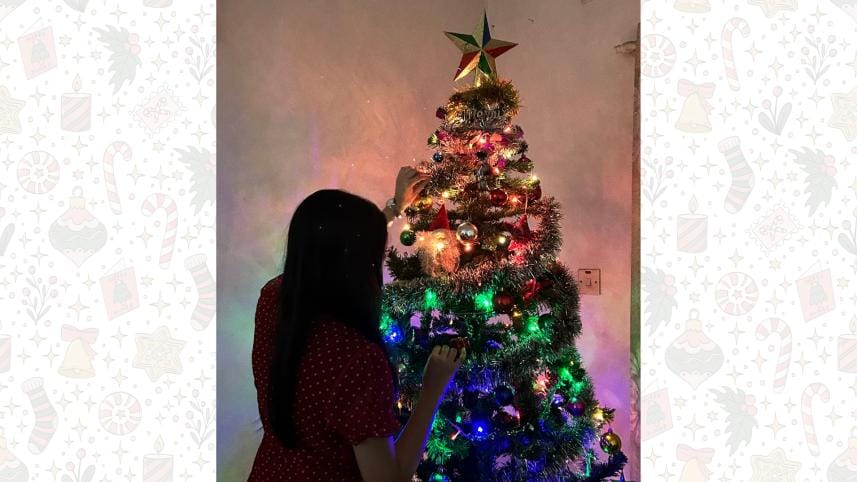
My brother and I were sent to missionary schools, the kind which helped us become familiar with many urban middle-class families in Bangladesh. It was a practical choice, and I remain grateful for it. And for 12 years, I found myself amidst friends and peers of different faiths, including Christianity. Thanks to this, December meant waiting for my best friend's Christmas tree to light up. I learnt the significance of Christmas before I learnt its theology. In my school, religious festivities were shared and enjoyed, even by those who did not share the same beliefs.
Progga D'Rozario, the friend with whom my Christmases were spent, speaks of the traditions of Christmas: "There are two Christmas masses, that is, church services, on December 24: one is held in the evening, and the other takes place at midnight. Many people happily choose the late-night mass, as the cool winter air heightens the joy of the season. The chilly weather and the new clothes add to the Christmas spirit. Although masses are also held on the morning of December 25, most people prefer to celebrate by attending the services on Christmas Eve."
 For all latest news, follow The Daily Star's Google News channel.
 There are instances of Christmas miracles as well. Progga adds, "The Christmas tree holds a special joy for me as well. When I was in grade nine, I dreamed of having an artificial Christmas tree that would touch the ceiling. Such a tree seemed impossible to find. My father searched everywhere but returned empty-handed. Then, on the night before Christmas, he walked into a supermarket and discovered a tall Christmas tree. He bought it without hesitation. The tree even came with ornaments. To me, it felt like a Christmas miracle, filled with warmth and wonder."
In December, right before the festivities begin, Christmas trees can be found around churches in little shops. Your usual Christmas tree ornaments can also be bought from those vendors, but there are shops in Farmgate and Chawkbazar that offer different options. Many opt for the convenience of online shops that deliver the artificial Christmas trees right to their homes.
Young students take part in Christmas carols in groups to spread happiness and goodwill. Christmas carols are songs or hymns centred on the story and spirit of Christmas. The carolling season usually begins in early December and continues until just before Christmas. During this time, the youth visit different Christian households and sing together. Families often offer money as a gesture of gratitude. Some families also share food with the carol singers, adding to the warmth and joy of the season. Christmas carols also serve as a small fundraiser, as the money collected from households is often used by the students to support community projects or charitable activities.
For Flora Gomes, a 15-year-old student of grade ten, Christmas is a time of prayer, reunion, gratitude, and spiritual renewal because families get together and go to churches to pray together on this blissful occasion.
Another cherished tradition of Christmas is the fruitcake. It is lovingly prepared at home or ordered specially for the occasion. The cake represents community, memory, and celebration for many families.
"Christmas is the most sacred and joyous celebration for Christians. As a school student, I am fortunate to have a winter vacation that overlaps with Christmas," Flora explains.
Some schools in Bangladesh take into consideration the need for Christmas holidays for students to celebrate with their friends and families. However, not all Christian students are fortunate enough to experience the full extent of the holiday spirit.
"Christmas offers us only a single day of vacation," says Flora. "One day is simply not enough to embrace the vastness of this celebration. We wish to spend this time with our parents, grandparents, and extended family, many of whom live in villages. Travelling to and from the countryside itself takes time, making it nearly impossible to spend even a full day together."
Flora's words pay credence to the miles travelled by families to villages where parents, grandparents, and relatives live, and to the disappointment of gatherings shortened or missed altogether due to the time that is required to travel. Even within the same family, she notes, Christmas is not experienced equally. While Flora has acknowledged that she was fortunate to have a winter vacation that overlapped with Christmas, this is a privilege not shared by everyone she loves.
She says, "My elder sister, who is a medical student, does not receive such extended holidays. For her, Christmas often passes between lectures, ward duties, and academic responsibilities. The contrast is painful; it shows how unevenly this sacred day is experienced amongst Christian students."
Matters grow harder still when, as she adds, examinations are sometimes scheduled immediately after Christmas, sometimes even on 26 December. Flora's account echoes a central argument of this piece. In Bangladesh, the holidays are observed without fully considering how much they mean for those who really celebrate them.
The current structure of holidays, often limited to a single day or undermined by examinations and academic pressure, reduces Christmas to a symbolic concession rather than a lived observance. In a system where the majority of religious festivals are accompanied by extended breaks and institutional flexibility, this imbalance is a cause for concern. Equal consideration would mean acknowledging that religious observance cannot always be fit into a single date. Granting Christian students adequate holidays accommodates the cultural and spiritual lives of its students rather than forcing them to choose between school and family time.
Elizabeth Ankita Gomes, an 18-year-old O level student, captures this tension as she explains, "Christmas, for me, is always a mix of joy and quiet struggle. At my institution, there is no official break on Christmas Day, let alone the days before or after, unlike many other countries."
This leaves many students having to balance exam schedules with church responsibilities. Ankita's words constitute a reality in which academic revision runs parallel to choir practice and late-night services. Even when they have a few days off, many bemoan being overburdened with homework.
Yet Ankita's reflection also gestures towards endurance and meaning. "The pressure can be overwhelming, but it also forces us to be resilient," she says.
Even amid academic stress, Ankita finds that the joy of celebrating with her community reminds her why the season matters. The joy is shared abundantly, even if it's for a day.
Communities of different faiths have long lived side by side, sharing schools, neighbourhoods, and public life in Bangladesh. Yet, coexistence requires more tolerance and attentiveness. Being considerate of one another means responding thoughtfully to differences in marginalised communities that are a part of us.
Comments