


Smoke signals about Bangladesh’s future


Smoke climbed the stairwells of two news media buildings in Dhaka, and people who spend their lives telling other people's stories ended up living one themselves. Staff were trapped. Phones kept ringing. Outside, a crowd decided intimidation was politics, and fire was speech.
Earlier on that day, in Bhaluka, a garment worker was falsely accused of offending religious sentiment. A mob beat him to death and burned his body. Afterwards, there were arguments about the details—who started the rumour, who filmed, who watched, but that did not change the fact that a human life was erased by a crowd acting as judge and executioner.
 For all latest news, follow The Daily Star's Google News channel.
 The simplest description of what is happening in Bangladesh is this: many people are beginning to believe a crowd can do what the state will not. That belief reshapes everyday life. A parent tells their child to stay quiet on the bus. A teacher edits their words in class. A young woman thinks twice before posting online. Fear seeps into markets, schools, offices, and homes.
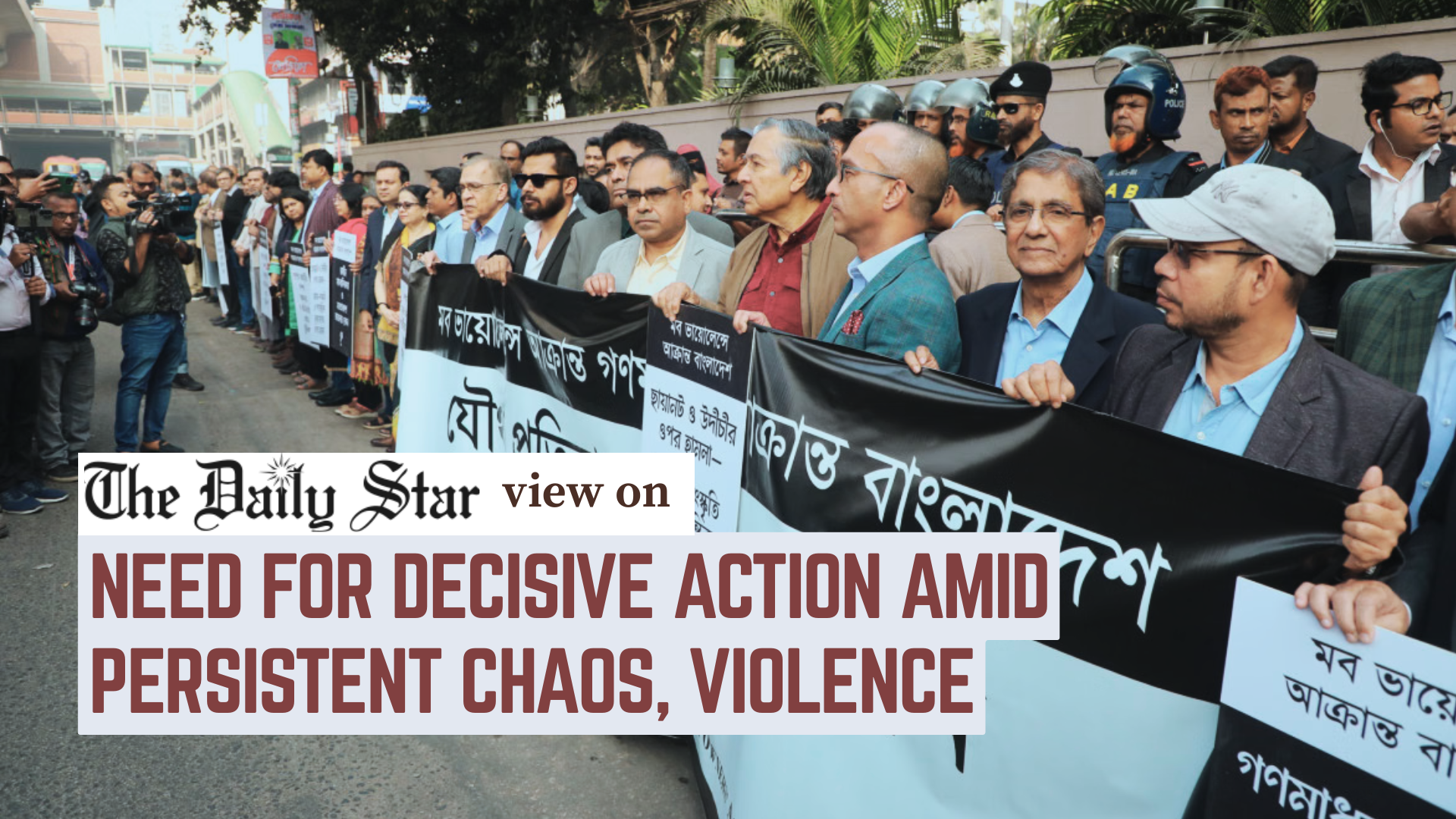
Bangladesh has never been a quiet society. We argue, laugh, and live with contradiction. The social fabric holds because of the expectation that disputes would return to rules. That expectation feels weaker now. When rules seem absent, people search for substitutes. The cheapest substitute is vengeance.
So why the rise in intolerance, mob violence, and radicalism?
Economic stress is one accelerant. Many families feel squeezed. Many young people feel stuck. Stable jobs, fair chances, and predictable futures feel harder to secure than they used to. Frustration without outlets becomes combustible, and it starts searching for someone to blame.
But economics alone does not create mobs. Mobs require permission. Permission comes from impunity, from the belief nothing serious will happen to perpetrators, or worse, that violence is a public service. When people see others get away with brutality, the next crowd forms faster. Fear spreads and consequences fade.
Permission also comes from speed. Rumours move through forwarded voice notes. Accusations become verdicts in minutes. The first "evidence" is often a shout, a screenshot, a clip stripped of context. By the time facts arrive, the crowd has already decided on a verdict. Technology did not invent intolerance, but it amplifies outrage.
Politics adds fuel. Bangladesh is heading into an election season. In stable times, elections are about persuasion. In fragile moments, they become about intimidation. Some groups test boundaries. Opportunists wrap ambition in religion or nationalism. Threatening a newspaper, a cultural event, or a minority neighbourhood becomes a shortcut to power.
The danger is not only the violence. It is what it does to the public square. When spaces that hold disagreement are attacked, disagreement does not disappear. It migrates into darker places. People stop debating and start whispering. The bold become reckless. The cautious become silent.
And then comes the question that keeps boardrooms awake: what happens to investment?

Investors do not demand perfection. They demand predictability: contracts that mean something, disputes resolved without muscle, employees who can move safely, and decisions that do not accidentally become political statements. When street violence rises, costs rise too. Security spending increases. Supply chains turn brittle. Entrepreneurs delay expansion because uncertainty cannot be priced. Markets react early, not at the peak, but at the smell of smoke.
What is the way back, then?
Bangladesh does not need a new identity. It needs enforcement of the one it already claims: a society where difference is normal and law is the referee.
That begins with consequences: visible prosecutions for mob violence, regardless of the victim. Faster, credible justice delivered by the proper state agencies; otherwise, delayed justice will continue to create space for vigilantism. Protection for journalists and cultural spaces, because a society cannot correct itself if its mirrors are smashed, voices strangled. Political leadership that speaks clearly against intimidation, because silence is heard as permission.
There is also a moral choice for ordinary citizens. A country turns when bystanders stop being bystanders, when community leaders refuse to bless cruelty, when we decide dignity is non-negotiable.
Bangladesh has survived storms, floods, and political earthquakes. We know how to rebuild. The question now is whether we will rebuild what matters most: trust in each other, and trust in the rule that no crowd gets to decide who belongs.
Mamun Rashid, an economic analyst, is chairman at Financial Excellence Ltd and former managing partner of PwC Bangladesh.
Views expressed in this article are the author's own.
Follow The Daily Star Opinion on Facebook for the latest opinions, commentaries, and analyses by experts and professionals. To contribute your article or letter to The Daily Star Opinion, see our guidelines for submission.
Comments