


They want our silence, but we will not give it to them

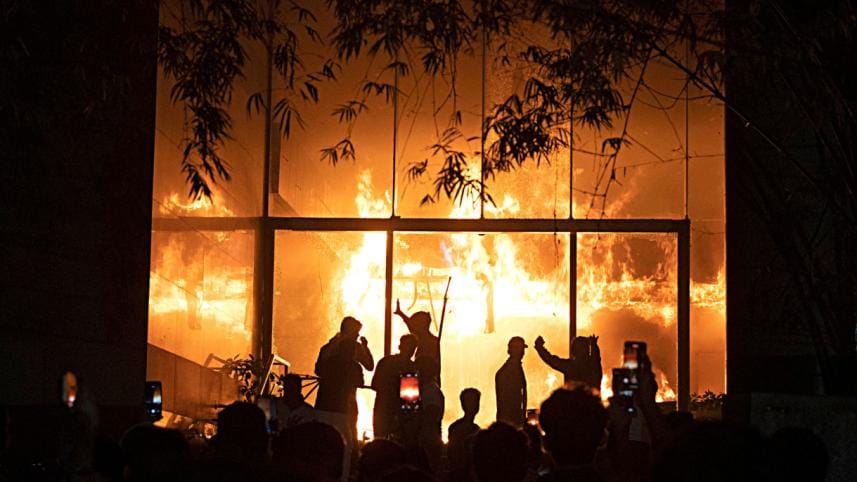
From late Thursday night through the early hours of Friday, December 19, my colleagues at The Daily Star were trapped on the roof of their burning workplace, unsure if they would survive. Journalism is not a vocation that pays, nor does it sustain our lives fully, but we do it anyway because we find immense value in keeping readers informed and voicing the truth against autocrats, censorship, and potentially a threat to our lives. Yet, last night, the same premise set The Daily Star and Prothom Alo offices ablaze.
Mobs have no regard for the truth; they only care about a skewed sense of justice. They care about their unification under the banner of violence because it makes them feel like they are doing something. Mobs have not only bent the will of the interim government, but they are surely pushing journalists towards self-censorship—something the now-repealed Digital Security Act, 2018, had once accomplished.
 For all latest news, follow The Daily Star's Google News channel.
 The question "Who does this violence benefit?" does not occur to the perpetrators. But I'll add a layer to this and still ask—Who does a post-truth society benefit?", one where public opinion is shaped more by swaying emotions than objective facts. The answer is simple—it benefits extremism, populist leaders, and it benefits Bangladesh's personal favourite word of the year—fascism. It is because emotional narratives (fear, anger, belonging) are greater mobilisers than rationality and facts—the more politically polarised a society is, the easier they are to control. Which is why, since August 5, 2024, any and every criticism against the establishment or radicalised figures is viewed as anti-establishment.
We are now living in a post-truth society where discrediting experts, science, and traditional media has created a vacuum filled by partisan sources and conspiracy theories, making populations easier to sway. People retreat into "truth" bubbles within their communities, resisting outside facts—a phenomenon amplified by social media. What they fail to notice is that the Awami League government used these same tactics to subdue us. Populist figures are now using the violence we witness today as a tool. The AL government normalised violence against the public to such an extent that succumbing to revenge politics now seems like a justifiable course of action for many. The AL government promoted a political identity which centres around the belief that if you criticise our ways, you are the enemy. Besides, the Awami League also bears a large part of the blame for the role allegedly played by it in inciting or perhaps committing some of the recent violence. Sadly, the AL era mindset persists, and my words, along with those of many other journalists, continue to receive the "enemy" label. But we are stubborn; in the face of fear, our voices grow louder.
Our constitution mandates the protection of journalists, which the interim government's home ministry has failed to provide. Despite the instigators discussing this violence for days prior, the interim government's home ministry failed to reinforce tight security measures around media houses and important cultural institutions. With elections announced and the government's willingness to hand over power to the democratically elected, the government's muted response to stop mob violence appears puzzling. Identifying the perpetrators should not be difficult, since mobs mostly make sure to show off their actions on social media. Otherwise, in the absence of strict legal action, mob violence will continue.
Seeing the pictures of harmoniums being thrown to the ground with such determined rage and passion at Chhayanaut, and seeing archives and dreams burn at The Daily Star and the daily Prothom Alo offices, made me feel hollow. I couldn't help but wonder where this rage is coming from. How can an average individual with a family at home suddenly resort to such violence? It may be due to record-low employment rates, inability to afford necessities, years of pent-up frustration and radicalisation, or simply because they are being paid or incentivised in other ways to instigate this. Whatever the case, the enemy they've chosen, the very institutions they are trying to harm now, are the ones that stood by them when the Awami League tried to subdue their right to freedom of speech. The journalists of these two media outlets have done so over the 15 and a half years of AL rule, though their phones were tapped and their existence threatened with the possibility of enforced disappearance.
That's is why even after a harrowing night, these people have cleared the ash and rubble from their desks and returned to work. The sky fell on journalists in the wee hours of Friday. I hope they continue to use it as a blanket.
Nazifa Raidah is a journalist, researcher and development practitioner.
Views expressed in this article are the author's own.
Follow The Daily Star Opinion on Facebook for the latest opinions, commentaries, and analyses by experts and professionals. To contribute your article or letter to The Daily Star Opinion, see our guidelines for submission.
Comments