


A smarter solar strategy essential for Bangladesh’s clean energy transition
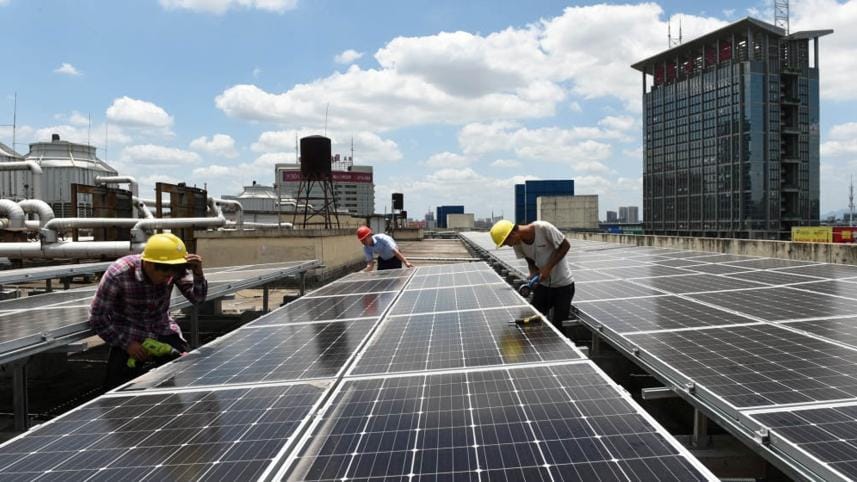
In recent years, Bangladesh has made notable progress in renewable energy production. The Sustainable and Renewable Energy Development Authority (SREDA) estimates that five percent of the country's total generation capacity now comes from renewables. Solar energy is the primary contributor, accounting for 82 percent of renewable generation. Rooftop solar is steadily expanding, with 4,267 net-metered systems installed nationwide to date. Large-scale solar parks are also playing an increasingly important role.
Despite these advances, Bangladesh's solar potential remains largely untapped. Experts estimate this potential at 50,174 MW—sufficient to meet around 80 percent of the country's projected energy demand of 60,000 MW by 2041. The urgency to harness this potential has been heightened by the recent energy crisis. Responding to these challenges, the interim government announced ambitious targets in its Renewable Energy Policy of June 2025, aiming to generate 20 percent of energy from renewables by 2030 and 30 percent by 2040.
 For all latest news, follow The Daily Star's Google News channel.
 While rooftop solar continues to grow, Bangladesh must explore more effective alternatives to increase the share of renewables in its overall energy mix. Advances in solar, storage, and smart-grid technologies offer opportunities to leapfrog traditional power systems. One promising innovation is perovskite solar cells, a new class of photovoltaic (PV) material capable of converting up to 50 percent more sunlight into electricity than conventional silicon panels. This makes them particularly suitable for low-light conditions, including Bangladesh's monsoon seasons. Lightweight and adaptable, these cells can be printed or spray-coated, enabling applications such as "solar paint" on roofs or walls. Unlike traditional silicon PV, perovskites can be processed at near room temperature, significantly reducing manufacturing energy use and costs. Such high-efficiency, low-cost PV technologies could allow Bangladesh to expand capacity within limited rooftop and urban spaces while lowering adoption costs for households, industries, and SMEs.
Alongside perovskites, emerging technologies such as thin-film and organic photovoltaics (OPV) offer distinct advantages. They are lightweight, flexible, and inexpensive to manufacture. Thin-film cells can be produced on rolls or plastic substrates, making them suitable for curved roofs, portable devices, and building-integrated solar windows. In Bangladesh, thin-film modules could be installed on lightweight rooftops and building exteriors where heavier panels are impractical, while OPV films could supply power to village shops and small electronic devices.
Solar power generation typically requires more land than conventional power plants. As Bangladesh faces acute land constraints, floating photovoltaic (FPV) systems provide a way forward by enabling solar deployment on reservoirs, lakes, and ponds. Water acts as a natural coolant, improving panel efficiency and durability, while also reducing evaporation and algae growth. Bangladesh has already installed an FPV plant in Bagerhat, and this modular, scalable technology could rapidly add capacity without displacing farmers or occupying scarce land.
Agrivoltaics offers another solution by integrating solar panels and agriculture on the same land. Elevated PV arrays create dual-use fields where crops grow under partial shade while panels generate electricity. Studies show that this approach can increase overall land productivity, reduce water requirements, and raise combined crop and energy yields by 35 to 73 percent. In Bangladesh, trials with BRRI-33 rice indicate that intermittent shading does not reduce yields and may even improve plant growth, soil conditions, and water retention. A 100 MW semi-agrivoltaics project is already planned in Jamalpur, where green chillies, turmeric, and ginger will be cultivated beneath solar panels.
Beyond photovoltaic systems, solar thermal technologies also offer potential for renewable power generation. Thermoelectric generators, for example, can convert solar heat directly into electricity. Other solar thermal options, such as concentrating solar power (CSP), use mirrors or lenses to heat fluids that drive turbines. Unlike PV systems, CSP can store energy as heat—often using molten salt—and deliver electricity on demand. This feature is particularly valuable as it allows energy supply during periods of low sunlight. Feasibility studies, especially in the Dinajpur region, have identified significant potential for CSP deployment.
In addition to CSP, several storage technologies are being developed to support photovoltaic power. Flow batteries store energy in liquid electrolytes held in external tanks, separating power capacity from storage volume. They offer long lifespans, often exceeding tens of thousands of cycles, and allow full depth-of-discharge. Although their energy density is lower than that of lithium-ion batteries, flow batteries are well-suited to large-scale, multi-hour grid storage and can smooth daily or weekly fluctuations in renewable generation with minimal degradation. Bangladesh currently has no grid-scale flow battery installations, but declining costs could make them viable for island grids or long-duration solar storage.
Among long-duration storage solutions, pumped-storage hydropower (PSH) is the most established. It uses surplus electricity to pump water to an elevated reservoir, releasing it later to generate power during peak demand. PSH offers large capacity at a relatively low cost per kilowatt-hour and can operate reliably for decades. Although Bangladesh has no PSH plants at present, the 2016 Power System Master Plan has set a target for the first project by 2030. Locations such as Kaptai, where an existing hydroelectric dam operates, or reservoirs in the hilly northeast could provide gigawatt-hour-scale storage.
Modernising the power grid is essential to integrating renewable energy effectively. Smart grids use digital sensors, automated controls, and real-time data to optimise electricity flows and manage intermittent supply. In Bangladesh, US-funded studies have launched pilot projects in Dhaka and at the national transmission level to improve grid efficiency and flexibility. The 2025 net-metering reforms mark another important step. Under the revised policy, households and businesses can use rooftop solar for self-consumption and export excess electricity to the grid. Net exporters receive energy credits, which can be used to purchase electricity later. These measures encourage decentralised generation. When combined with smart-grid investments, these measures will help Bangladesh manage its expanding renewable capacity more efficiently.
Nafis Mubarrat is programme associate at South Asian Network on Economic Modelling (SANEM). He can be reached at nafis.sanem@gmail.com.
Sheikh Tausif Ahmed is research associate at SANEM. He can be reached at sheikhtausif897@gmail.com.
Views expressed in this article are the author's own.
Follow The Daily Star Opinion on Facebook for the latest opinions, commentaries, and analyses by experts and professionals. To contribute your article or letter to The Daily Star Opinion, see our guidelines for submission.
Comments