


Piety, protest, and the search for a sacred public life

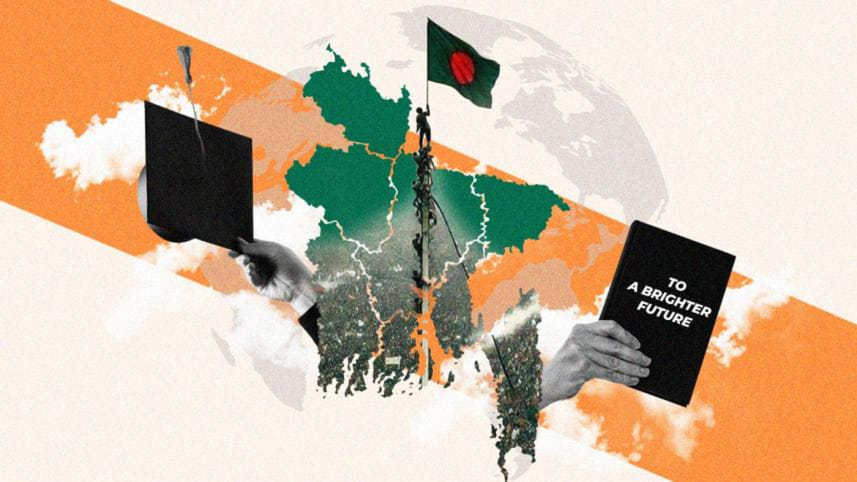
I do not think the contemporary public mood in Bangladesh can be explained only through the old argument between secularism and religion. Something else is going on, and it feels deeper. Across campuses, in political speeches, in reform talks, even in everyday frustration with corruption and disorder, I sense a search for moral seriousness. People are seeking a public life that feels cleaner, weightier, more answerable to conscience. That is why the language of this moment so often sounds ethical before it sounds ideological.
British Psychotherapist Andrew Samuels had a name for this kind of atmosphere: resacralisation. He did not mean a simple return to religion, but a broader attempt to move a sense of holiness, dignity, and ethical meaning back into the ordinary world of politics and institutions. He saw it as a response to collective disgust with public life and as a search for a new ethical basis for society. I find that idea useful in Bangladesh, because what many people seem to want now is not merely a change of rulers, but politics that can recover some moral gravity.
 For all latest news, follow The Daily Star's Google News channel.
 You can hear this most clearly in the generation shaped by July. When The Daily Star spoke to students at Begum Rokeya University ahead of the election, they did not speak in the tired vocabulary of patronage. They spoke about democracy, merit, justice, freedom of speech, unfinished trials, and the feeling that the spirit of July had not yet been honoured in practice. One student answered the question of what mattered most after graduation with a single term: “A job.” That combination matters to me. It shows that idealism here is not abstract. It is moral and material at once.
The same longing now appears in formal politics. The ruling party’s recent orientation for MPs and ministers focused on parliamentary rules, legislative procedure, and governance priorities suggests an awareness that power must be taught to behave differently this time. The health minister’s drive to remove “dalal syndicates” from public hospitals, with visible help desks and accountable officials, carries the same moral charge. These are administrative measures, yes. Yet, they also speak to a deeper public hunger for institutions that do not humiliate ordinary people.
Ramadan has exposed the contradiction with unusual clarity. A recent opinion piece published by The Daily Star put it bluntly: in much of the Muslim world, the month brings discounts and solidarity, while in Bangladesh it often brings a predictable surge in prices. A season meant to cultivate restraint becomes, in practice, a season of extraction. That detail matters far beyond the market. It tells us that public piety on its own does very little unless it is matched by a moral economy. Otherwise, holiness stays in speech while daily life remains organised by opportunism.
Still, this search for a sacred public life can fail. It fails when moral language floats above institutions. It fails when purity becomes more important than procedure. It fails when reform speaks in noble tones while old habits slide quietly through the back door.
Dhaka University’s appointment of yet another unelected vice-chancellor is one such warning. An recent editorial by The Daily Star noted Transparency International Bangladesh’s claim that, after the uprising, key university appointments were divided among major political actors and influenced by public pressure. That is exactly how moral aspiration gets emptied out.
It also fails when the language of national renewal leaves whole constituencies outside the room. Only around four percent of the candidates who contested the 13th national election were women, and only seven women were elected. So, I cannot take any rhetoric of ethical rebirth seriously unless it widens participation, especially for those who helped carry the country through its hardest moments. A sacred public life, if the phrase is to mean anything, has to be more inclusive, more procedural, and more patient than the politics we already know.
I am not calling for sanctimonious politics. I am saying that Bangladesh is clearly searching for a public sphere that people can respect again. July gave that search a new urgency. Ramadan has shown its contradictions. Reform debates are giving it institutional language. The real question now is whether we can build a politics where dignity is not ceremonial, morality is not selective, and conscience does not end where power begins. That, to me, is the real struggle underneath the noise.
Maruf Ahmed is an architect and lecturer at Khulna University of Engineering and Technology (Kuet).
Views expressed in this article are the author's own.
Follow The Daily Star Opinion on Facebook for the latest opinions, commentaries, and analyses by experts and professionals. To contribute your article or letter to The Daily Star Opinion, see our guidelines for submission.


Comments