


The burqa and the bomb: A disturbing war narrative

It is the burqa again—the piece of cloth that many Muslim women choose to wear for religious reasons. Yet this garment has been burdened with some of the harshest and most dehumanising representations imaginable.
Recently, the burqa was invoked in a shocking claim suggesting that being bombed to death would be preferable to living while wearing one. Such a statement is completely detached from the lived experiences of the women who actually wear the garment. It reflects a projection shaped by Western power, cultural hegemony, and deep-seated prejudice.
 For all latest news, follow The Daily Star's Google News channel.
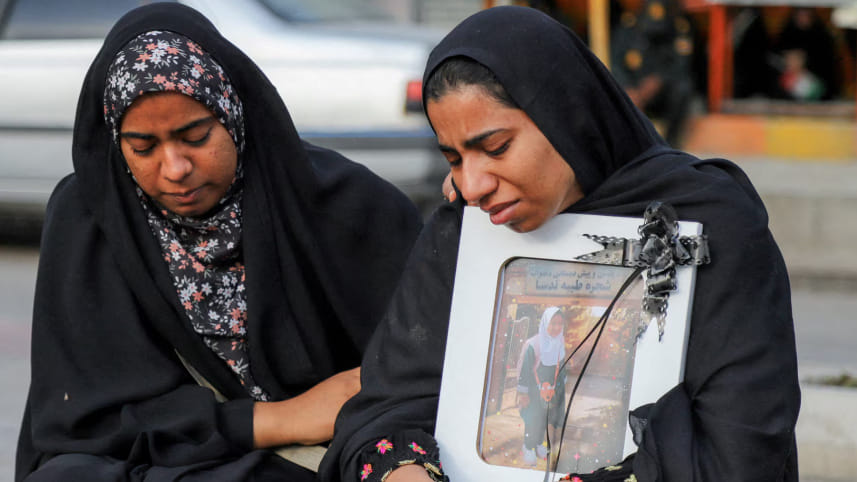
 This remark was made by Matt Schlapp, an American political lobbyist, prominent supporter of Donald Trump, and chair of the Conservative Political Action Committee (CPAC). During an appearance on Piers Morgan Uncensored, Schlapp was discussing the US–Israeli bombing of the Shajareh Tayyebeh girls’ school in southern Iran—a strike that killed 175 children, mostly girls, along with several school staff members. When journalist Peter Beinart argued that the victims would still be alive had the United States and Israel not attacked Iran, Schlapp responded that the girls would otherwise have grown up wearing the burqa—a common practice in Iran—which he described as part of a “barbaric” society.
His remark drew widespread criticism for implying that death was preferable to life in a burqa. Even though he later denied making any such comparison, no amount of backtracking can conceal the logic embedded in his statement. Anyone with a basic understanding of language and communication can see that Schlapp’s comment attempted to justify the US–Israeli attack and the killing of innocent children.
Schlapp’s theory suggests that living in a burqa is not simply undesirable—it is worse than death. By extension, millions of Muslim women who wear the burqa in other parts of the world must, in this worldview, be living lives “worse than death.” If killing girls is justified on the grounds that they might grow up wearing burqas in Iran, then the same logic could be applied elsewhere.
Wearing a burqa is neither new nor unique to Islam. Variants of veiling have existed for centuries across multiple religions and cultures. What is new are the dangerous meanings projected onto it—meanings shaped by globalisation, migration, and the encounter between diverse cultural practices. As the burqa became more visible in Western societies, it was increasingly perceived as a threat. This perception fuelled efforts to ban it in several European nations.
Dominant discourses have framed the burqa as a symbol of oppression enforced by Muslim men or theocratic governments. Burqa-wearing women are portrayed as if they were living prisons—denied freedom, mobility, or the pleasures of life. Yet, even this prison metaphor seems mild compared to Schlapp’s invocation of the burqa in the context of the US–Israeli aggression against Iran.
Invoking the burqa to justify mass murder reveals how effectively it can be weaponised.
This reference also underscores the religious framing of the war. Since the 1979 revolution, Iran has defined itself as an Islamic nation with strict religious laws. Whether all Iranians embrace these rules is a legitimate question, but what is clear is that Iran never concealed its religious identity. It also consistently stated that it did not seek war with the US or Israel, although it vowed to defend itself if attacked.
The US’s motivations, by contrast, remain ambiguous. Some explanations cite regime change, control of Iranian oil (as in Venezuela), preventing nuclear capabilities, or being pressured by Netanyahu. Others frame the war in religious terms. At times, the US casts itself as the arbiter of intra-Muslim conflicts, claiming a role in resolving the Sunni–Shia divide. This is striking given decades of portraying Islam—without distinction between sects—as a source of terrorism.
The conflict has also been framed as a “religious war” by certain circles within the US and Israel. Reports suggest American service members were told they were fighting a “holy war” against Islamic infidels. Images circulated of Christian clerics apparently praying over Trump, claiming divine anointment and suggesting the war would hasten the second coming. The “holy war” metaphor is not new—President Bush used similar language during the global war on terror. What is new is the invocation of Armageddon.
The burqa debate may now be overshadowed by official denials of responsibility for the bombing of the Iranian school. Both Trump and his defence secretary suggested the attack might have been carried out by Iran itself, although there has been mounting evidence that the US was responsible for the killings. This is also a denial of history by American leadership. Such denials fail to acknowledge the audience of their words and their actions.
As the war continues with no clear pause or resolution, one can expect the narratives to shift further—more references to the burqa or sharia, more denials, and more rhetorical manoeuvring, often with little connection to the realities on the ground.
Dr M Obaidul Hamid is associate professor in the School of Education at the University of Queensland in Australia.
Views expressed in this article are the author's own.
Follow The Daily Star Opinion on Facebook for the latest opinions, commentaries, and analyses by experts and professionals. To contribute your article or letter to The Daily Star Opinion, see our guidelines for submission.
Comments