


What Bangladesh and the Global South face

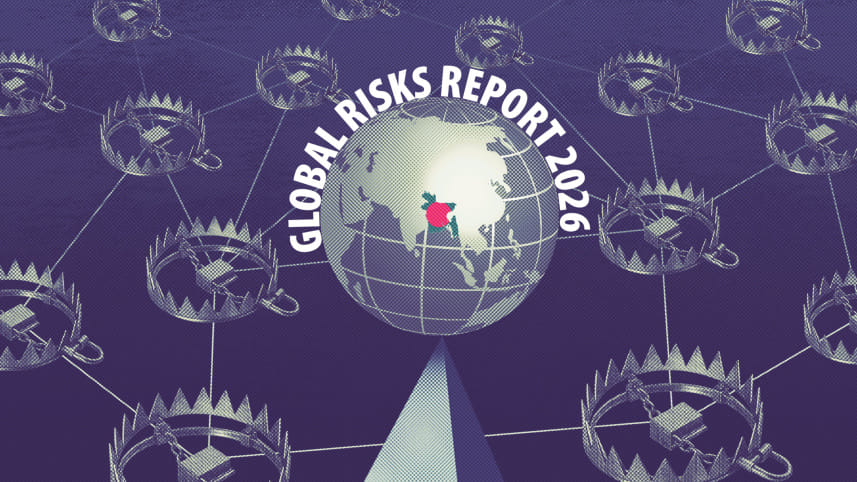
The Global Risks Report 2026, published by the World Economic Forum (WEF), presents some of the stark realities of the world today. The report, published ahead of the WEF’s Annual Meeting in Davos, Switzerland, assesses the threats countries will face in the immediate, short- and long-term. Based on a Perception Survey of more than 1,300 experts and leaders from government, business, academia, and civil society, and the Executive Opinion Survey of 11,000 business leaders from 116 countries, this report provides multi-stakeholder insights into the likelihood of various global risks and their impacts.
The report suggests the world is facing an “age of competition.” Multilateral frameworks for cooperation are weakening as major powers increasingly prioritise national strategies and leverage economic tools as instruments of power, thereby reducing mutual trust. Experts mentioned uncertainty as a greater threat than any single threat. Half of the respondents feel the outlook over the next two years is turbulent, and 57 percent expect it to remain so over the next decade. In fact, geo-economic confrontation has emerged as the top global risk, most likely to trigger a major crisis in 2026, replacing armed conflict and climate shocks at the top of the risk rankings. Created through the strategic use of economic tools—trade restrictions, tariff impositions, investment controls, currency policies, and supply chain limits—to gain a competitive advantage over other countries, geo-economic confrontation is now being used as a “weapon” in geopolitical rivalry.
 For all latest news, follow The Daily Star's Google News channel.
 This reordering of global priorities reflects a structural shift in which economic policy is no longer driven solely by efficiency and mutual benefits, but by a strategic power equation. Competition for supply chains, critical technologies, access to resources, and industrial leadership is intensifying. Economic statecraft is rapidly replacing traditional security confrontation as a key area for global competition.
In the short-term risk rankings, geoeconomic confrontation is followed by state-based armed conflict, extreme weather events, and then by societal polarisation and misinformation and disinformation. Rising inequality, erosion of human rights, cyber insecurity and adverse outcomes of artificial intelligence (AI) are other important risks the report mentions.
Over the long term, in the next decade, environmental risks, including extreme weather events, biodiversity loss, and critical shifts in Earth systems, top the ranking. This indicates that while geopolitical and economic confrontation dominate the immediate horizon, the existential threats of climate change and ecological collapse remain unresolved and severe.
The implications of the Global Risks Report 2026 are particularly crucial for Bangladesh and the Global South, because they have typically limited financial, institutional and strategic strengths to absorb systemic shocks. They are disproportionately exposed to climate impacts, more dependent on external trade and investment, and often lack diplomatic leverage to navigate geoeconomic rivalries.
In an era where economic policy is itself a battlefield, countries that are deeply integrated into global trade and investment but lack the scale to influence the rules face heightened vulnerability. Trade fragmentation, supply chain disruptions, shifting standards, and barriers to investment can all significantly affect growth trajectories.
Climate vulnerability compounds this picture in most Global South regions, experiencing intensifying floods, droughts, cyclones, heatwaves, and sea-level rise. Adaptation costs are high, and access to climate finance remains limited. Failure to address these risks could lock many developing countries into cycles of disaster recovery rather than development.
Among social risks, inequality is one of the most interconnected with implications for social cohesion, political stability and trust in institutions. Misinformation and cyber insecurity can exacerbate divisions and erode governance capacity at a time when rapid digital adoptions outpace regulatory frameworks. Therefore, the Global South will need to manage internal development challenges while navigating an increasingly competitive and fragmented external environment, with rising barriers to cooperation.
Bangladesh is an export-oriented economy integrated into global supply chains, particularly in the readymade garments (RMG) sector, and is dependent on external demand, remittances, and foreign investment. Geoeconomic fragmentation threatens preferential market access, raises compliance costs, and disrupts the very trade relationships that have driven decades of growth.
Besides, Bangladesh is one of the world’s most climate-vulnerable countries. With low-lying geography, dense coastal populations, and frequent cyclones, the country faces chronic exposure to flooding, sea-level rise, heatwaves, and salinity intrusion. Extreme weather events, identified as the top long-term risk in the WEF report, are the lived reality in Bangladesh and will continue to stress infrastructure, agriculture, water systems, and the urban environment.
Bangladesh is also highly sensitive to social and technological risk factors. The rising prominence of misinformation, cyber insecurity, and inequality in global risk rankings mirrors challenges in Bangladesh, where rapid digital adoption, urbanisation, and demographic change coexist with persistent inequity and governance gaps.
Among the top five risks identified by the Executive Opinion Survey, “crime and illicit economic activity” is ranked as the most serious risk for Bangladesh, followed by geoeconomic confrontation, inflation, economic downturn and rising debt. These five risks highlight the growing pressure on the country’s economic and institutional foundations. Illicit financial flows, smuggling, cybercrime, and money laundering weaken governance and reduce public revenue. Intensifying global trade and technology rivalries expose Bangladesh to supply chain disruptions and market uncertainty. Persistent inflation erodes purchasing power. Slower growth threatens employment and poverty reduction. Rising public debt further constrains fiscal space and limits the government’s ability to respond to future shocks.
To curb illicit economic activity, Bangladesh must strengthen law enforcement, financial intelligence, and regulatory oversight. A credible anti-inflation strategy should be pursued through close coordination between fiscal and monetary policy, so that government spending, borrowing and taxation do not undermine price stability. Prudent budget management, disciplined deficit financing, and effective interest rate policy must work together to anchor inflation expectations, stabilise the exchange rate and protect household purchasing power. Export diversification, investment-friendly reforms, and proactive trade diplomacy can reduce geoeconomic vulnerabilities by lowering dependence on a few markets and products. A broader export base, easier business regulations, and stronger trade partnerships can help Bangladesh withstand global shocks, maintain market access, and attract stable long-term investment. Prudent debt management, better revenue mobilisation, and stronger institutions are critical to achieve macroeconomic stability and sustain long-term development.
Dr Fahmida Khatun is an economist and executive director at the Centre for Policy Dialogue. Views expressed in this article are the author’s own.
Views expressed in this article are the author's own.
Follow The Daily Star Opinion on Facebook for the latest opinions, commentaries, and analyses by experts and professionals. To contribute your article or letter to The Daily Star Opinion, see our guidelines for submission.
Comments