


An ode to winter, sadness and survival

As autumn slowly, too slowly, went by I could sense the winter taking over. December came with a certain kind of sadness I cannot quite really put my finger on. There is no sharp pain or dramatic sudden grief, but a blanket of grief slowly taking over everyday lives. It's a type of longing without knowing what I am longing for. The air grows colder, harsh, the sun shy away making the days shorter, as if the world itself is taking a retreat from itself. The trees look bare, even the chaos of Dhaka seems to be more silent. Time itself moves cautiously. In this season, sadness comes without any announcement; it lingers, blends into the atmosphere until it feels almost natural.
This sadness comes with how we understand life and vitality. We are easily drawn to movement, colours and visible signs of growth. We love spring and summer because it validates us with proof of how we think life should unfold. Leaves return, plants bloom with colours of flowers and our world seems generous. Winter, in contrast, seems to remove what we have learned to associate with liveliness. Faced with this bareness we assume that something essential is missing.
 For all latest news, follow The Daily Star's Google News channel.
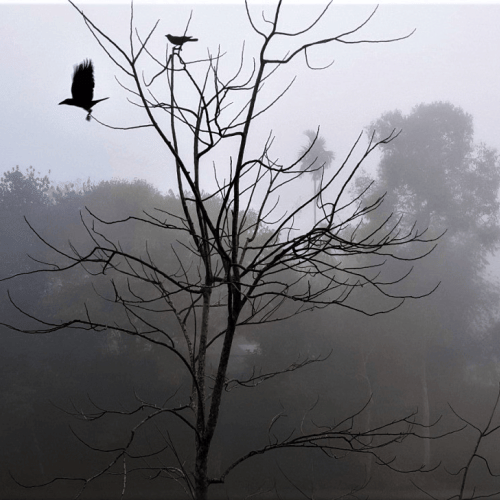
 This assumption of ours reflects a much deeper philosophical habit. We equate existence with expression. What is visible, seen and measured are valued and treated as real. What remains hidden is easily dismissed. Trees shed their leaves not due to failure but out of necessity. They turn inward, preserve energy and slow down on processes focusing on survival rather than display. What we perceive as "emptiness" from the surface is in fact a careful reorganisation of life beneath the soil.
The tree that appears lifeless is in reality, strengthening its roots. It is anchoring itself more deeply against future storms. This inward labour is slow, invisible, and uncelebrated, but it is essential. Without it, the tree could not withstand the weight of spring blossoms or the force of summer winds.
Our sadness during the winter follows a kind of similar pattern. As stimulations from the external environment fade, we are left alone with ourselves. In the absence of those, unresolved emotions and dissatisfaction may rise to the surface. Winter sadness is not just a consequence of the season, the season just creates the stage, revealing it. The cold does not invent our fragility, it makes it harder to ignore.

This exposure of sadness is not necessarily destructive. We might try to reproach our understanding of winter as a time when life withdraws itself to persist. The tree that appears lifeless is in reality, strengthening its roots. It is anchoring itself more deeply against future storms. This inward labour is slow, invisible, and uncelebrated, but it is essential. Without it, the tree could not withstand the weight of spring blossoms or the force of summer winds. In the same way, the phases of sadness might serve a different function in human life. When external momentum slows down, we are compelled to be self-reflective. Reflection replaces our movement and endurance replaces ambition. These moments might feel unproductive, especially in a culture that values constant growth and visible success. We are taught to fear stillness, to treat rest as weakness and sadness as a sign of personal failure. Winter challenges this belief by showing that withdrawal can be purposeful.
Our grief and sadness need our patience. Sadness, like winter, demands patience rather than solutions. It resists quick explanations and cannot be rushed away without cost. When we attempt to escape it too quickly, we risk ignoring what it is trying to reveal. Winter sadness invites a different relationship with time; one that allows for pauses, uncertainty, and resilience. It teaches that not all forms of growth are immediate, and not all strength announces itself.
We are taught to fear stillness, to treat rest as weakness and sadness as a sign of personal failure. Winter challenges this belief by showing that withdrawal can be purposeful.
I am not romanticising suffering or ignoring that winter can in fact bring real discomfort. Cold, isolation, and emotional heaviness are genuine experiences. But acknowledging their presence does not require interpreting them as meaningless. Just as nature does not apologise for winter, our life does not need to justify its slower seasons either. There are times when survival itself is the work being done. Ultimately, winter offers a corrective to our narrow understanding of vitality. It reminds us that life is not a constant upward movement, but a cycle of expansion and retreat. Sadness, within this cycle, is not an interruption but a phase. A phase that prepares rather than destroys. Like the tree, we may appear bare, unremarkable, or stalled to the outside world. Yet beneath the surface, something essential may be taking place.
To accept winter sadness is not to surrender to despair, but to trust in unseen processes. It is to believe that periods of quiet endurance can lead to deeper grounding. When spring eventually returns, it does not erase winter; it carries its lessons forward. And perhaps we, too, emerge not unchanged, but steadier, rooted more firmly because we once learned how to endure the cold.
Sazida Nahrin Auhona is an undergrad student who lives somewhere between art, literature, and philosophy. You can reach out to her at auhonanahrin@gmail.com
Send your articles for Slow Reads to slowreads@thedailystar.net. Check out our submission guidelines for details.
Comments