


The anxiety of facing the job market as final-year university students
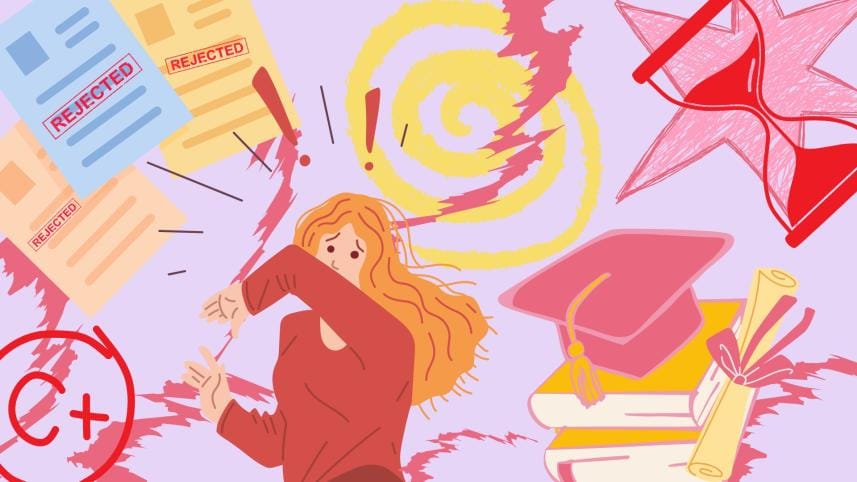
Rushing from one class to another, scrolling on LinkedIn for job openings, constantly editing and sending out your CV to employers, and wondering whether your skills and connections are cut out for today's competitive job market — this is what an average day in a final year university student's life looks like. You see your friends and classmates landing their dream jobs, and while you are genuinely happy for them, a voice deep within your mind often whispers, "When will it be my turn? Am I ready to enter the real life?"
The last dance of your university life feels like a war between excitement and panic. The uncertainty of what comes next can leave you feeling overwhelmed. Most of our university life is spent in a routine — attending classes, meeting deadlines, and worrying about our grades. But now, our anxieties extend beyond worrying about CGPA. This feeling, while excruciating, is an inevitable part of life. These feelings of nervousness and stress are not reserved for those belonging to any particular department or university; it is universal for final-year students. Some of us manage to deal with the transitional phase relatively well, while others may cave under the stress.
 For all latest news, follow The Daily Star's Google News channel.
 We asked a few final-year university students about their feelings on being in the last year of undergraduate studies and their imminent entry into the workforce. Most of them shared similar experiences — a mix of excitement, nervousness, and anxiety regarding whether they had enough skills, experience, and connections for their desired jobs.
Anika Toushin Sinthia, a final-year student from BRAC University, who is pursuing a Bachelor's degree in Computer Science with a minor in Economics, states, "The final-year of my university life has felt much more overwhelming and stressful than the past three."
Anika mentions that the reason she decided to add Economics as a minor to her profile is due to the highly competitive nature of the job market ahead. She adds, "As a final-year student, I'm seeing many of my seniors struggling to land a job in their field of study. This makes me extremely anxious about what will happen when it's my turn. Thus, as a way to diversify my profile, I decided to add Economics as a minor during the final stage of my university life."
Other than her worries about the competitive job market, she has also shared her personal struggles as a final-year student. She often ends up comparing herself to those who have already landed their dream internships or jobs, and this comparison makes her question the credibility of her skills and abilities.
Md Yasin Alam, a fourth-year student of Dhaka University (DU), studying in the Department of Communication Disorders, shares mixed feelings regarding his impending graduation. He begins, "It feels like a mix of excitement and nervousness. Entering the job market and competing with others comes with responsibilities that I have never had to take before. The fear and anticipation make the transition a bittersweet one."

His journey has made him aware of his possible shortcomings, causing him to feel somewhat unprepared for the job market. He adds, "Although we are given enough theoretical and practical exposure in the Department of Communication Disorders, I still lack a few skill sets required for my field of work. I feel that gaining more practical skills and experience, especially, would have been better for me."
Opsora Zaman Esha, a student from the Department of Journalism and Media Studies at Jahangirnagar University (JU), shares the same sentiment. She states, "Our curriculum has focused more on textbook knowledge than practical aspects such as the workings of media houses, radio stations, or newsrooms. This heavy reliance on theory has impacted my confidence in navigating the job market as I'll be required to deal with the practical side of things."
Journalism has limited opportunities in the workforce and is highly competitive, which adds to Esha's anxieties. She mentions, "As a fourth-year student, I have begun to realise that my area of study is very niche and the job market is very tight, which makes me even more worried. As such, I am considering applying for alternative career options."
According to Esha, the final-year of university has given her a reality check. This is generally the time when we reflect on our entire undergraduate journey and address the regrets of missed opportunities. Abdullah Ajmain Abir, a final-year finance major from North South University (NSU), shares his story about regrets. He says, "One of my biggest regrets is not networking enough during my university years. The university that I go to, NSU, offers a lot of networking opportunities as we have strong alumni connections and clubs. Unfortunately, I could not grasp onto said opportunities properly."
Abir believes his introverted nature held him back from seizing his chances. As a result, he doesn't feel confident about entering the workforce without a strong network.
These stories highlight the common scenarios that students go through in their final-years. The common denominator tends to be a sense of nervousness, and having to constantly polish and brush up your skills to have a shot at landing a suitable job.
It starts to feel as though the weight of the entire world is on your shoulders, yet you're expected to hold onto your sanity. Which brings forth the question, how can you stay composed during this critical stage of life? Abir shares how he deals with the unavoidable stress.
"The best way to deal with the pressure is to trust the process. I have talked to a few of my seniors and faculty members who have successfully manoeuvred this stage of life, and all of them said that it does indeed get better. It may feel very hectic and overwhelming at the moment, but having faith in the process helps."
The truth is that this universal struggle is inevitable, but very necessary for individual growth. It goes without saying that almost no one can graduate feeling fully prepared and ready. The uncertainty is what makes the transitional phase a great lesson for everyone. It's best to cope with the stress by seeking help from friends, family, seniors, or even faculty members. Support from them can make this transitional phase smoother. Every challenge that you face during this period of life helps you build confidence, courage, and adaptability, which you will carry throughout your entire career.
Shailee is a highly anxious overthinker, losing sleep over worries. Reach her at shaileenahreenkhan@gmail.com
Comments