


The English-medium student’s public university admission test dilemma
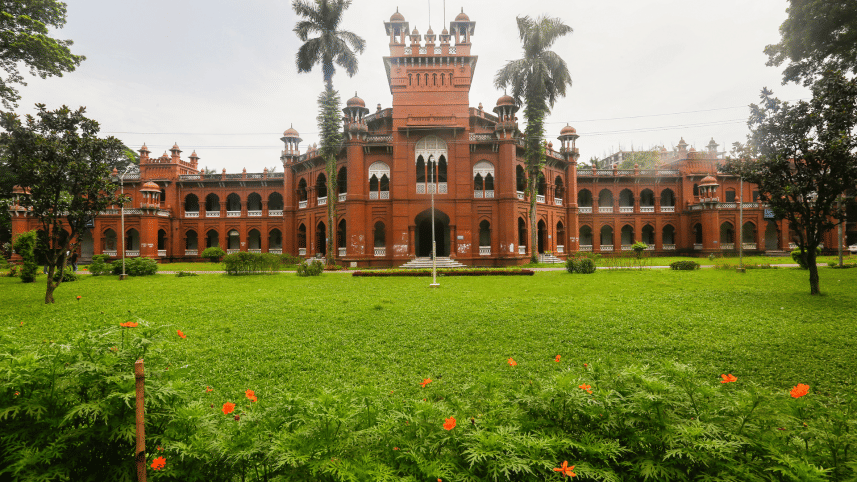
There’s a palpable unease in the months after finishing your A level exams. In addition to receiving their high school diploma, some students also receive a ticket to the chaotic journey to public university exams. Securing a seat at institutions like Bangladesh University of Engineering and Technology (BUET), Dhaka University (DU), or the country’s leading medical colleges is an ambitious dream for many English-medium candidates. While some gear up for the admission exams with determination, many step into the process underestimating what it really takes to secure a rank in these prestigious universities.
I was one of those people: dismissive, naive, and overconfident in my abilities.
 For all latest news, follow The Daily Star's Google News channel.
 Behind the multitude of examinees are competitive parents who serve as the driving force throughout the process. Starting from the hunt for home tutors and Facebook groups exchanging academic resources to racing for spots at coaching centres, these guardians have the whole agenda planned. Conversations with parents during this time often include examples of a niece or nephew who miraculously cracked the secret code to attaining public university prestige.
While parents mean to be harmlessly encouraging, it’s also easy to feel pressured when you’re being constantly compared academically. During this time, you inevitably forget to ask yourself, “Am I ready for this?”
As the public entrance exams are held under the National Curriculum and Textbook Board (NCTB), English-medium students often feel like fish out of water when they begin preparing. Their most common observation is that the board relies heavily on memorisation, an approach they weren’t accustomed to.

“We were expected to memorise things like the periodic table for chemistry, which I had never needed to do at A levels. Memorisation took away time from actually practising concepts,” said Shaira Paromita, an examinee with an English-medium background, who sat for DU’s Science unit, better known as the “A unit” admission test.
Rewiring your brain to learn an entirely new education system in the span of months requires extreme dedication and strong will. The way I studied my entire life was to understand, practise and apply. As classes continued in the coaching centre I was enrolled in, my eagerness to continue began to falter. Mathematics wasn’t just solving problems; it was also having to recall pages of extensive formula derivations.
At coaching classes, the teachers often stated that they wouldn’t be able to cover a lot of content due to a lack of time. The solution they offered for this was to memorise every book line by line, which I found impractical. There were very few people in class who questioned the methods, studying with the immense passion that I failed to develop. At the same time, my parents eagerly awaited my mock test scores to improve, and the fear of disappointing them motivated me to try harder.
A few months into the preparation, the classroom began to slowly empty out. A portion of the coaching batch left after A level results were published, being unable to qualify to sit for the entrance exams. A few weeks later, despite qualifying myself, I made the choice not to take any entrance exams. It was a decision born not out of rebellion, but of desperation. After a long period of denial, I realised that following the crowd was not a requirement. I may have had the ability to push through with enough effort, but I was no longer willing to keep myself under constant pressure. For the first time in my life, I was putting in the effort without seeing any real improvement or success.
Although I had doubts before I quit, accounts of English-medium candidates who actually sat for the exam also gave me new perspectives. A previous candidate who sat for the medical exam in 2024 shared their experience: “I studied rigorously for the medical admission test (MAT), often feeling that it was unfair that NCTB students had a head start, as they were familiar with the curriculum. The probability of getting in was already halved due to the newness of the material. It was like chasing an impossible dream.”
These discussions often raise questions about fairness. Shifting from the British or international curriculum to suddenly covering two years’ worth of the NCTB syllabus in just a few months can be overwhelming, and English-medium students are frequently at a disadvantage. Many wish to pursue medical colleges or other reputed institutions in Bangladesh, not necessarily abroad. If fairness is the goal, the system could consider aligning public university exams more closely with students’ educational backgrounds. Beyond policy, it’s also a reminder of how challenging the path can be for those navigating between two different worlds of learning.
While these systemic challenges affect every student, the experience is always personal. For me, reconnecting with fellow candidates who had also decided not to go through with it gave a sense of comfort and recognition. “It was the right decision for me. Passing public exams is not an impossible task, but it was impractical for me to master two completely different curricula with little overlap,” says previous BUET aspirant Mehrak Mizan. He continued, “I achieved three A* for Physics, Chemistry, and Mathematics in my A levels, but ultimately it was the syllabus differences that kept me from proceeding further.”
This broadens the narrative that even straight-A students can struggle to keep up with the intensity and resilience the preparation demands. The journey highlighted the sharp divide between the English medium and NCTB learning styles, showing just how academically and emotionally challenging the path towards public university admission can be.
Looking back, taking that step allowed me to regain control over my own path. The weight of expectations that had once felt unbearable started to loosen its hold. I could focus on learning in ways that suited me and rediscover my academic enthusiasm without the constant shadow of comparison. For the first time in months, I felt a sense of relief from being able to move at a pace on my terms.
Comments