


Career opportunities in Printing and Publication Studies
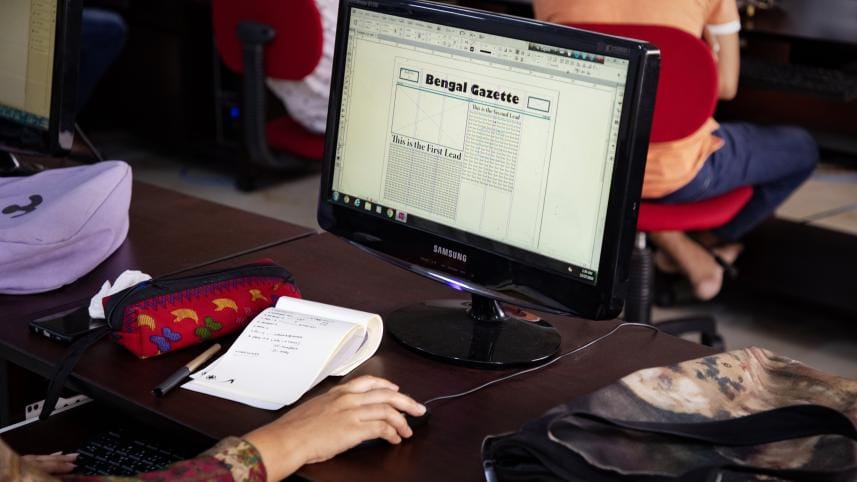
The debate of whether printed books will survive or not arose when Philip Meyer, a professor of Journalism, predicted a finite lifespan for the printed newspaper. He went further ahead and predicted that the last printed newspaper would run out of daily readers sometime around 2040. Since then, many debates have arisen, and much research has been conducted to find out whether digital publications would really take over the age-old printed publication.
According to the World Economic Forum (WEF), in 2021, 45 percent of people bought a printed book, compared to the 23 percent who bought an e-book. When the world is rapidly shifting towards a paperless digital phenomenon, in the case of publishing, debate prevails over whether print will live or die in the near future. Amid this debate, the existence of an academic department that offers honours and master's programmes on this subject might seem meaningless to many.
 For all latest news, follow The Daily Star's Google News channel.
 What is the use of studying this subject, and what will you do after graduating? These are just a few of the questions the students of this discipline face when they tell someone that they are pursuing their bachelor's degree in Printing and Publication Studies at Dhaka University (DU).
This experience is perfectly captured by Kotha Nahian, a lecturer in the Department of Journalism, Communication and Media Studies at the State University of Bangladesh (SUB), who was a student from the very first batch of this department. She recalls, "Initially, whenever somebody asked about my subject, they used to ask what this subject was and what I would do by studying this subject."
The constant questioning took a toll. She found this line of questioning to be disappointing and unmotivating.
However, Kotha explains that this initial perception is born from a misunderstanding of the programme's true scope.
"As we started progressing through the programme, we were introduced to courses like graphic design, printing methods, management, and packaging," she says.
The degree isn't just about old-fashioned printing; it was a gateway to a diverse and creative industry.
In his autobiography, Dhal Prohorer Alo, Dr Bimal Guha, the visionary behind the Department of Printing and Publication Studies, speaks about his experience studying editing and publishing in other countries, which was enlightening. This later compelled him to establish this department.
Dr Guha also realised that there was a large gap between academia and training and the printing and publishing sector in Bangladesh. Those working in the government or private companies had no formal education in this field. This lack of professionalism was evident in the publications. He believed that this kind of on-the-job training was not enough for quality publishing.
Developed countries were far ahead because they had educational programmes for this subject. For Dr Guha, the answer was clear: Bangladesh needed a proper discipline to teach printing and publishing so it could produce skilled professionals for the future. Thus, Printing and Publication Studies began its journey in 2015. Prof. Dr Sudhangshu Sekhar Roy is the Founding Chairperson of the department.

The honours programme's curriculum is structured to build a student's expertise from the ground up. In their first year, students focus on foundational skills through courses like Bangla and English Writing Skills, Basic Computer Skills, and Copy Editing and Proofreading. They study the history of printing and publishing and the global and local industry. As they advance, the curriculum delves into more specialised and technical areas.
Mohosina Islam, Assistant Professor of the Department of Printing and Publication Studies at DU, explains, "The curriculum we have designed has been created in relation to social science," she notes. "Even so, some scientific topics come up. Aesthetics will definitely come up, as it is related to publication. Students can select their profession by giving importance to their area of interest."
The ultimate goal, as Assistant Prof. Mohosina clarifies, is to prepare students for leadership roles in this specific sector. "We don't really want to see them as printers," she states. "We hope that they will be in the management of those houses. We give them basic knowledge, from the initial thought to the entire post-press process."
In this modern era, the industry mostly functions based on traditional practices. Assistant Prof. Mohosina, on this matter, shares, "Our publishers don't know these things academically or theoretically. They know it through practice. They have applied their knowledge based solely on experience and brought it to this stage. If they had theoretical knowledge alongside their experience, they could take the industry to a much better position."
The Printing and Publication Studies department has passed one decade of its academic journey. The fresh graduates are out, preparing themselves for the job market. When asked about the job opportunities in this sector, Sheikh Jinat Sharmin, an assistant professor of Printing and Publication Studies at DU, emphasises, "Graduates have several career paths, majorly divided into the printing and publishing sectors. A major field is Public Relations (PR). The publishing industry itself is highly diverse, offering opportunities in specialised areas like children's books, e-books and audiobooks. This allows students to choose a path that matches their specific interests."
In the fourth industrial revolution, new technologies are being introduced regularly. The impact is also clear on the publishing sector. Assistant Prof. Sharmin, in this regard, says, "The rise of digital and online platforms has created a large demand for book marketing. Students are well-prepared for this; learning practical skills in graphics, advertising, public relations, and packaging can contribute to both marketing campaigns and overall product design."
Even though Printing and Publication Studies is a relatively newer subject, there are interesting opportunities for graduates. Nafew Sajed Joy, a postgraduate student of this department, shares an overview of this subject in the marketplace. He shares, "When we talk about job opportunities for this subject, I think there are quite a few. However, there remains one initial problem, which is that not many people know about this department and what topics we study. So naturally, there is a gap."
As this discipline is relatively new, there have been fewer graduates out in the job market. Even though publishing has been around for a long time, it has fewer professionals. The job sector is new and expanding, which offers ample opportunities for graduates to explore.
Nafiew adds, "Besides the traditional job sectors like government jobs and bank jobs, graduates of this department can also get into media houses. If someone starts writing from an earlier stage and learns to write well, the path becomes smoother for them."
Sharing the same sentiments, lecturer Kotha says, "When I was in my second year, I had the opportunity to work as a news presenter for a television channel. At that time, my job was to edit the news reports and present them. My knowledge in editing and proofreading helped me to do the job well."
While the debate over print's survival continues, the Department of Printing and Publication Studies proves that the industry is not dying but evolving. Born from a vision to professionalise a field long reliant on informal training. The department equips its graduates with a versatile skill set, spanning from design and editing to marketing and management. Though they may face the initial challenge of raising awareness in the job market, these students are uniquely prepared to lead the industry's transformation. They are the skilled professionals who can bridge the gap between its rich history and its dynamic, digital future.
Reference:
World Economic Forum (April 21, 2021). This survey shows that people prefer printed books – even in the digital age.
Adrin Sarwar is a student of printing and publication studies. Reach her at adrinsarwar@gmail.com.
Comments