


China calls for end to war in Middle East warning of economic impact
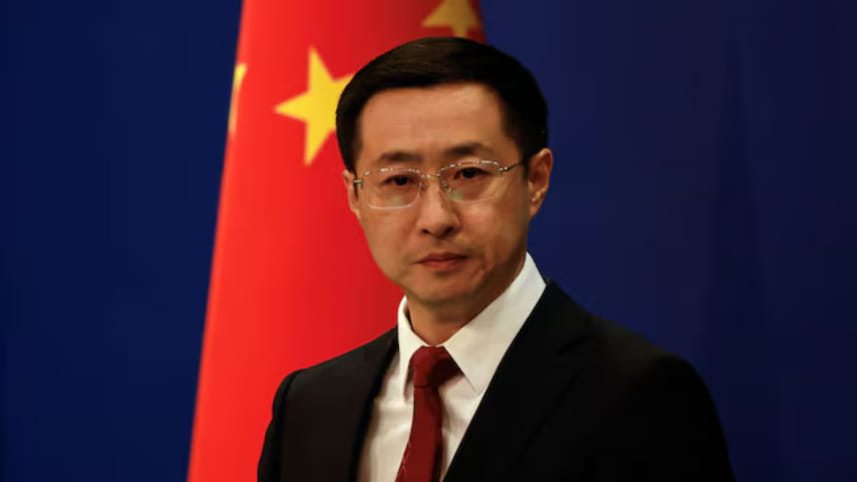
China called for an end to the war in the Middle East on Friday, warning of the impact on global energy, shipping and trade, with the near three-week conflict showing no sign of slowing.
"History and reality have repeatedly shown the world that force is not the solution to problems and armed conflict will only breed new hatred," Lin Jian, a spokesperson for China's foreign ministry said when asked whether Beijing had a message for Muslim communities as they mark the end of the holy month of Ramadan.
 For all latest news, follow The Daily Star's Google News channel.
 The "still widening war" in the Middle East harms the common interests of all countries, Lin said, repeating Beijing's position that all sides in the Gulf conflict should cease fighting and that energy flows from the region should be unimpeded.
The remarks came on the 23rd anniversary of the Iraq War, which began in 2003 when US-led forces invaded Iraq to oust Saddam Hussein, partly on claims that his government possessed weapons of mass destruction.
That war resulted in years of chaos and instability and created a power vacuum that led to the rise of the Islamic State terrorist group.
The US-Israeli war has uneven consequences for China. Analysts say the conflict gives Beijing an opportunity to cast itself as the more reliable superpower. However, the higher energy costs threaten its manufacturers and could trigger higher inflation if the conflict continues.
The uncertainty also threatens to disrupt Chinese President Xi Jinping's flagship "Belt and Road" initiative.
Parts of the project run through the region and help move Chinese goods to key export markets in the Gulf, North Africa and Europe at a time of heavy reliance on external demand due to depressed domestic demand.
The war has led to a meeting between Xi and US President Donald Trump to be delayed for about a month and a half. Trump's China trip had been seen as a chance for a reset in relations between the two economic superpowers that have been rattled by US tariffs.
Comments