


Ramadan supplies adequate, but Ctg feels port backlog impact


With Ramadan at the doorstep, price movements in the essential commodities market present a mixed picture. Analysis of import data and market visits suggests that while overall import volumes of major Ramadan essentials are higher than last year, temporary logistical constraints have influenced price trends in certain wholesale hubs.
In Chattogram, the country’s main port city and wholesale nerve centre, traders are reporting price increases of chickpeas, sugar and lentils. They blame a short-lived strike at Chattogram port, which handles some 90 percent of the country’s external trade, and election-related holidays for creating a supply bottleneck precisely when pre-Ramadan demand was building.
 For all latest news, follow The Daily Star's Google News channel.
 In Dhaka, traders say prices of edible oil, sugar and pulses are stable or returned to normal after a brief spike. Fruit and dates importers in the capital report no upward pressure whatsoever.
PORT BACKLOG BITES
A visit to Chattogram’s Khatunganj, one of the country’s largest wholesale commodity markets, yesterday showed lively trading activity. Trucks were unloading items as traders prepared for the seasonal spike in demand.
According to data from the National Board of Revenue (NBR), imports of most Ramadan essentials have increased over the past two and a half months compared to the same period last year.
Importers also say there are no shortages. “Every item, including sugar, oil, salt, flour and pulses, is available. There is no shortage of any fast-moving consumer goods products,” said SM Mujibur Rahman, head of accounts of Meghna Group of Industries, a major commodity processor and importer.
NBR data shows that edible oil supply has been particularly robust. Between December 1 and February 16, combined soybean and palm oil imports were 5.84 lakh tonnes, up by about 27,500 tonnes year-on-year. Soybean seed imports also rose 16 percent to 6.86 lakh tonnes, which can yield around 1.21 lakh tonnes of oil after crushing.
With and estimated Ramadan demand for edible oil ranging between 3 lakh and 3.5 lakh tonnes, import volumes appear more than adequate.
Sugar imports during the same period reached 4.85 lakh tonnes, nearly 40 percent higher year-on-year, against an estimated Ramadan demand of around 3 lakh tonnes.
Revenue board data also shows that lentil imports totalled 2.29 lakh tonnes over the past two and a half months, about 43 percent higher than in the corresponding period last year. Chickpea imports stood at 1.59 lakh tonnes, exceeding the typical Ramadan demand of roughly 1 lakh tonnes.
Yet, wholesale prices have edged up in recent days due to the port strike earlier this month and later amid holidays during the national parliamentary elections, claim traders.
Ehsan Ullah Zahedi, owner of Al Madina at Khatunganj, said delayed unloading during the port disruption tightened short-term supply. “Chickpea prices increased by Tk 5 to Tk 8 per kg depending on quality. Supply has resumed now, and we expect prices to stabilise soon.”
At the beginning of February, standard-quality chickpeas were selling at Tk 74-Tk 78 per kg at the wholesale level. Prices have now increased to Tk 78-Tk 87 per kg, depending on quality. Retail prices range between Tk 82 and Tk 95 per kg.
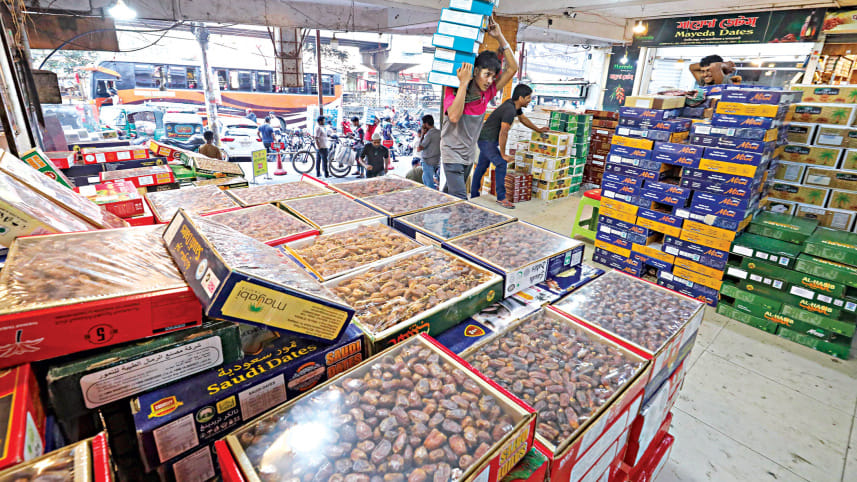
Meanwhile, traders say imports of dates, another Ramadan staple, dipped slightly to 39,000 tonnes year-on-year but were supplemented by carryover cold storage stocks. Earlier imports had peaked at 47,073 tonnes under a reduced-duty window.
Nurul Azim Munna, proprietor of Amena Traders at Khatunganj, said dates are now selling between Tk 250 and Tk 1,600 per kg, depending on quality, marking a 5 to 7 percent increase over the past week.
“Imports increased after the duty cut, and more consignments are in the pipeline. Once those are cleared, supply will improve further,” he said.
Wholesale sugar prices have increased by about Tk 5 per kg in the past week to Tk 110, while onions are selling at Tk 45-Tk 50 per kg. Lentils have risen by Tk 5 per kg to Tk 75-Tk 77.
Retailers say consumers are already feeling the pressure.
Ehsanul Haque, owner of Mohammadiya Store in the Muradpur area, said retail traders have adjusted prices in line with the wholesale market.
“When wholesale prices go up, we have to follow. Customers are complaining, especially about chickpeas, sugar and oil. Demand is rising every day as Ramadan approaches,” he said.
DHAKA: TCB SHOWS HIKE, TRADERS CLAIM STABILITY
An analysis of data from Trading Corporation of Bangladesh (TCB), which keeps track of essential commodity prices in the capital, shows that over the past week, the price of loose soybean oil has increased by 0.28 percent, and the price of lentils has risen by 2.70 percent.
Traders, however, claim that prices are stable. At Dhaka’s Moulvibazar, a major wholesale hub for sugar and edible oil, trader Abul Hashem said prices of most Ramadan-linked items are generally stable and supply remains normal. “Sugar prices had increased earlier but have since returned to normal.”
Retailers at Karwan Bazar, one of the largest kitchen markets in the capital, echoed similar trends.
Mohammad Bablu, a retailer there, said prices of edible oil and red lentils had ticked up slightly a few days ago but have since stabilised. “The prices of products that typically see higher demand during Ramadan are fairly stable.”
Mohammad Sohail, a Dhaka-based fruit importer, said the price of dates has remained steady over the past week, as supply is sufficient. “No price hike is expected in the coming days.”
Comments