


The renewables gambit: Race against time and tariffs

Bangladesh’s garment sector faces a blunt ultimatum from its largest export market. When the European Union’s (EU) carbon border adjustment mechanism (CBAM) takes full effect in 2030, Bangladeshi exporters unable to demonstrate meaningful decarbonisation may see orders evaporate overnight.
The South Asian Network on Economic Modeling (Sanem) estimates a potential 30 percent drop in exports to the bloc, which will likely devastate the garment industry, responsible for over 80 percent of national export earnings.
 For all latest news, follow The Daily Star's Google News channel.
 This is not hypothetical posturing. Global apparel brands have already committed to emissions targets aligned with the mechanism. American Eagle now demands that at least 10 percent of the electricity used by its tier-one and tier-two suppliers comes from renewables. Levi Strauss and GAP have pledged to cut emissions by 42 per cent by 2030.
The ruling Bangladesh Nationalist Party (BNP) has set an ambitious target in response: 35,000 megawatts of power generation capacity by 2030, with renewable energy accounting for 20 percent of the total mix -- roughly 7 gigawatts.
However, the gap between aspiration and reality remains vast, and a poorly conceived tariff structure stands in the way of achieving this target.
COMPETITIVENESS GAP
Bangladesh is falling behind its direct competitors in the race toward industrial decarbonisation. While regional rivals rapidly green their industrial grids to meet Western buyer demands, Bangladesh’s heavy reliance on fossil fuels places its exporters at a distinct disadvantage.
India’s renewable energy share has reached over 50 percent, buoyed by strong federal incentives, government data shows. States like Karnataka and Tamil Nadu offer wheeling charge waivers that enable high industrial renewable uptake.
Cambodia derives 62 percent of its power from renewable sources -- its high reliance on hydropower provides a naturally lower carbon footprint for its textile sector. Meanwhile, Pakistan’s renewable share stands at around 46 percent as of September 2025.
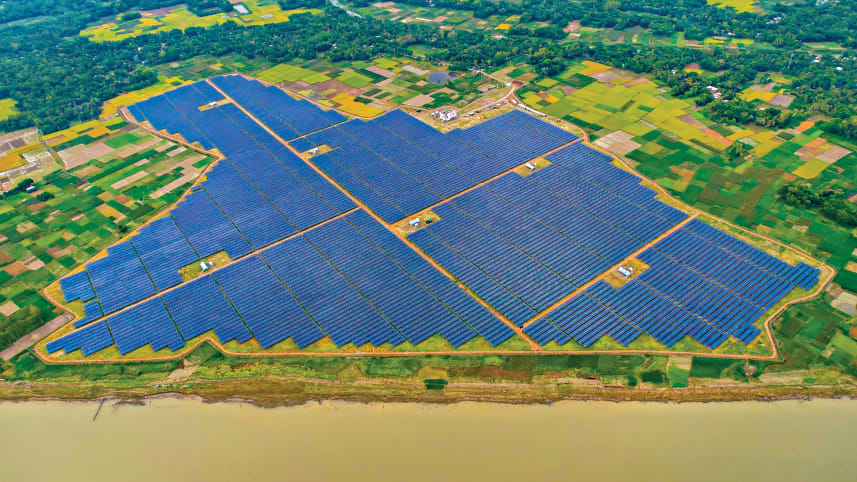
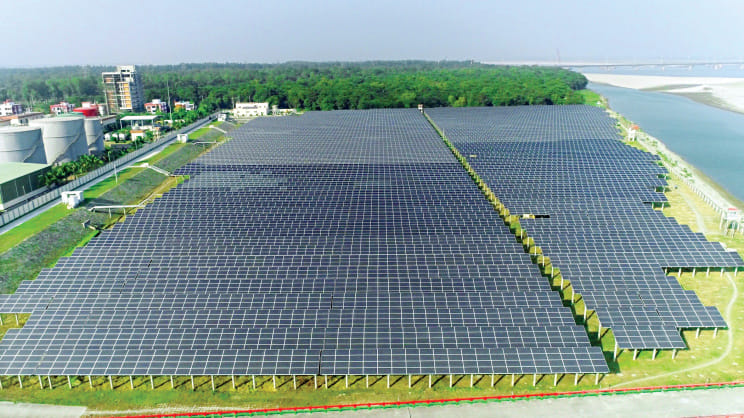
Bangladesh, by contrast, has installed just 5.38 percent renewable energy capacity for electricity generation, according to the Sustainable and Renewable Energy Development Authority. Solar energy dominates this meagre share.
Without effective merchant power projects -- private power plants that sell electricity in the open market without specific power purchase agreements -- this gap is likely to widen, isolating Bangladesh from premium markets.
The problem extends beyond generation capacity. Bangladesh’s existing renewable energy targets have been formulated primarily from a supply-side, “grid-mix” perspective.
Analysts point out that this approach focuses on total capacity but fails to account for the distinct, additional renewable electricity demand required by export-oriented industries.
OVERDEPENDENCE ON IMPORTS
Bangladesh’s power and energy sectors are struggling with rising financial losses, mounting public debt and an increasing burden from fuel imports.
Heavy dependence on imported fossil fuels, particularly liquefied natural gas (LNG) and crude oil, has made the country highly vulnerable to global market volatility and geopolitical shocks.
Domestic gas output has stagnated, prompting imports since 2018 through floating storage and regasification units at Moheshkhali. In 2025, Bangladesh imported 109 LNG cargoes worth $3.88 billion, up from 86 cargoes costing $3.02 billion in 2024, according to LightCastle Partners.
Recent tensions in the Middle East, which play a crucial role in global energy supply chains, have heightened the urgency of reform. Renewable energy offers a path toward both export viability and energy security.
But meeting the 7-gigawatt target will require more than good intentions.
Mustafa AK Khan, founder and managing director of FloSolar Solutions Ltd, argues that rooftop solar plays an important role but cannot deliver this scale within the required timeframe due to structural limitations and fragmented deployment.
His company recently signed 320-megawatt-peak agreements for merchant power projects with four multinational companies.
“Utility-scale merchant power projects are critical to unlock suitable land, achieve economies of scale, and attract long-term institutional capital,” Khan said.
“A predictable wheeling and tariff framework would enable faster grid integration, competitive tariffs, and bankable structures for industrial consumers. Necessary investment is not the problem -- the problem is supportive policy,” he added.
TARIFF TRAP
A policy has been formulated to enable private-sector investment in large-scale renewable energy. Yet the current regulatory proposal threatens to render it ineffective before launch.
The proposed tariff structure -- specifically, the inclusion of a Tk 2 to Tk 3 per kilowatt markup for legacy public subsidy recovery -- creates a prohibitive cost barrier that makes merchant power projects commercially unviable compared to grid power, according to industry representatives.
The Bangladesh Garment Manufacturers and Exporters Association (BGMEA) recently submitted an observation on the proposed tariff to the Bangladesh Energy Regulatory Commission (Berc).
The association argues that the markup artificially inflates utility costs for manufacturers already operating on thin margins, destroys the “bankability” of projects by deterring developers and lenders from committing capital necessary to build infrastructure by 2028.
Furthermore, it creates an environment where Bangladesh cannot compete with nations like Vietnam and India, noted the BGMEA.
“We call for a cost-reflective tariff based strictly on wheeling charges, decoupling private transmission from public subsidy recovery,” the BGMEA stated. “This adjustment is essential not only to secure the RMG sector’s survival but to safeguard the foreign exchange inflows and employment stability that underpin the Bangladesh economy.”
Vidiya Amrit Khan, vice president of the BGMEA, said the proposed framework may place additional financial pressure on private green energy procurement. “Our manufacturers are already operating on very tight margins, and any increase in utility costs directly affects their competitiveness and long-term investment decisions.
“Investing in energy transition is capital-intensive, and the return on investment takes time. Therefore, flexibility for factories is crucial during this transition period,” she added.
Echoing the concerns, Shahed Alam, Robi Axiata’s chief corporate and regulatory officer, said, “To scale up sustainable power generation, a favourable pricing policy is essential.”
He cautioned, “If industries need to spend much more to use renewable energy, it will not become popular, as it will directly impact their bottom line.”
Alam urged the government to address structural barriers in the energy market, particularly wheeling charges -- the fees paid for transmitting electricity from producers to consumers through the national grid.
“The government should find a way so that wheeling charges do not eat up the whole dream of making renewable energy popular in the country,” he added.
Jalal Ahmed, chairman of Berc, said the charge has not been officially implemented and remains at the discussion level among agencies like the Bangladesh Rural Electrification Board.
He said, “The government wants to implement the policy so that renewable energy can be boosted in the country. We will organise a meeting soon so that all stakeholders can transfer their views, reach a point and implement the policy.”
Speaking at a recent event, Khondaker Golam Moazzem, research director at the Centre for Policy Dialogue (CPD), said that despite continuously emphasising the impact of unfair tariff barriers on renewable energy generation, the rates remain higher than those of fossil fuels.
He pointed out that import duty, customs duty and tax on solar panels, solar inverters and mounting structures reach 58.6 percent. Lithium-ion batteries face the same rate, while lead-acid batteries carry an 89.32 percent levy.
Advance income tax, regulatory duty, and supplementary duty further discourage investment, he added.
EARLY MOVERS
Some firms, however, are not waiting for policy clarity.
Ha-Meem Group, one of the largest RMG exporters of the country, has established rooftop solar capacity to generate 12 megawatts of electricity, mainly targeting continued orders from buyers after 2030 and ensuring energy security, according to AK Azad, managing director of the group.
“By setting up rooftop solar, we are getting a good advantage. For example, during loadshedding, it works as a backup,” said Azad, a former president of the Federation of Bangladesh Chambers of Commerce and Industry.
The system supplies electricity to the government through a net metering arrangement during load-shedding, adjusting the company’s electricity bill accordingly.
“If we could not have renewable energy, we would have needed to depend on generators and diesel during load shedding. It would be highly costly and even problematic during the situation now prevailing amid the US-Israel war on Iran,” he added.
Azad received subsidised funding from the central bank through IDLC Finance for his first solar installation. He argues that it should be continued to attract other firms to set up renewable energy. “If the government gives support now, it would benefit the government in future as it will get a chance to reduce subsidies in the electricity sector.”
Bangladesh’s gambit is clear: achieve rapid decarbonisation or risk losing access to its largest export market. With four years until the EU mechanism takes full effect, the window for building the necessary infrastructure is narrowing.
Whether the government dismantles the regulatory barriers strangling renewable deployment, or allows them to persist, will determine if Bangladesh’s garment sector retains its competitive edge or watches orders migrate to rivals already racing ahead.
Comments