


A tangled knot of wealth and sin
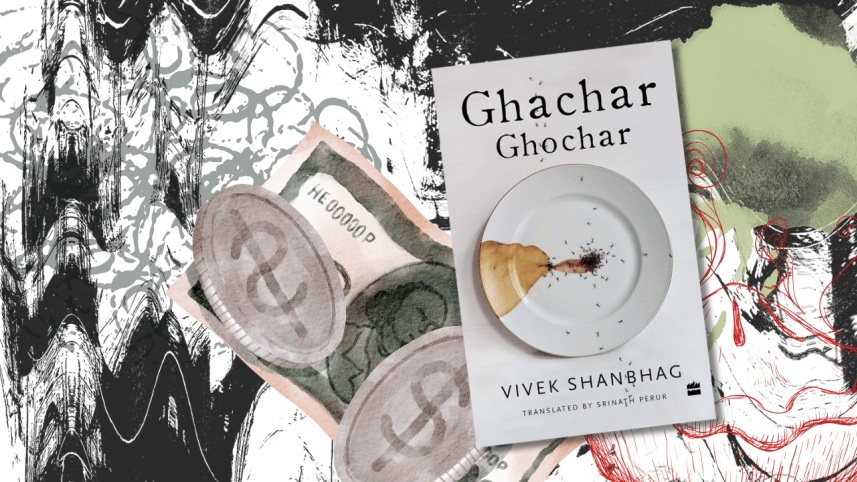
Money is a means of attaining power, especially in a capitalist society; thus, it is a great temptation. The clutch of this temptation becomes harder to control when money, suddenly, becomes a constant in one's life. "Ghachar Ghochar" by Vivek Shanbhag is a rags-to-riches story where money comes as an unprecedented visitor. It transforms the fate of a South Indian joint family situated in Kerala, which experiences an overnight financial miracle. The title "Ghachar Ghochar" is a nonsensical phrase created by the author through his characters, described as a tangled knot that refuses to come undone. Eventually, the enticement of power and money creates intricacies in each of the characters and blurs their rationale.
The novella has six characters: the unnamed narrator, Appa, Amma, Chikkappa, Anita, and Malati. The antagonist in this novella is money, which starts to control the whims of every character. Although none of the characters admit it, or in some cases acknowledge it, their actions say otherwise. Ultimately, they end up possessing at least one of the seven deadly sins.
 For all latest news, follow The Daily Star's Google News channel.
 The novella is written from the perspective of an unnamed narrator, who represents sloth. He is a nostalgic and unambitious man. Legally and on paper, he is the director of their family business, Sona Masala, although he does no actual work. His entire work at the office comprises signing a document or two sent to him by his uncle throughout the day, yet, he receives a hefty salary every month. The narrator spends the remainder of the day in a café called Coffee Shop, which he visits every day to reminisce about his and his family's moral downfall. On the other hand, he lacks the courage to vocally express his opinions, as being reticent is his superpower. He uses the café to escape the boredom at the office and the chaotic space at home.
Chikkappa, embodying greed, is the narrator's paternal uncle, his father's younger brother and the breadwinner of their family. He is also the brain of the family enterprise. He is the only one who knows every nook and cranny of the business. To protect the firm and their current family fortune, Chikkappa has employed unethical means—even if it includes killing off his kin—which is an open secret and never outrightly mentioned by other characters. Furthermore, he praises and justifies this perception of protecting one's legacy.
Malati, who signifies wrath, is the narrator's younger sister who lives with them. She is the youngest and the most spoiled member of the family. Her spoiled nature is the reason behind her divorce. Although she has always been impatient by nature, the immense wealth brought within her a transformation beyond recognition. As a result, her temper has become volatile, her expectations became unrealistic, and her mouth became verbal bombshells. She develops larger-than-life expectations that she deserves royal treatment. Failing to meet those expectations ends in terrifying consequences. For example, Malati broke an entire tea set when her mother-in-law asked her not to open the new tea sets when her parents visit and instead serve in the cups that they regularly use at home. On another account, Malati hires hooligans to harass her ex-husband and in-laws when she visits them for the last time.
However, the sin of wrath is present also among other female characters: Amma and Anita. All of them willingly and voluntarily participate in a war of words, which is never openly directed at any other members. Instead, they are guided under an innocuous statement that peels like onions, leaving everyone around them teary-eyed.
Other of the seven deadly sins explored in the novel is gluttony—embodied in the narrator's mother—and pride, represented by his wife, Anita. Money has opened up doors for Amma that previously never existed and has produced a shopaholic. During her daughter's wedding, the numbers and varieties of dishes served to guests become a favourite topic of discussion in the town as all the dishes that the caterer suggests for the wedding are selected. Additionally, the narrator points out how Amma drowned herself in gold jewelry at the wedding, which outshone even the gold-decked bride herself. On the other hand, Anita has high morals and takes pride in the values instilled by her birth family. As a matter of fact, her pride in those values makes her protest against everyone who challenges her beliefs. Anita believes having strong ethics and acting on them makes her invincible; however, the reality seems different. For example, after the marriage, Anita learns about her husband's unemployment and his lack of ambition, leaving her disappointed. Unable to accept the betrayal, Anita initiates petty fights with her in-laws, even though only Malati and Amma participate with equal rigour. More often than not, Anita loses these fights but she neither sees their futility of those fights nor their potential to kindle a fire that can incinerate her as well.
In retrospect, it seems that two sins, lust and envy, are absent—perhaps due to the length of the book, which limits further exploration of the characters. "Ghachar Ghochar" depicts characters who are eccentrically misshapen. It brings a realistic, albeit erratic, portrait of a rags-to-riches story. Although money is clearly the antagonist in this story, I'll leave it to the readers to decide whether the fault lies in the sudden change in fortune or hides latently within them, where money acts as a catalyst.
Tahmina Hossain is first and foremost a reader, a lover of literature, and then a writer. If you enjoy rambling about literature like her, then reach out at: literary.ramblings.by.t@gmail.com.
Comments