


Cross and concrete: Christianity’s built contradictions
The story of Christianity spans more than two thousand years, and as the world's largest religion, it commands respect from billions—each with a story woven into the wider tapestry of human experience. While Christianity has spread throughout the world, it has largely been understood through the lens of "the west". Yet, the oldest Christian churches stand in the Middle East, where the community has shrunk exponentially and ancient churches remain under constant attack by zealots and religious nationalists alike. The Greek Orthodox Church of Saint Porphyrius in Gaza comes to mind, recently damaged during the Israeli army's campaign against the Palestinian people and their heritage.
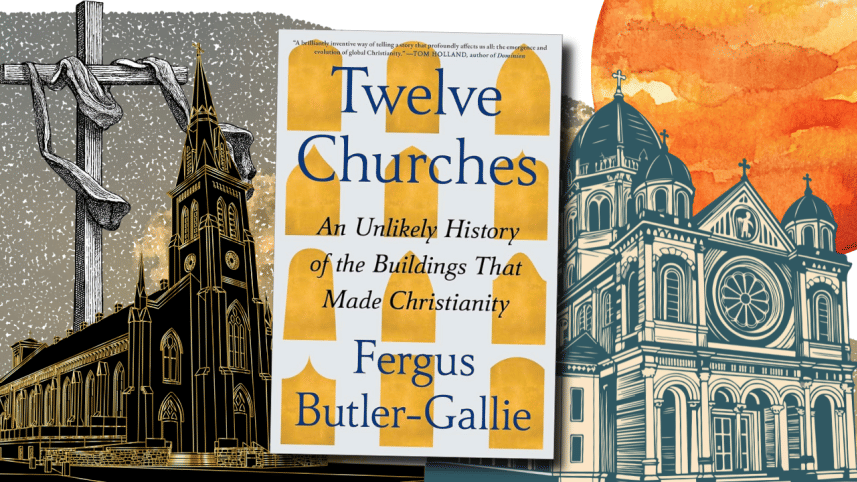
It is precisely this paradoxical history told through the entanglements of hope, persecution, and resilience that Fergus Butler-Gallie charts in his globe-trotting text, Twelve Churches: An Unlikely History of the Buildings That Made Christianity. An ordained Anglican priest, Butler-Gallie blends history, culture, anthropology, and human experience, exploring these buildings and the symbolic value they hold in the making of the faith itself. The structures range from an iconic church-turned-museum-turned-mosque (Hagia Sophia, Turkey) to megachurches (Lagos, Nigeria) to shrines (Kasuga, Japan). These buildings represent what the author calls the "messiness of the practical living of Christianity", a theme he warns will define the journey.
 For all latest news, follow The Daily Star's Google News channel.
 Butler-Gallie's first stop is the Church of the Nativity in Bethlehem, where Jesus Christ—the central figure in Christianity and revered in Islam—was born. The building of this church at Christ's birthplace cemented the spread of the faith in the Roman Empire. Built by Constantine the Great on the orders of his mother, Helena, the faith's early expansion owed much to this mother-son duo who saw in Mary and Jesus's relationship a mirror of their own. Described as "a complex living organism" rather than a static building—due to its history of withstanding natural disasters, internecine religious and national squabbles, and iconoclasm—the church symbolises not merely a persecuted faith through its structure, but through its followers who made it represent the "beautiful paradoxes of the Christian faith." Gradually, the author's journey takes us from the emergence of the Roman Catholic Church named after the martyr Saint Peter to Canterbury Cathedral, where the murder of Bishop Thomas Becket not only shaped Christendom in the heart of the empire but inspired the Middle English verse-collection The Canterbury Tales.
Butler-Gallie's narratives do not delve into the architectural minutiae of these buildings but instead highlight the wider narratives of placemaking and its impact on the modern world. Confronting the faith's history involves an honest reckoning that includes both its persecution and its role as persecutor of Jews, Muslims, pagans, and those who were not quite "Christian". He weaves a synthesis of storytelling that is beguiling and shocking in equal measure.
This comes through most vividly in the chapters on churches in Latin America and Japan, located on separate continents and carving different mosaics that make up global Christendom. Originally founded in 1494 by Christopher Columbus, Templo de las Américas in what is now the Dominican Republic centres the story of the church in the age of expansion and exploration. The church became the site of an "inter-continental encounter" between Spaniards and natives—a relationship forged through faith, fortune, violence, and the gradual Christianisation of a continent that today houses some of the world's most diverse and largest Christian communities. The nuances of historical information alongside the plethora of compelling characters in these 12 chapters make every church encounter a reflective and engaging read. While persecuting Muslims and Jews in Spain, the Roman Catholic Church sought converts in the New World, often with bloody consequences. The Church's excesses were critiqued by proto-human rights activists such as the Spanish clergyman Bartolomé de las Casas, signaling different interpretations from a single source. A single story, it seems, has many heroes and villains, with many straddling both worlds.
In Japan, by contrast, the kakure kirishitan (hidden Christian communities) represent a story of survival and resilience of a faith that has endured to this day under state-sponsored persecution and forced assimilation. The site highlighted is not a church but a shrine, signaling a syncretisation of local culture with a faith originating from an era and place thousands of miles away, where Buddhist and Shinto deities were used as depictions of Christ and the Virgin Mary.
While the book mentions churches in India threatened by a Hindu nationalist government, one mild criticism is the absence of churches in South Asia, where one of the oldest and most vibrant Christian communities calls home. In an era when Christian heritage faces threats from Gaza to India, Butler-Gallie's historical lens offers essential context for understanding faith's enduring yet endangered material presence. Twelve Churches succeeds in its ambitious goal of revealing Christianity's global complexity through architecture and human stories, embracing the deepest contested contradictions that add to the pageantry of religious faith in the modern world.
Israr Hasan is currently working as researcher in a public health institute.
Comments