


Singing a 900-year-old song: Exploring Rubaiyat of Omar Khayyam with Zeba Rasheed Chowdhury
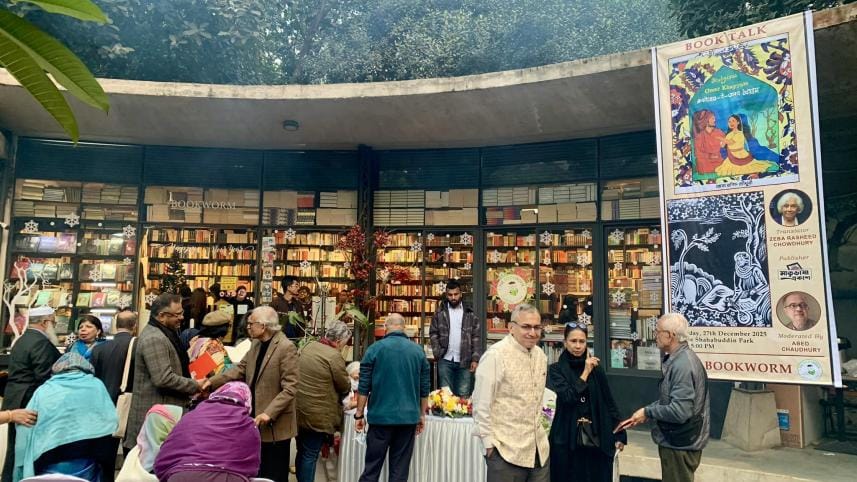
Since being translated into English by Edward Fitzgerald, the Rubaiyat of Omar Khayyam has been one of the most widely discussed poems among literary critics worldwide. But unfortunately, Khayyam is not much discussed in Bangla, even though poets like Kazi Nazrul Islam have cited him as one of their inspirations. Zeba Rasheed Chowdhury's latest work, the translation of the Rubaiyat of Omar Khayyam into Bengali, published by Matribhasha Prokash, aims to fill this void. A book talk on this book was held on 27th December 2025, at Bookworm Bangladesh.
 For all latest news, follow The Daily Star's Google News channel.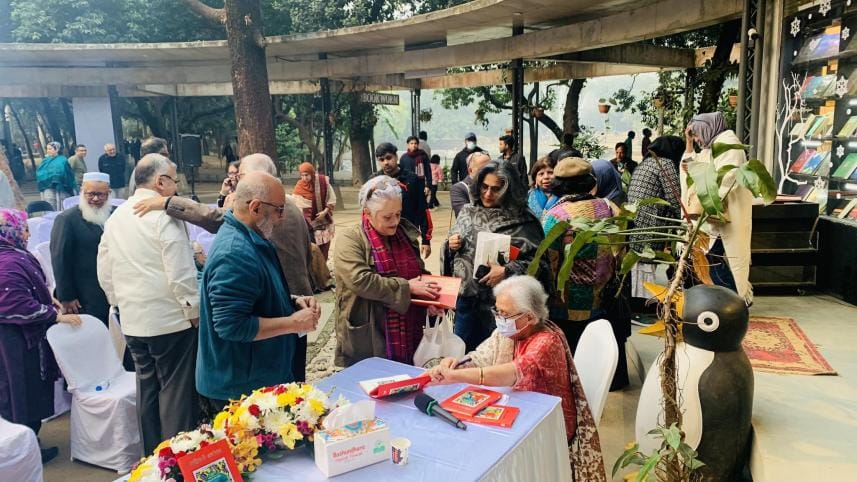
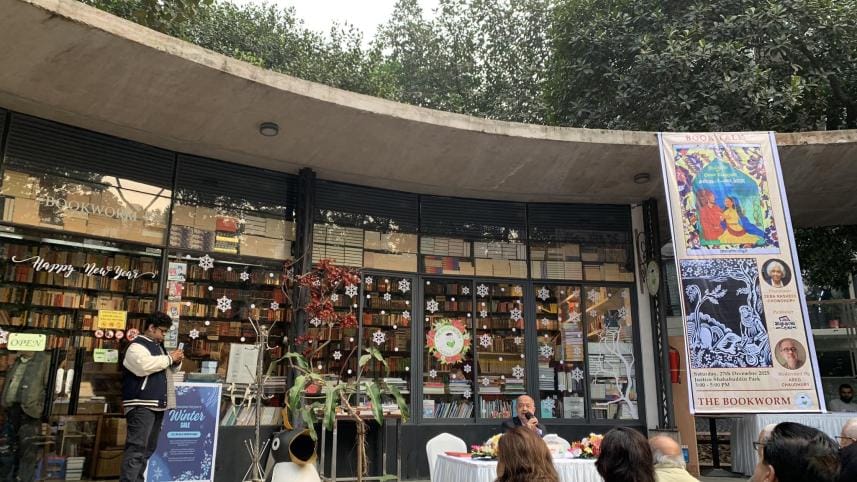
The event was hosted by scientist and writer Dr. Abed Chaudhury. He commenced the book talk by describing his own fondness for Farsi, the language of Khayyam. The Farsi or Persian language was banned as an official language in colonial India after 1860, and due to this restriction, the practice of Farsi died down slowly, even among the muslim community in this region. The tremendous legacy of Farsi poetry—Rumi, Hafiz, Khayyam, Sheikh Saadi—were neglected in Bengal.
There was an attempt to revive Khayyam through translation of his work, first by Kanti Chandra Ghosh, and then by Kazi Nazrul Islam. But again, that didn't last. This is the context, Abed Chaudhury explained, under which he considers Zeba Rasheed Chowdhury's work an important contribution - to reclaim the lost heritage and practice of Farsi literature in Bengal.
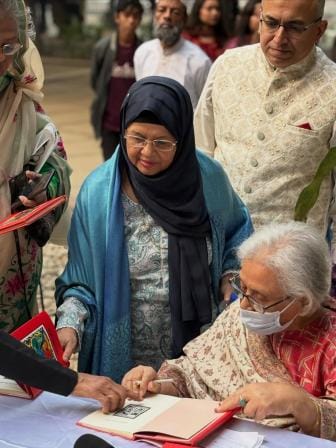
After him, the author's son spoke a few words regarding his mother's peculiar writing habits; the sudden explosion of creativity which forced her to write a lot in a few minutes, before she jumped back to her normal life and did not write for months. He shared how the manuscript of this specific book, the translation of Rubaiyat, was found suddenly while their house was being reorganised. After him, Nesar Uddin Ayub, the head of the publishing house Matribhasha Prokash took the stage and expressed his heartfelt gratitude for being able to publish the Bangla translation of Rubaiyat of Omar Khayyam. Khayyam, being much more prominent as a mathematician and astronomer, was not much recognised for his poetry before the 19th century when Fitzgerald translated him into English. It has been almost 900 years since his death, but still his words strike a chord among his readers who are from a time and place radically different from his. Ayub concluded his speech by saying that this timelessness of Khayyam would make him relevant from centuries to centuries, inspiring many more translations, debates and discourses.
Finally, the author Zeba Rasheed Chowdhury herself took the stage. She spoke about why Khayyam inspired her in the first place in childhood. It wasn't poetry per say, rather the pictures of the Fitzgerald edition which attracted her. After growing up, she revisited those poetries and took the initiative to translate them one by one, purely out of her passion. These translations were scattered all around in different places until they were collected together and published at the initiative of Abed Chaudhury. She thanked everyone for joining the talk, and the event ended with a round of applause.
Sadman Ahmed Siam, as the name suggests, is indeed a sad man. Send him happy quotes at: siamahmed09944@gmail.com.
Comments