


Lessons from our literary girls: Why freedom framed as favour is no freedom at all
The world has not yet opened its shutters, but she has already completed a shift no one will count. Her day begins not with ambition, but with obligation, as she swallows her own hunger so that breakfast reaches the table on time. She leaves one workplace only to step into another. So when a proposal arrives promising five hours of work for eight hours of pay, it lands strangely. Sweet on the surface, but with an aftertaste she recognises. As if the parts of her that hunger for purpose and self-definition can be gently trimmed to fit someone else's idea of comfort.
Fiction has long chronicled that women have always worked more than what is counted, felt more than what is acknowledged, and lost more than what anyone will ever quantify. Would the girls we read about in books thank us for the certain policies framed as generosity, or would they warn us that such gifts often come at a cost? Female characters have wrestled with expectations disguised as care, with social regulations presented as protection, and with choices curtailed under the guise of integrity. Literature teaches us that the most dangerous forms of control do not begin with force. They begin with sentiment. They begin with praise. They begin with the soft language of concern.
 For all latest news, follow The Daily Star's Google News channel.
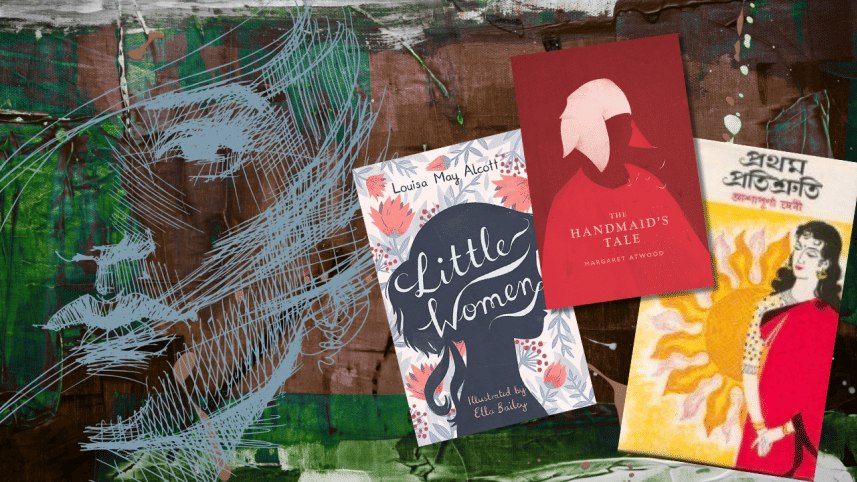
 Margaret Atwood understood this well. The Handmaid's Tale (1985) opens with women already trained to interpret restriction as protection. In the totalitarian state of Gilead, every new rule is framed as a moral duty, every loss of freedom repackaged as safety, every coerced sacrifice painted as tradition. The takeover comes at the hands of wealthy, devout men who tighten their grip while the public stands frozen. By the time the women sense something is wrong, the ground beneath them has already been tacitly pulled away. What the novel makes devastatingly clear is that oppression is most effective when wrapped in the language of compassion. Protagonist Offred's world shrinks not through overt brutality but through small, persuasive reassurances that the state is merely caring for her.
The chilling genius of Gilead lies in how oppression is disguised as benevolence. And perhaps the sharpest instrument in this disguise is the figure of the Aunt. These are women appointed to police other women—tasked with teaching compliance and legitimising the regime through the authority of familiar faces. Resistance feels harder when the oppressor looks like you, speaks like you, and claims to know what is best for you. When the voice of repression comes in a familiar tone, the violence becomes easier to swallow.
The parallels with today's rhetoric are uncomfortable. A proposal that takes away a woman's autonomy over her working hours has been presented as empathy, and the celebration of stay-at-home mothers as 'rotnogorbha' operates much like Gilead's symbolic rewards—constructed to reinforce a hierarchy of femininity where domesticity sits at the top and ambition is gently, implicitly asked to step aside. Atwood warns that societies rarely lose freedom through violence alone; they lose it through portrayal of care and honour that conceal the gradual removal of agency.
Bangla literature, too, has long grappled with the tension between societal expectation and women's self-determination. In Rabindranath Tagore's Shesher Kobita (1929), Labonno emerges not as a passive participant in a romantic narrative but as a deliberate, self-aware agent navigating cultural standards. Unlike the conventional female characters of early 20th century Bangla literature, Labonno actively shapes her own life rather than letting love define her existence. She pursues education and cultivates her professional and personal identity alongside her relationships. Her choices unsettle Amit, the male protagonist, because they challenge the ingrained notion that a woman's ultimate purpose is domestic. She refuses to allow prescribed norms to dictate her path. Labonno's stance is profoundly relevant: independence of will, whether exercised in the workplace or at home, cannot be dictated by policy or societal pressure without eroding the essence of freedom. Her character reminds readers that genuine care for women means supporting their ability to make informed choices, not glorifying one lifestyle at the expense of another.
And in Ashapurna Devi's Prothom Pratisruti (1964), Satyabati grows up in a society where aspirations for women are circumscribed by deeply entrenched patriarchal norms. From a young age, she questions the injustices and superstitions that limit women's lives, particularly the denial of education. The novel captures how coercion can appear voluntary when familial forces persuade women to internalise their confinement as moral responsibility. Satyabati confronts the constant weight of societal judgment and the pervasive message that obedience is virtue. Her struggle is for the ability to define herself on her own terms. Here, oppression is not physical but emotional, shaping choices before they are even made. Similarly, by offering full pay for just five hours of work, with the government covering the remaining three, the policy frames women's labour as a commodity to be subsidised rather than a manifestation of ambition or personal growth. It reduces meaningful work to a transactional calculation, implying that women do not need, or deserve, the same scope for effort and achievement as men. Not all labour is performed for money alone. Many women, like Satyabati, pursue education and strive to work to hone their skills, assert self-reliance, or pursue passion projects. The policy implies that women's presence in the workforce is negotiable, that full engagement is optional, and that ambition may be deferred in favour of domestic recognition.
Louisa May Alcott's Little Women (1868) offers a timeless portrait of women navigating established conventions while fiercely claiming their own voice. Jo March is the embodiment of defiance against gendered limitation. From the moment she declares her desire to write and earn her own living, Jo challenges the 19th century notion that a woman's ultimate purpose is domesticity and marriage. Her ambition is not merely professional—it is a declaration of selfhood. Jo asserts that a woman's intellectual labour is as vital and legitimate as any man's, demanding recognition in a society that frequently undermines female voices.
In contrast, Meg March chooses marriage and motherhood. Yet Alcott does not portray her choice as inferior or passive. Instead, Meg embodies a conscious, reflective exercise of agency. She evaluates her desires, understands the sacrifices involved, and embraces the responsibilities of domestic life with dignity and intentionality. Alcott demonstrates that autonomy does not require rebellion; it requires consent and clarity of purpose. The narrative highlights that the value of a woman's life is not contingent upon her adherence to a single model of success. Both Jo and Meg exemplify freedom in different forms. Alcott also depicts the social pressures that constrain choice. Jo's ambition is often met with scepticism or gentle censure from family and society, reflecting the cultural anxieties surrounding women who prioritise work over domesticity. Meg faces expectations to marry and care for a household, pressures that, if accepted unthinkingly, could limit her independence. Jo sometimes questions her place in society, while Meg occasionally wonders if her choice is enough in a world that privileges men's achievements.
"Just because my dreams are different than yours does not mean they are unimportant"—Little Women reminds us that neither path is inherently superior; what matters is that the choice belongs to the woman herself.
These texts converge on one central lesson: the right to choose is non-negotiable and the fulcrum of empowerment. As the world enters the 16 Days of Activism to end gender-based violence against women, we are reminded that violence is not only physical. Violence can be signed into policy with the softest smile. It can sound like concern for women's well-being while quietly restricting the futures they are allowed to imagine for themselves. This observance is a clarion call to confront invisibilised violences and demand real solutions rather than telling women to shrink themselves to fit a system designed to keep them small.
If the girls we read about could speak today, their voices would be both sharp and unflinching. They would caution that reducing women's working hours under the guise of protection does not empower; it confines. True empowerment would mean creating systems where both mothers and fathers share domestic and caregiving responsibilities, where affordable childcare exists, and where workplace policies protect and support rather than contract women's roles. Every system that has attempted to dictate which version of herself a woman may become has failed to reckon with one truth: the right to choose is hers alone. Whichever path she selects for herself, that choice belongs to her, not to the government, not to society, and certainly not to a policy designed to look like liberation while echoing restraint.
Agnila Roy is listening closely to the voices that never fit neatly into a box. Send her your thoughts at agnilaroyy@gmail.com.
Comments