


An inter-cultural romance

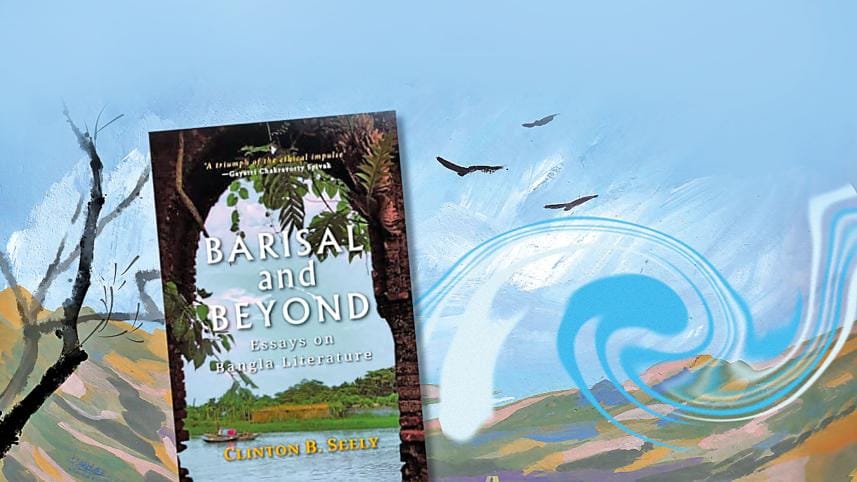
The author of this book is the protagonist of a charming inter-cultural romance. He is one of fewer than a handful of living Westerners who fortuitously fell in love with Bengali literature and made a distinguished career of teaching it—at the University of Chicago in his case. A major in Botany from Stanford, he volunteered for the Peace Corps and spent a year and nine months (1963-65) training high school science teachers in Barisal. In the process he picked up Bangla and, through the desultory chitchat that Bengalis call 'adda', gathered some idea about the greatest writer in the language, Rabindranath Tagore. At the end of his stint he enrolled for graduate studies at the Department of South Asian Languages and Civilisations, University of Chicago, and discovered Bengal's greatest modern poet, whose hometown was his familiar Barisal.
His PhD thesis, published as A Poet Apart: A Literary Biography of the Bengali Poet Jibanananda Das, 1899-1954 (UNKO, 1990), won him West Bengal's most prestigious literary award, the Ananda Puraskar. His other publications include three translated volumes, of which the one of Michael Madhusudan Datta's epic, The Slaying of Meghnada: A Ramayana from Colonial Bengal (Oxford University Press, 2004), got him the A. K. Ramanujan Book Prize for translation. Anyone interested in a detailed critique of it may look up my review, "Bengal's Modern Epic", in The Daily Star Book of Bangladeshi Writing (Daily Star Books, 2006), edited by Khademul Islam. The main point I make there is that although the translation reads smoothly, it is based on a fundamental misunderstanding of Bengali prosody. The Bengali of the original is written in unrhymed lines of 14 metrical units or matras, which may or may not be equivalent to syllables, depending on whether they are "open" or "closed". Seely mistakenly equates a matra with a syllable, ignores the importance accorded to the caesura, and ends up with rhythmically limp lines far from Datta's robust amitrakshar chhanda, his Bangla equivalent of blank verse.
 For all latest news, follow The Daily Star's Google News channel.
 The present volume is a mixed bag of essays and lectures covering a number of significant aspects of Bangla literature. Though the focus is predominantly on modern or post-Plassey literature, Seely's grasp of the earlier tradition of Bangla writing is palpable in several essays.
The present volume is a mixed bag of essays and lectures covering a number of significant aspects of Bangla literature. Though the focus is predominantly on modern or post-Plassey literature, Seely's grasp of the earlier tradition of Bangla writing is palpable in several essays. His treatment of the earlier writings serves a salutary purpose, bringing out the organic connections between them and modern Bangla literature and thus effectively countervailing the thesis of loyal colonial subjects like the late Nirad Chaudhuri that the latter is thoroughly Western in sensibility.
"Say it with Structure: Tagore and Mangal Kavya" analyses the parallels between the play "Tasher Desh" or "Land of Cards" (1933) and the conventions of the medieval mangal kavya genre. The argument has something to it, though that something may seem rather tenuous. Besides the superficial difference between a play and the traditional pala in payar-tripadi, which is the vehicle of the mangal kavya proper, one also misses the robust and often menacing presence of a subaltern deity. By contrast, much of the play's charm lies in its delightful comic and satiric elements, and instead of forceful deities we have two opposed abstractions, Niyam, the foundation of a rules-based existence, and Ichchha, which allows us to be fancy-free. Of the four essays dealing with Michael Madhusudan Datta, one comprehensively reveals the "Indian Sources of Inspiration" behind his magnum opus, the epic Meghnad Badh Kavya; the critical view for long had been that Michael was a "European" poet who wrote in Bengali. Two essays on Jibanananda Das go for intriguing hair-splitting, though the one titled "Shifting Seas and 'Banalata Sen'", on the true geographic location of maalay, which features in Das' best-known poem, "Banalata Sen", as well as in another poem, "Nirankus", leaves me unconvinced.
The generally accepted rendering of maalay is that it refers to Malaya. This is how Seely himself rendered it the first time he translated the two poems. The poet himself in his English translation of "Banalata Sen" renders the phrase "maalay sagare" as "to/ the seas of Malaya". But Seely has second thoughts, prompted by a reader's comments, which he has followed up with an examination of dictionaries and atlases. Confusingly, maalay can be the adjectival form of malay, which can refer to the Malabar region. Seely decides to revise his translations accordingly, for two main reasons. First, if "maalay sagare" is retranslated as "to seas up the Malabar coast" (a clumsy phrase), all the geographical references in the poem are contained in India as it was at the time of composition, thereby making it "a strongly nationalistic poem." Second, in the poem "Nirankus" there is an anonymous Malayali, a word widely used in India to refer to a speaker of Malayalam, the language of the Malabar Coast. Seely therefore retranslates the poem, changing "the Malayan coast" to "On the coast along the Western Ghats" (another clumsy expression).
I find Seely's reasoning quite spurious. Das was never strongly nationalistic—his sense of geo-cultural rootedness applied to undivided Bengal rather than India as a whole—and it is difficult to see why he should wish to limit the peregrinations of the speaker in "Banalata Sen" to India, especially when the opening line describes him as "roaming the paths of this earth" (Seely's translation). More importantly, it is absurd to think that by "Malaya" in his own translation, Jibanananda Das—a college lecturer in English—could have meant "Malabar".
As for the poem "Nirankus", I agree that "Malayali" and not "Malayan" is the correct rendering of malayali, but that does not mean we have to shift the locale from Malaya to Malabar. There have long been economic migrants from Malabar in Malaya, and Das, exiled from his native East Bengal could, I imagine, readily empathise with the Malayali exile as he cast an anguished gaze over the desert of the sea. As for the uprising mentioned in the third stanza as having taken place in the late 19th century, it could refer to troubles in the Malay region, of which there were scattered instances, rather than anachronistically to the Malabar rebellion of 1921 as Seely suggests.
"Viewing Bangla Literature," a brief but beguiling essay, provides hints rather than an argument, and would have benefited from a fleshing out. Contrasting the Indian concept of "darshan" and the "gaze" much talked about in contemporary theory—the power relations are reversed, "darshan" yielding to "gaze" in potency—Seely moves on to sum up Said's thesis in Orientalism (Pantheon Books, 1978), and then provides examples from the works of Shamsur Rahman, Jibanananda Das, and Shaheed Quaderi, to show that these Bengali poets have subjected their own culture to a voyeuristic gaze. Finally, facing up to his own problematic situation as a foreign scholar-critic-translator vis-à-vis Bengali literature, he endorses an Indian critic's judgment calling for the cultivation of "cultural inwardness."
"A Muslim Voice in Modern Bangla Literature: Mir Mosharraf Hosain" deals comprehensively with the only noteworthy Muslim writer belonging to the period of the so-called Bengal Renaissance. His Bishad Sindhu (1891) is a novel of epic proportions centred on the martyrdom of Imam Hosein, grandson of Prophet Muhammad, at the Battle of Karbala, and raises interesting critical questions regarding genre and diction. Seely also shows how the literary career of Mosharraf Hosein (1848-1912) registered the increasingly uneasy relations between the Hindu and Muslim communities.
"Translating between Media" is a sensitive comparative study of Tagore's story "Nastanirh" ("The Fouled Nest") and Satyajit Ray's cinematic translation, Charulata. The essay on "Raja Pratapaditya, Problematic Hero" ranges over a wide variety of texts, among them Bharatchandra's Annadamangal, an examination of which in the light of Propp's morphology of folk tales is also the opening piece of the collection. The penultimate essay is the weakest, in my view at least: "Serious Sahitya: The Prose Fiction of Bangladesh's Rizia Rahman" does not rise above plot summaries and fails to provide evidence of the "richness" it claims for its subject.
The "Epilogue–Comings and Goings: From Madhusudan to the Diaspora of Today", with its juxtapositions of travelling and stay-at-home Bengalis—Michael, Tagore, Jibanananda, Syed Shamsul Huq, Bharati Mukherjee, Jhumpa Lahiri—is a coda appropriate to our particular moment in cultural history.
An earlier, and slightly shorter, version of this review article appeared in Asiatic, Vol. 3, No. 1, in June 2009.
Kaiser Haq is a Bangladeshi poet, translator, essayist, critic and academic.
Comments