


From Pakistani living rooms to South Asia’s reels feed: The meme-ification of Rooh Afza


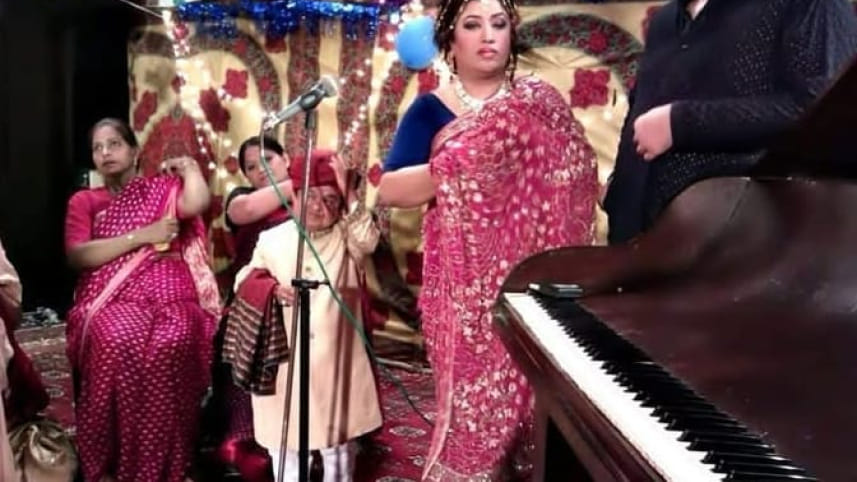
The internet, for all its fleeting enthusiasms, occasionally performs an act of cultural archaeology. Characters long presumed archived are excavated, polished by nostalgia, and propelled into the digital bloodstream.
That curious resurrection is precisely what has happened with Rooh Afza, the imperious, sharp-witted woman immortalised by Hina Dilpazeer Khan in the cult Pakistani comedy-drama “Quddusi Sahab Ki Bewah”.
 For all latest news, follow The Daily Star's Google News channel.
 More than a decade after its original broadcast, the series has acquired a second life on Instagram and TikTok.
This revival is not accidental.
It is the result of something subtler and more powerful: collective memory rediscovering its own humour.
Rooh Afza has become the unlikely sovereign of short-form video culture. Clips of her withering glances and surgical one-liners now circulate with the fervour usually reserved for contemporary content.
Across Pakistan, India, and of late, Bangladesh, younger viewers hail her as a “sassy queen”, a “liberal feminist icon”, and a character who appears startlingly modern despite being born in a very different televisual era.
What was once domestic sitcom humour has matured into digital satire.
The name itself carries a deep resonance.
“Rooh Afza”, meaning “refreshment of the soul”, originates from a 19th-century poetic expression and is famously shared by the ruby red drink ubiquitous across South Asia.
The character, however, is anything but sweet.
She is acidic wit in silk, a woman whose barbed retorts travel faster than household gossip. Dilpazeer did not simply anchor the sitcom. She detonated it from within.
While most actors are canonised for a single defining role, she performed more than 40 characters within the same universe.
Each persona possessed its own cadence, posture and emotional temperature. The audience never felt they were watching an actress change masks.
Instead, the screen seemed populated by an entire extended family of eccentric souls.
Rooh Afza emerged as one of the most unforgettable among them because she embodied theatrical excess without losing recognisable truth.
Dilpazeer’s dialogue carried rhythm; her facial expressions had an elasticity reminiscent of classical stage comedy; her body language suggested a woman perpetually oscillating between righteous indignation and theatrical triumph.
The effect was not caricature but heightened observation.
One sensed that Rooh Afza existed somewhere in the collective South Asian household -- the aunt who dominates family gatherings, the relative whose tongue is bolder than her jewellery.
This authenticity explains why the character thrives in this algorithmic age.
Social media rewards performances that communicate emotion within seconds. Dilpazeer’s acting style, built on precise gestures and expressive pauses, compresses beautifully into short clips.
Another element strengthens the character’s digital longevity -- tone. “Quddusi Sahab Ki Bewah” relied on situational humour rooted in middle-class domestic life.
The anxieties were familiar: inheritance quarrels, sibling rivalries, whispered negotiations about marriage and money.
The comedy resisted vulgarity. It relied on wit rather than provocation.
In today’s climate, where humour often leans toward shock or spectacle, that restraint feels almost radical.
Ramzan also plays its quiet role in this revival. Families gather after iftar, and television historically became part of that ritual. “Quddusi Sahab Ki Bewah” belonged to that seasonal atmosphere, an evening companion after the day’s fasting.
When Ramzan returns, memory follows. Old scenes circulate online like digital samosas and dates, exchanged with affectionate nostalgia.
What is particularly striking is the cross-border afterlife of Rooh Afza.
Viewers in Bangladesh and India, many of whom never encountered the original broadcast, are discovering the show through social media reels.
Comedy travels easily across linguistic boundaries because gesture and rhythm transcend vocabulary.
South Asian households share certain universal motifs. Even when an Urdu idiom escapes precise translation, the emotional architecture remains intelligible.
Thus, legacy television mutates into platform-native culture.
A young viewer encounters a meme, searches for full episodes on YouTube, and suddenly becomes a devotee of a series older than their internet habits.
Beyond virality lies a deeper reason for Rooh Afza’s endurance -- Dilpazeer’s artistic fearlessness.
Comedy demands the sacrifice of vanity. She allowed herself to appear ungainly, shrill, exaggerated. She refused to polish herself into glamour for the camera’s approval.
That refusal reads today as refreshing authenticity. In a media environment saturated with curated beauty, such unguarded theatricality feels almost rebellious.
Dilpazeer’s astonishing range supplied elasticity to that canvas, proving that disciplined versatility can coexist with mass popularity.
The result is a peculiar alchemy. A sitcom from another era becomes an algorithmic gold mine. A fictional relative transforms into a transnational meme. A Ramzan comfort watch evolves into digital folklore.
And when a character survives not merely its script but its era, slipping gracefully from television sets into smartphone screens, one may conclude that something rare has occurred.


Comments