


A league in a hurry: Women's Football League returns today
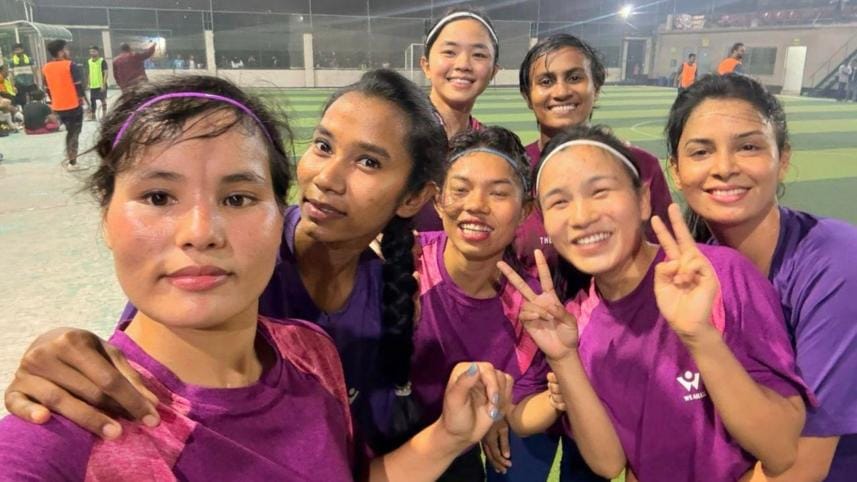
The much-awaited Bangladesh Women's Football League kicks off on Monday with 11 teams, but serious doubts persist over whether the competition will provide any meaningful sporting value amid uneven team formation, logistical shortcomings and the absence of commercial backing.
Bangladesh Police take on Bangladesh Army in the opening match before defending champions Nasrin Academy face BKSP at the Birshreshtha Shaheed Mostafa Kamal Stadium in Kamalapur -- the league's sole venue.
 For all latest news, follow The Daily Star's Google News channel.
 Organised after a gap of one and a half years, the league appears hurried and procedural, raising concerns that it is being staged largely to satisfy Asian Football Confederation (AFC) requirements rather than to nurture competitive women's football. AFC statutes demand a minimum of 10 matches per team, a condition the Bangladesh Football Federation (BFF) has met by enrolling exactly 11 teams in a single-leg round-robin format.
As many as 55 matches will be crammed into just 33 days, with up to five matches scheduled on most match days. Limited floodlight facilities, the lack of alternative venues and an intense match calendar threaten to compromise player welfare and match quality.
In an effort to create balance, the BFF placed 36 players in a central pool, allowing clubs to sign five senior players from Pot-1, five age-group players from Pot-2 and one goalkeeper from Pot-3. However, the results have been starkly uneven.
Newcomers Rajshahi Stars, bankrolled by Nabil Group, have assembled a formidable squad featuring 11 national team players, while Farashganj have recruited six. In contrast, five teams will compete without a single national team player, relying largely on academy footballers or personnel from services teams.
Defending champions Nasrin Academy have also been hit by the imbalance. Club owner Nasrin Begum said she was able to sign only one age-group national team player, highlighting the financial constraints faced by most teams.
"Funding and sponsorship are the main issues. Most clubs are depending on academy players because there is no financial support," she said.
The league itself does not have a title sponsor.
Foreign participation is equally limited. Although each team is allowed to sign four overseas players and field two in a match, only Farashganj have recruited two Nepalese footballers, while Nasrin Academy are trying to rope in one Australian-Bangladeshi player.
The scheduling also mirrors earlier contradictions in planning. National team coach Peter Butler had previously criticised the decision to allow players to compete in the Bhutan Women's League, warning that a lack of competitive fixtures would harm fitness and sharpness. His concerns appeared justified after heavy national team defeats against Thailand and during last month's Tri-Nation series. Similar risks now loom over a league squeezed into a short window with minimal recovery time.
BFF women's wing chairman Mahfuza Akter Kiron acknowledged the organisational challenges.
"Organising multiple matches on a single day is definitely challenging. However, we have to finish the league within one month, so we don't have any alternatives," she said, citing limitations in floodlights and facilities.
She also confirmed a lack of interest from established clubs.
"We sent invitation letters to everyone. Ataur Rahman Bhuiyan Academy did not submit an entry. Abahani said they would form a team next year."
Adding to the sense of disarray, the BFF failed to provide a complete list of team registrations less than 24 hours before the league's opening day.
Comments