


Untold stories of young Bangladeshi migrants in France

I live in a small town in the west of France with a population of 7,500 inhabitants — hardly a union's ward for Bangladesh. Four years ago, on my way back from the market, I stopped to chat with a neighbour at the corner of the small lane leading to my house. Suddenly, I thought I heard people speaking Bangla — something very surprising, since, like most rural areas in France, the town is not very cosmopolitan, and the Bengali community in France is still quite small. I walked a few steps closer and saw two young people looking at the few words in Bangla that decorate my front door. I asked them if they were from Bangladesh — a surprise for them as well, since most people in France would more likely assume they were "Indian." This is how I came to know Sahel and Shimul, who were 17 and 18 at the time, respectively, and were indeed apprentices in the two nearby fine-dining restaurants. Since then, we have stayed in regular contact, and I've been introduced to a dozen of their friends living in the area or in Nantes, the nearby metropolis. Over time, I've gathered their stories and it was encouraging to see that — although they had to go through multiple hardships — many of them have eventually been following rather successful paths in France.
The exact number of Bangladeshis living in France is not accurately known since not all of them are documented migrants. The most reliable sources estimate that there would be somewhere between 50,000 and 80,000 people who started to arrive by the end of the 80s. Most of them arrived claiming political asylum, which many were eventually granted; however, many too were denied this status, and thus remained in France under an irregular status. Almost all of these migrants — whether documented or not today — arrived in France as adults and now constitute the bulk of the Bangladeshi community established in France.
 For all latest news, follow The Daily Star's Google News channel.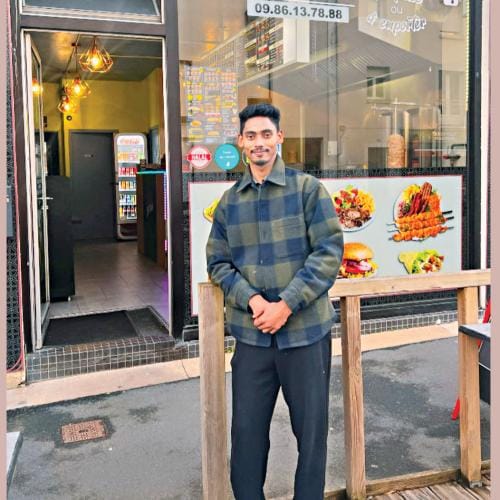
Around 15 years ago, a new phenomenon emerged: the arrival in France of very young people — children, in fact — who had left Bangladesh and travelled alone. They arrive in France at the age of 15 or 16, full of hope but with very little knowledge about the country they've reached. They rarely speak English, almost never know a word of French, and generally don't know anybody here. The vast majority come from the Sylhet region. They are part of the few thousand young people — boys mostly — of various nationalities who arrive in this way, claiming to be under 18. Many come from French-speaking countries in Africa, but also from Afghanistan, Nigeria, Sudan and other conflict-affected or economically distressed regions. The proportion of those coming from Bangladesh varies from year to year, ranging between 3% and 7% of those who apply for the status of unaccompanied minor migrants.
Once they have arrived, these youths have indeed a potential advantage over adult migrants: theoretically, according to French law, children are considered children regardless of their citizenship, and anyone who is recognised as being under eighteen not only cannot be deported, but must also be taken care of by the State. So, any person arriving in France and claiming to be an unaccompanied minor should legally be directly provided with shelter, food, healthcare and education, even before their minority status is officially recognised. Yet, the French State is often failing to fulfil its duty, and a number of these young people are left to cope by themselves in dire conditions: a now common sight in Paris is these rows of tents under which young migrants try to find a fragile shelter. Many NGOs are engaged in helping them deal with the administration for the recognition of their minority, organising canteens to feed them or finding families to host them when needed.
Approximately 25% of them will eventually have their minority recognised and get a legal status in France. Those whose minority has not been recognised can no longer benefit from State protection, but only 3% of them are actually deported. Although no official data are available, several NGO volunteers have noted that young Bangladeshis are more often recognised as minors than others. They believe this trend may reflect a possible bias among the judges responsible for determining age, based on certain stereotypes. Since judges often question the validity of birth certificates, they tend to rely on the youth's physical appearance. Bangladeshi teenagers, who often appear more fragile than their African peers, may unintentionally benefit from this.
The location in France where the youths apply also plays a role in their chances of being granted "minor migrant" status. They are generally better outside of Paris, and, through the network they quickly build, the youths may decide to try their luck in places known as "being easier." This is how the area where I live, in the west of France, has seen the arrival of many young migrants, some of whom ended up being hosted and educated in small towns like mine. If a certainly too high proportion of the young migrants are not treated as prescribed by the law — and in a growing number with the shrinking of budgets allocated to social services — yet many youths — almost 20,000, for instance, in 2023 — also benefit from legal protection regarding minor migrants.
The children are hosted in youth migrant centres or hotels under the supervision of care workers until they have finished their education. For education, they join the mainstream French school system in which they are generally following a two-to-three-year vocational education for occupations that are in high demand in France such as mason, plumber, electrician or cook. It is this last occupation that almost all of the young Bangladeshis in France choose.
As apprentices, they spend half of their time at the local high school and the other half training in the restaurant. After two years, they receive an initial diploma and can choose to complete an additional year to earn a higher-level one. Most young Bangladeshis start working after the first diploma, as they are eager to begin earning more money than the apprentice allowance. Having been trained in French cuisine, it is then not a problem for them to find a job, given the shortage of trained candidates. Their salaries increase quickly, reaching over €2,000 within just a year or two, notwithstanding overtime hours, when the minimum salary in France is €1,400.
All the young Bangladeshis I met were focused on saving as much money as possible, since their goal is to open their own restaurant as soon as they can. For instance, Sahel Mia, who is now 21, opened his a few weeks ago, and his friend Joynal, who is just two years older, moved to the south of France a year ago to take over a fast-food restaurant, just like Sahel. Their maturity and remarkable entrepreneurial spirit are truly noteworthy. Opening a traditional French or "Indian" restaurant — with a large dining room, waitstaff, and so on — would be financially out of reach, at least as a first venture. However, thanks to their savings, securing a bank loan to open a fast-food establishment is relatively feasible, and such a business can become profitable fairly quickly. Yet, as young people, they are also eager to explore the world. Many of Sahel's friends have travelled to several European countries, often staying with fellow countrymen. Despite these ventures, they remain committed to regularly supporting their parents with money and gifts.
Having attended French school and trained as apprentices in French restaurants, they quickly gain fluency in the language — unlike many of their compatriots in France. This is a major asset — combined with their professional skills and achievements — in their ambition to obtain French citizenship: a citizenship that would allow them to escape the burdensome administrative procedures involved in renewing residency permits and would give them the freedom to travel more easily, as many of them wish to do.
According to the associations I spoke with, these successful integration paths are common among young Bangladeshis who arrived in France when they were still children. They rely on strong solidarity among themselves, an ability to make use of the local support offered by NGOs, a fierce determination to succeed, and great courage.
Of course, among those who arrived in France, there are also young people whose paths have been far more chaotic. They are difficult to get to know, since as undocumented migrants they are forced to live extremely discreet lives — rarely going out and working off the books, often in the back of restaurant kitchens as dishwashers or cleaners. Among those who left, there are also those — though their number is impossible to determine — who never managed to reach their intended destination, having been deceived by smugglers, and whose journeys ended tragically in Libya or the Mediterranean Sea. For all of them — regardless of future success — the path is marked by a series of hardships that must be overcome.

It all begins with the journey. Some, like Sahel and a few of his friends, were relatively lucky: they obtained a tourist visa for Dubai and from there — by paying €2,000 — a tourist visa for Italy, from where they were able to reach France by train. Others had to pay between 8 and 12 lakh takas to travel from the Gulf to Turkey, cross the Mediterranean to Greece, and gradually make their way to France. This journey, full of dangers and undertaken without ever having left their families before, is in itself a formidable ordeal. Some took the worst path through Libya.
Once in France, the youths had to figure out where to find help to avoid sleeping on the streets and to begin the legal process for recognition as minors — all without speaking the local language. They then had to adapt to the French school system, to unfamiliar food, and to the demanding work of an apprentice, despite the fact that almost none of them had worked before in Bangladesh. They had to cope with missing their families, learn to build a network of friends and support, figure out how to find housing, navigate administrative systems, plan a career path, and manage a budget. They had to face the stress of not getting the precious resident permit once they reach 18 and are not protected anymore under the minority status. They also had to deal with pressure from their families back home, who often expect financial help soon after their arrival and do not always understand the difficulties they face. It's a heavy burden for kids who are barely more than children…
Not so long ago, I was invited for lunch at the apartment that Sahel shares with a group of friends. The Bangla food was plentiful and delicious. The atmosphere was warm and joyful. Each of them shared their plans with me: one wanted to learn how to prepare Japanese sushi because "it works well in France," another told me about the girl his family had suggested he marry — someone he would certainly bring back to France — and a third asked me to help him fill out a visa application for a trip to Canada, etc. I left feeling happy for them and full of respect for these young men — so enthusiastic and full of energy.
It would certainly not be wise to encourage young Bangladeshis to take this path, as it is fraught with obstacles and exposes them, from the outset, to the mercy of often unscrupulous smugglers. It is also clear that not all teenagers have the strength or ability to face such an ordeal. Finally, the care provided to unaccompanied minors in France is becoming increasingly strained and will eventually leave more and more youths abandoned by the system. Still, those who succeeded despite everything deserve recognition and admiration.
Marie Percot is currently Visiting Professor at the International Institute for Migration and Development (IIMAD), Thiruvananthapuram, Kerala, India.
Send your articles for Slow Reads to slowreads@thedailystar.net. Check out our submission guidelines for details.
Comments