


Persistent violence threatens our democratic transition
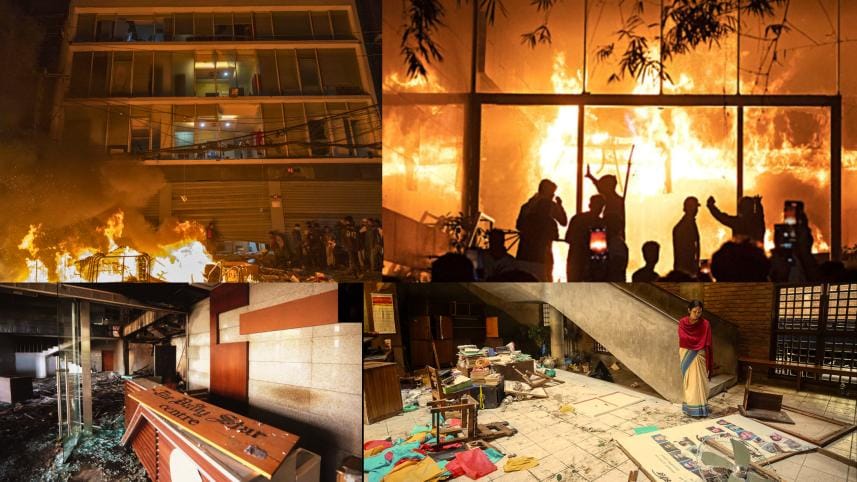
In the early hours of December 19, horrific attacks were carried out on Prothom Alo and The Daily Star, and later on two cultural organisations, Chhayanaut and Udichi, along with Nalonda School. These incidents mark an unprecedented episode in Bangladesh's recent history. The attackers entered the buildings and deliberately destroyed documents, equipment, and valuable archives. There was widespread looting as well. Inside The Daily Star building, the lives of journalists and others, women and men alike, were put in grave danger. When New Age Editor Nurul Kabir tried to go inside to help rescue those trapped, he too was attacked. At the same time, a violent madness was unleashed against several institutions, homes, and individuals across different parts of the country. Bangladesh has rarely witnessed such a coordinated outbreak of violence against its cultural/intellectual heartlands.
As unthinkable as these events may seem, they were by no means sudden. For quite some time now, certain institutions have been repeatedly targeted through misleading information and aggressive rhetoric, with clear attempts to incite the public. These provocations came both from within the country and from abroad. It is therefore inconceivable that the government, intelligence agencies, or those who regularly monitor the situation were unaware of what was unfolding. The effort to manufacture tension and to create, or legitimise, an environment conducive to organised violence was unmistakable.
 For all latest news, follow The Daily Star's Google News channel.
 Following the killing of Inquilab Mancha leader Sharif Osman Hadi, this group became even more active in exploiting the situation. Yet within hours of the attempt on Hadi's life, ordinary citizens were analysing CCTV footage on social media and identifying suspects. Footage was collected and examined to determine who carried out the attack and how it was executed. At that time, however, no visible initiative came from the intelligence agencies or government forces to shed light on the situation.
Instead, it was first claimed that the killer had crossed the border into India. Later, police statements suggested that there was no specific information confirming whether the accused had actually gone to India. Capitalising on this ambiguity and confusion after Hadi's death, one act of destruction occurred after another, targetting pre-selected institutions and individuals.
After Hadi's death, intelligence agencies should have anticipated what kind of reaction might follow and who might seek to exploit the situation. On social media, some individuals, including certain leaders of a section of Islami Chhatra Shibir, were openly calling for violence. Other forms of provocation were also underway. None of this should have been unknown to the intelligence agencies. Yet, despite having so much information, such horrific incidents were allowed to unfold.
These attacks did not happen in a vacuum. For months, we have seen a pattern of shocking inaction by the government despite prior intelligence. We have also seen similar provocations leading to assaults on shrines, attacks on Baul singers, violence against minority communities, threats against women, obstruction of cultural activities, pressure on theatre and music events, and attempts to shut down performances. Those involved have exerted immense pressure on artists and cultural practitioners. The same group has been linked to these acts time and again. They have been able to continue this violence because the government has so far failed to take effective action against the real perpetrators.
As a result, they now feel empowered, convinced that they can say and do whatever they please. We have seen instigators operating from abroad spreading violent hatred for months, openly calling for vandalism, terror, and attacks. What is astonishing is that, in many cases, when attacks are carried out in response to such incitement, heavy machinery, including bulldozers, appears on the scene, while security forces remain silent spectators.
These developments raise serious questions. Does the government have any connection with those inciting violence from abroad? Is it being directed or influenced by them? Is it using them? Why does it appear that those carrying out terrorist activities in the name of religion are enjoying a degree of indulgence from the state? This is the central question.
The government's silence and inaction were glaringly evident during the events of December 18-19. After the attacks, the perpetrators proudly recorded videos and circulated them. Their faces were clearly visible on television cameras, and as such identifying them is not difficult. From Facebook posts and YouTube calls, it is evident who incited violence, who issued calls, and who spoke of attacking. Incitement to violence is a criminal offence. Yet days after the incidents, no action has been taken against the main instigators.
This points to a clear continuity in the government's role. That continuity suggests a certain leniency—and covert patronage—towards those who pursue discriminatory politics, spread terror and hatred in the name of religion or patriotism, and seek to obstruct democratic transition. Sometimes they have been benignly described as "pressure groups" in alleged attempts to legitimise them. No effective measures have been taken. As a result, terrorist activities erupted and continued in various parts of the country. In another case, the brutal killing of worker Dipu Chandra Das in Bhaluka—beaten mercilessly, set on fire, and hung from a tree on a false allegation of blasphemy—has been a horrifying experience for us all. In Lakshmipur, a BNP leader's home was locked and set ablaze, killing his seven-year-old daughter. These incidents are happening because the attackers assume that the government is on their side, or that there is no effective government at all.
In this context, it is worth recalling that not long ago, at the ceremony marking the signing of the July Charter, the chief adviser said that Bangladesh was entering a phase of "civilisation." Are these brutal acts examples of that "civilisation?"
In fact, those who are creating this savage, hateful, and violent situation are enemies of Bangladesh's democratic transition, enemies of the Liberation War, and enemies of the 2024 mass uprising. They want to push the dream of a discrimination-free Bangladesh in the opposite direction. They oppose women's independent participation, oppose cultural expression, and seek to suppress free and lively intellectual activities.
They want to create a society where people exist like robots and where violence is inflicted on those who differ in opinion, religion, gender, or identity. This experience delivers a stark message: years of authoritarian rule, plunder, and political opportunism have produced a dangerous, violent force within society. Without confronting this force, a democratic transition is impossible, and progress towards a discrimination-free Bangladesh cannot be achieved. To do so, united action by all democratic forces is essential—resisting discriminatory extremist forces at every level and expanding people-oriented intellectual, cultural, and political engagement.
Anu Muhammad is a former professor of economics at Jahangirnagar University.
Views expressed in this article are the author's own.
Follow The Daily Star Opinion on Facebook for the latest opinions, commentaries, and analyses by experts and professionals. To contribute your article or letter to The Daily Star Opinion, see our guidelines for submission.
Comments