


Can COP30 elevate climate adaptation?

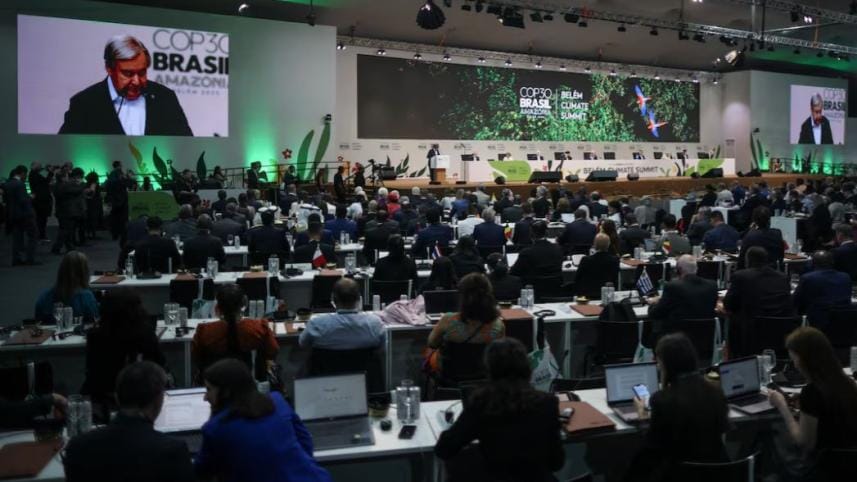
As the world braces for the 30th Conference of the Parties (COP30) in Brazil, the host nation's presidency is signalling a decisive shift in climate policy, placing the issue of adaptation at the forefront of its agenda. Through a series of eight impassioned letters, it called on the global community to view adaptation "through new lenses."
In the eighth letter, shared on October 23, the COP30 presidency designates adaptation as the signature agenda. Even in the first letter, the presidency argued for "a major inflection on adaptation" to align climate actions with people's lives through multilateral cooperation. The last letter states: "survival has never belonged merely to the strongest, but to the most cooperative...cooperation has been the essence of our humanity in natural selection." These ideas reflect the organising principle of this COP, i.e., Mutirão—the Brazilian culture of community cooperation to solve a problem through dialogue—extended globally as the "global Mutirão." This sentiment that adaptation must be viewed through a new lens is also reflected in the Report of the Circle of Finance Ministers.
 For all latest news, follow The Daily Star's Google News channel.
 Authoritative reports such as Adapt Now: A Global Call for Leadership on Climate Resilience of the former Global Commission on Adaptation and studies by the World Bank estimate that robust adaptation measures can yield two to ten times their cost in economic, social, and environmental benefits. The COP presidency rightly deplores that adaptation remains undervalued and underfunded. Nominal adaptation support ($28 billion) represents only a quarter of total climate finance, which is at least 20 times smaller than the estimated needs. According to Oxfam, the already insufficient official figure for adaptation funding is a gross exaggeration, and the actual, effective amount of support is roughly three times smaller than what is being claimed. Moreover, two-thirds of public adaptation support comes in the form of loans to developing countries, and over half even to the least developed countries (LDCs). Bangladesh is an example where climate debt continues to mount, as shown in research by Change Initiative.
However, the COP presidency does not elaborate on the underlying dynamics of why adaptation remains the "poor cousin" of mitigation. As a long-time negotiator and writer-activist, I have been arguing for strengthening the conceptual and legal basis of adaptation. Progress is finally being made, though slowly, for its expanded understanding.
As adaptation has never been officially defined, epistemic ambiguity persists. It began its journey in the UN Framework Convention on Climate Change (UNFCCC) as an afterthought, while mitigation was prioritised. This was justified because mitigation was and still is considered the cardinal solution. By the end of the first decade of the climate regime, adaptation witnessed a steady ascent for three reasons: developed countries were not pursuing mitigation, climate disasters were becoming the new normal with increasing frequency and severity, and the climate justice movement was gaining momentum because poor communities and countries contributing least to the problem were suffering most, with the least capacity to adapt. The outcome was a recognition of adaptation as a pillar equal to mitigation at the 2007 United Nations Climate Change Conference in Bali.
The Paris Agreement included an article dedicated to adaptation, linking its need to the level of mitigation. Still, adaptation remains perennially underfunded. I ascribe this poor funding to three reasons. First, there is a spatial disconnect between the main causes and the main sufferers of climate change. Hence, the empathy of the rich historical emitters fails to reach the faraway victims, despite an obligatory responsibility under the climate regime. Second, private sector support is weak because adaptation benefits are seen as non-exclusive, shared freely by others.
Here lies the fundamental lacuna: adaptation is perceived as providing only local or national benefits. Under the narrow neoclassical understanding, public goods, defined more than 70 years ago by economist Samuelson, were bounded by national territories, when extra-territorial pollution problems had not yet emerged. By the early 1990s, global commons problems like climate change had begun to manifest as the most intractable crisis.
Socio-economic concepts evolve in response to societal needs and cannot be treated like religious precepts. In recent years, cross-border and secondary impacts of pollution have been increasing and recognised. Many organisations and writers, led by the United Nations Development Programme (UNDP), have argued for an expanded understanding of public goods to cover developments beyond national territories.
In a similar vein, I have been arguing for an expansive interpretation of adaptation as a global public good (GPG). The argument is: if mitigation to restore climate stability is universally recognised as a GPG, then why should adaptation to address climate change impacts (CCIs) resulting from non-mitigation not also be regarded as a GPG? CCIs are global public bads (GPBs), plain and simple. Therefore, the solution to GPBs should be provided by taxing the GPBs, which is a fundamental lesson from neoclassical economics. The climate regime is founded on this mainstream model, and the UNFCCC parties are supposed to promote it (articles 3 and 5). Here lies the "moral corruption" of historical emitters in avoiding the underlying dynamics of climate change.
Many examples illustrate that funding adaptation brings both direct and indirect global benefits—bio-physical shifts in ecosystems and species, transboundary river pollution, trade disruptions, financial instability, increasing human displacements, etc. Addressing these issues through adaptation provides benefits at all scales. If the most vulnerable economies of more than a hundred low-income countries—including LDCs, small island states, and large economies like Bangladesh, India, and Pakistan—continue to decline due to devastating CCIs, will regional and global security, trade, and financial stability not also be affected?
Global statesman President Roosevelt argued at the opening of the Bretton Woods Conference in 1944 that established institutions like the World Bank must acknowledge that "economic diseases are highly communicable; [i]t follows, therefore, that the economic health of every country is a proper matter of concern to all its neighbours, near and distant." Climate change and COVID-19, which induced compound health and economic distress affecting all countries, exemplify such communicability. This was foreseen even 266 years ago by Adam Smith, the father of modern economics, who argued in The Theory of Moral Sentiment (1759) that interests are indivisible at individual, national, or international levels; one cannot pursue personal or national interests while ignoring the interests of others.
Finally, upon reading the letters shared by the COP30 presidency, we see a common thread—a deep and passionate advocacy of global cooperation based on norms and values befitting the intricately wired world of today, not the Westphalian order of the 17th century. Along this vein, we hope all countries at COP30 will agree to a capacious framing of adaptation that can mobilise funding through solidarity levies from high-emitting economic and industrial sectors.
Mizan R Khan is technical lead at LDC Universities Consortium on Climate Change (LUCCC).
Views expressed in this article are the author's own.
Follow The Daily Star Opinion on Facebook for the latest opinions, commentaries and analyses by experts and professionals. To contribute your article or letter to The Daily Star Opinion, see our guidelines for submission.
Comments