


A long-overdue urban roadmap
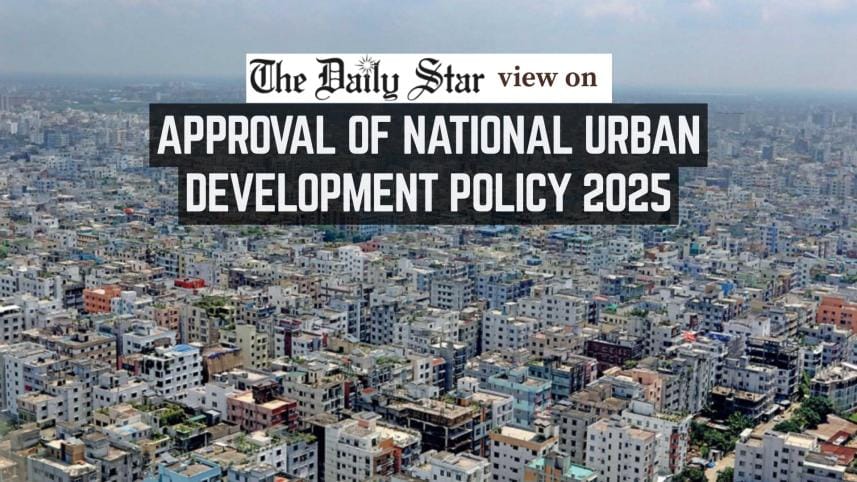
After more than two decades of delays, the approval of the National Urban Development Policy-2025 is a welcome step. As rapid urbanisation continues to reshape Bangladesh's economy and society, the absence of a comprehensive national framework has long hampered efforts to manage cities in a planned, equitable, and sustainable way. The policy's approval, therefore, offers hope for better-managed, more liveable cities in the years ahead.
Although only about 32 percent of our population lives in urban areas, they generate over 60 percent of the national output. However, this growth has largely been unplanned, placing severe pressure on housing, transport, water supply, waste management, and the environment. Congestion, pollution, loss of open spaces, and rising climate risks have been continuously eroding urban liveability. In this context, the policy's stated aim of building climate-resilient, inclusive, and liveable cities is appreciable.
 For all latest news, follow The Daily Star's Google News channel.
The policy classifies cities into four categories—megacities (population of one crore and above), metropolitan cities (population of 5,00,000 to one crore), medium or district towns (50,000 to 5,00,000), and upazila or small towns (20,000 to 50,000). By classifying urban centres into these categories and assigning distinct economic functions to each of them, the policy recognises that balanced urban development requires differentiated strategies. Discouraging industrial establishments in megacities while encouraging investment elsewhere is particularly important for easing population pressure on Dhaka and reducing long-standing regional disparities. The emphasis on decentralisation is equally encouraging. Envisioning metropolitan cities as regional hubs, district towns as centres for agro-processing and trade, and small towns as service centres, which will provide administrative and professional services and facilitate the exchange of farm products, offers a more balanced model of growth. If implemented effectively, this could create jobs beyond major cities and slow the continuous migration that continues to overwhelm core urban areas.
However, as experts have noted, the policy is indicative rather than legally enforceable. Without supporting laws, regulations, and strong institutions, its impact will be limited. While forming a National Urban Development Council under the policy is a good idea, it must be empowered with real authority, resources, and coordination capacity.
We, therefore, urge the government to move swiftly from policy to practice. This means enacting enabling legislation, strengthening local governments, and integrating the policy into city plans, transport strategies, and climate actions. The policy provides a long-awaited roadmap. Whether it leads to more liveable and resilient cities will now depend on political will and effective implementation.
Comments