


CAAB ignored the fire risks for years
The Civil Aviation Authority of Bangladesh (CAAB) failed to build the capacity needed to prevent or fight fires at Hazrat Shahjalal International Airport, despite seven major incidents since 2013, a probe committee has found.
It also notes that a 2021 recommendation to shift dangerous goods warehouses was never implemented -- long-standing weaknesses that left the airport unable to prevent or contain the blaze that tore through the import cargo complex on October 18.
 For all latest news, follow The Daily Star's Google News channel.
 These findings appeared in the investigation report submitted yesterday to Chief Adviser Prof Muhammad Yunus by the 12-member core committee led by the home ministry's senior secretary.
The committee confirms that the fire began from an electrical short circuit, dismissing speculation that the incident was planned or an act of sabotage. Instead, it points to years of ignored safety rules, the unprotected storage of flammable and dangerous goods, and repeated failures by CAAB, Biman, Customs, and courier agencies to ensure even basic fire safety in the cargo complex.
After Disaster Management and Relief Adviser Faruk E Azam handed over the report, Chief Adviser's Press Secretary Shafiqul Alam said at a briefing at the Foreign Service Academy that the blaze started from electrical arcing and subsequent short circuiting inside the courier shed.
"The committee found 48 iron-grilled offices of various courier agencies in the shed, none of which had any fire alarm, smoke detector, sprinkler system or hydrant. Flammable products, including polythene-wrapped cloth rolls, chemicals, compressed perfume and body spray bottles, electronic goods, batteries, and pharmaceutical raw materials, were piled there without any compliance or caution," he said.
He added that the fire began in the extended north-western section of the courier shed, between cages used by DHL, RS, and SRK -- a conclusion supported by specialists from Turkey, BUET experts, fire professionals, and CID forensic analysts.
According to the report, smoke was first spotted around 2:15pm by Ansar member Ismail. CAAB's first fire engine arrived at 2:22pm and the second at 2:25pm, while the first unit from Uttara Fire Station reached at 2:50pm.
The report reveals widespread breaches and structural failures across the cargo village. The section where the fire originated was not built according to the approved design. About 400 tonnes of goods are stacked daily in the apron area, blocking access for fire service vehicles. There is no permanent fire station at the airport, despite its critical importance. Flammable and dangerous goods continue to be stored without safeguards, and imported cargo is handled without proper systems.
Firefighters faced severe operational barriers: obstructed access due to piled-up cargo, no hydrants, inadequate water and foam, locked iron grills, unknown chemicals in the shed, structural collapse, falling debris, and a fully developed fire burning at more than 1,500°C.
The committee notes that roughly 75 percent of the burnt goods were auctionable items that should have been stored elsewhere but were stacked inside the shed.
Warning that similar disasters may recur without urgent reforms, the report assigns primary responsibility to CAAB for structural and safety failures, saying it did not enforce fire safety or ensure compliance with the Bangladesh National Building Code (BNBC) in the leased courier and cargo sheds. Biman Bangladesh Airlines also failed to ensure protection within its leased areas, while courier agencies did not install fire safety systems. Customs House, Dhaka, is faulted for not removing auctionable goods to a safe location.
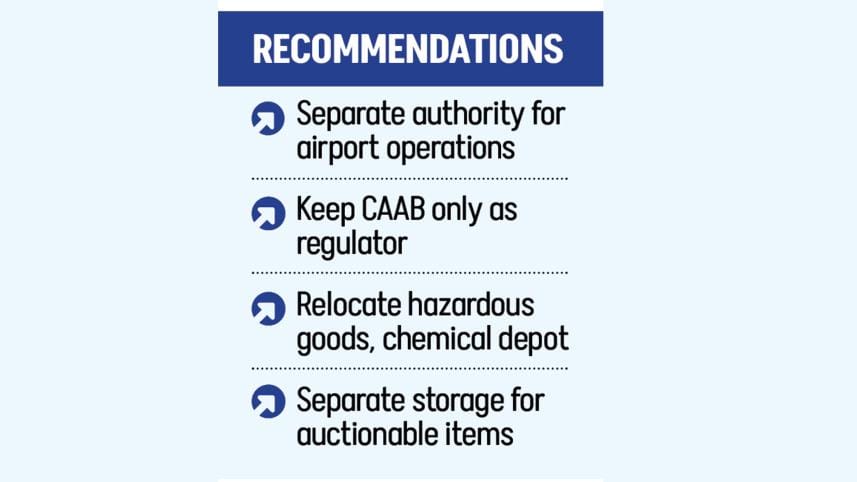
To prevent future catastrophes, the committee proposes creating a separate operator or authority to run and maintain airport operations, leaving CAAB to focus solely on regulation. It recommends limiting Biman's role to flight operations and assigning ground handling to a CAAB-appointed skilled operator.
Other measures include strict adherence to ICAO and BNBC standards, urgent approval of the fire safety plan, construction of a specialised fire station, relocation of dangerous goods warehouses, and separate storage for auctionable items. The committee also urges regular fire drills, a digital cargo inventory system, and firefighting, rescue, and first-aid training for at least 18 percent of staff in every airport department.
The report concludes that years of unmanaged operations, weak coordination, and persistent disregard for procedure have kept the airport exposed to grave fire risks, and will continue to do so unless the recommended reforms are carried out without delay.
Comments