


Nilkhet as Dhaka’s unofficial academic support system

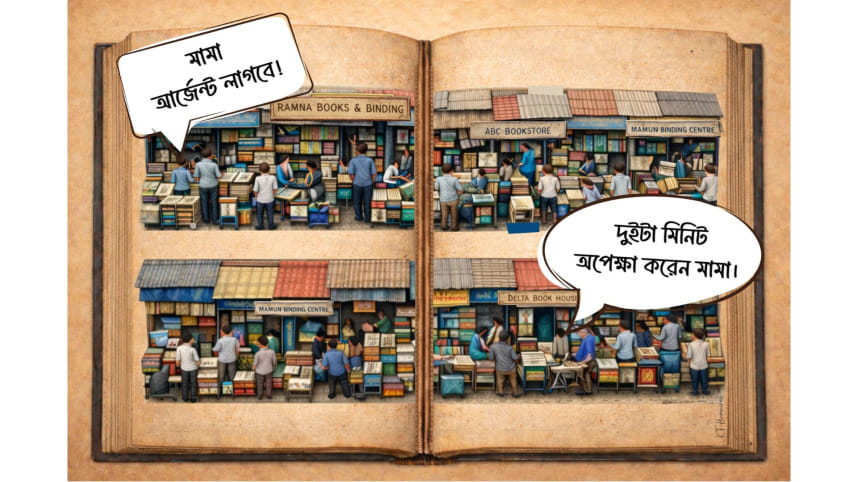
Dhaka has many places that promise knowledge. Nilkhet, of course, is not the tidiest of them, but it is certainly the truest.
Anything even remotely academic that a student needs to survive -- a semester, or sometimes an entire degree -- has a place there.
 For all latest news, follow The Daily Star's Google News channel.
 We are used to calling it a book hub, a photocopy capital, a student bazaar. Polite shorthand, really. The sharper truth is this: Nilkhet is where academic urgencies arrive at the last possible minute, relying on someone, somewhere, to fix them before the deadline catches up.
Its geography explains it all. University of Dhaka, Buet, Dhaka Medical College, Dhaka College -- some of the city’s most demanding institutions -- sit almost within walking distance from Nilkhet. So, their academic pressure spills naturally into Nilkhet’s narrow lanes. When lectures end, when department offices lock their doors, when deadlines refuse to budge, students drift in: pen drives in hand, loose pages tucked under arms, faces carrying the quiet panic of people running out of time.
And Nilkhet never disappoints. Even on Tuesdays, the only holiday this market gets, there is always one or two shops open for urgent support.
There are parts of Nilkhet that stop behaving like a book market and start behaving like an emergency ward, whether it is daylight or after dark -- especially during semester finals and submission season. Students are seen sitting outside binding shops in tight, anxious rows, clutching lab reports, and wearing the unmistakable expression of people who know the deadline is tomorrow but are still hoping time can be negotiated.
Rakibul Islam, now a student at the University of Kansas, still remembers his master’s thesis submission days at the University of Dhaka the way one remembers a near-death experience.
Six copies were required. Two had to be bound differently for external faculty. Rakibul arrived at Nilkhet around 7 pm. By 11 pm, all six copies were ready. But one instruction had been followed incorrectly. The hardcover needed changes. Some internal pages were wrongly glued. And worst of all, the thesis title had been mistyped on the cover. The “mama” had already gone home. Rakibul called. He begged. He may have cried. Academic panic does not respect dignity.
And against all logic, the mama returned. Pages were reprinted. Covers were remade. The entire binding was done again. At 2 am, while Dhaka slept, a "Nilkhet mama" quietly saved a thesis defence. This is the part of Nilkhet that rarely gets written about.
Every department, every faculty, every batch of students has their own mama or bhai here. This loyalty is irrational sometimes. For example, if Geography department trusts one mama, Geology trusts his rival. Economics students will not cross certain invisible lines even if it saves them Tk 2 per page.
Nobody remembers how these allegiances started. Seniors recommend them. Juniors inherit them. Trust is passed down like trauma? We don’t know.
During peak submission season, sometimes a single binding shop becomes an unofficial department extension. When an entire batch shows up with a deadline looming, the loyal mama does not pretend he can handle it alone. One printer, one assistant, and a hundred theses is more ambition than any mortal -- or mama -- can manage.
So work is distributed. Printing happens here. Binding happens there. Cutting happens somewhere else. Hardcovers is made somewhere. Everyone knows their role.
This efficiency is not accidental. Nilkhet is a dense, stubborn ecosystem of small enterprises that have learned to survive by cooperating.
Sure, universities award degrees. Convocation halls clap. Certificates are framed.
But this side of Nilkhet rarely earns a mention, even though countless academic lives in Dhaka have been quietly rescued here.
Comments