


Taking Bangladesh to Milan through jamdani and artistry
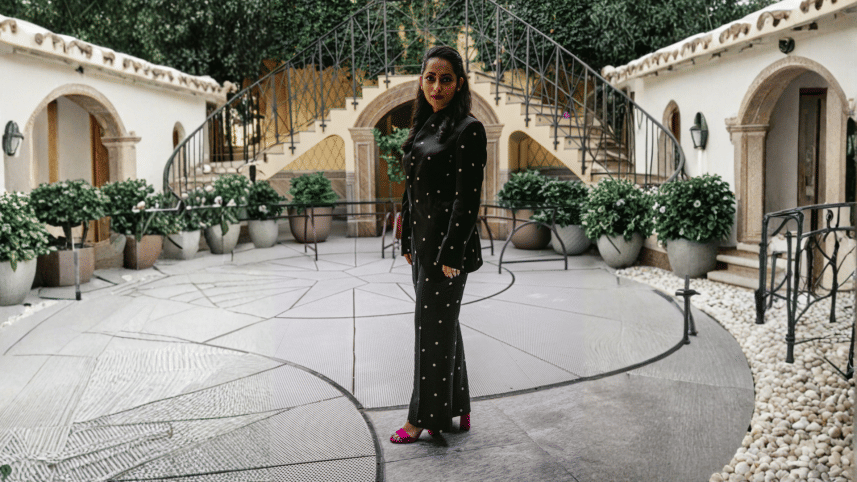
“I have been doing this for 15 years now, ever since 2011,” Tonmoyee Mokaddes Syeda begins. What started as a passion project, designing for friends and experimenting with fabric in a modest operation, soon became a practice that has taken Tonmoyee’s traditional artistic flair to contemporary New York and more recently, to the runways of Milan.

Small Steps
“When my sister moved back to Dhaka, she pushed me to pursue this professionally,” she recalls. Before fashion, Tonmoyee was an artist. “I had been an artist all my life, I loved working with paint.” However, her relationship with paint was short-lived, prompting her to redirect her creative energy. “My relationship with art could only continue through designing.” Who would have thought that what she had took to be a second-best alternative to paint would take her to the pinnacles of success?
 For all latest news, follow The Daily Star's Google News channel.
 In the early years of the brand, she was running a modest shop: “I had a storefront, a small space under my home, with 2 tailors, 4 karchupi craftsmen and 2 embroidery craftsmen.” Even after returning to Dhaka in 2018, she balanced design with family business responsibilities, not going all in.
In 2021 however, Tonmoyee’s father’s passing marked a turning point in her life. “Regardless of how busy my father was, he would always attend my art competitions; he always had time. After him, I felt that I had to restart my designing — it was my way of grieving and keeping him close.” That same year, she relaunched her brand on a larger scale and expanded her base, splitting time between New York and Dhaka.

New York’s Fashion Collective
Tonmoyee’s prefers her work to speak for itself. “I don’t publicise myself too much. I like to maintain a low profile here.” Still, she networked among like-minded designers in New York, which led to a membership in Flying Solo, a fashion collective with a storefront in SoHo.
Milan Fashion Week
Her Milan appearance was presented in association with Flying Solo. The moment carried an additional feather to her cap: “I also found out that I was the only Bangladeshi designer to ever have participated in Milan Fashion Week and it felt incredible.” But the run-up to the show was not without obstacles. “I had issues with visa as queues were very long at the Bangladesh Italian Embassy. They only let me know in early August and the show was in Sept. That was the only hiccup.”
Once in Milan, Tonmoyee was swept up in the energy of a global fashion capital. “It was amazing to be in Milan, the fashion capital of the world, with international designers, fashion models, and just the vibe of the entire city. It’s different from any other time you visit.” Rather than intimidation, she felt immersion: “Surprisingly, I was not nervous. I was taking everything in, I was learning, I never second-guessed, or compared myself to the other designers. From walking the runways as a designer to meeting buyers from around the world, I’m at a loss for words to explain how it was. Backstage chaos, fitting and rehearsal night, all left a lasting impression.”

“One takeaway from Milan to NY for me is that NY is dynamic, one of the biggest cities in the world, a melting pot of cultures, a city of immigrants. Milan on the other hand, or European fashion in general, while still changing, has managed to hold on to their roots and values. They are very traditional in many ways, but they still dictate fashion around the world.”
She uses that contrast to clarify her own intent: “I make it a point to stay true to everything Bangladesh, especially Dhaka, while incorporating fashion from all over the world.”
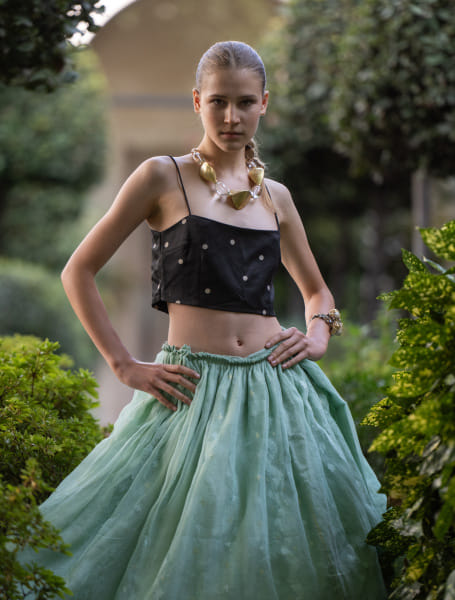
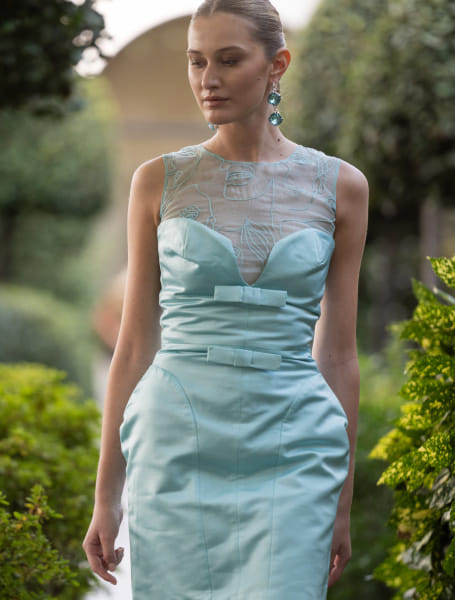
Her Milan collection explicitly showcased Bangladeshi materials and techniques. “I did dresses and bubble hemmed skirts, a gown, all with jamdani. I used Rajshahi silk for a peplum dress, and muslin skirts from Rajshahi. All the raw materials were sourced and made in Bangladesh.” Making and sourcing locally wasn’t merely a marketing choice but a statement of cultural stewardship: she kept craft, weavers and artisans at the heart of production.
The Non-Negotiables of Designing
Tonmoyee frames design as an extension of her artistry rather than the product of formal schooling: “I don’t have a training or formal education in designing. I’m an artist.” From that perspective, her core values are clear: authenticity, information, and sustainability.
She is critical of superficial sustainability gestures. A garment’s value, to her, lies in versatility and longevity. “A good piece of clothing should be something you can repeat often and be able to style in 6 different ways. “Even a pair of earrings!” Originality is non-negotiable for Tonmoyee. “Being inspired by someone is one thing, making a cheap copy of someone else’s work is unacceptable.”
The Evolution of Bangladeshi Fashion
When asked whether fashion has evolved in Bangladesh, Tonmoyee paints a dismal picture of snail-paced change mixed with deep structural problems. “It has evolved but very little. We don’t know how to use or value our own resources.”
Part of the problem, she says, is the marketplace and the perceptions of buyers. “The mindset has also changed for us — people buy so many clothes which are foreign and overpriced, but they don’t want to spend the same amount for locally produced clothes - in their minds, if it is locally produced, it should be cheaper.” That misconception undermines artisanal labour: “A karchupi craftsman or a jamdani weaver can only produce so much work in a set amount of time and that makes it expensive. Our buyers need to be better informed. I try to educate them as much as possible.”
Way Forward
As she continues to split her time between Dhaka and New York, Tonmoyee Mokaddes Syeda remains committed to a practice that is artistic, ethical, and rooted in place. “I make it a point to stay true to everything Bangladesh, especially Dhaka, while incorporating fashion from all over the world.” Her work — the garments, the artisans, and the stories woven into each piece — are, in her view, the true ambassadors. “I don’t want to be the face of the brand — I want my work to be the face of the brand.”
Photo: Courtesy
Comments